
Factory launches 2.0 software factories with model independence and continual learning
Factory 2.0 expands from coding agents to end-to-end software factories spanning tickets, code, tests, deployments, and incidents. The release makes feedback loops and model routing first-class parts of engineering automation.
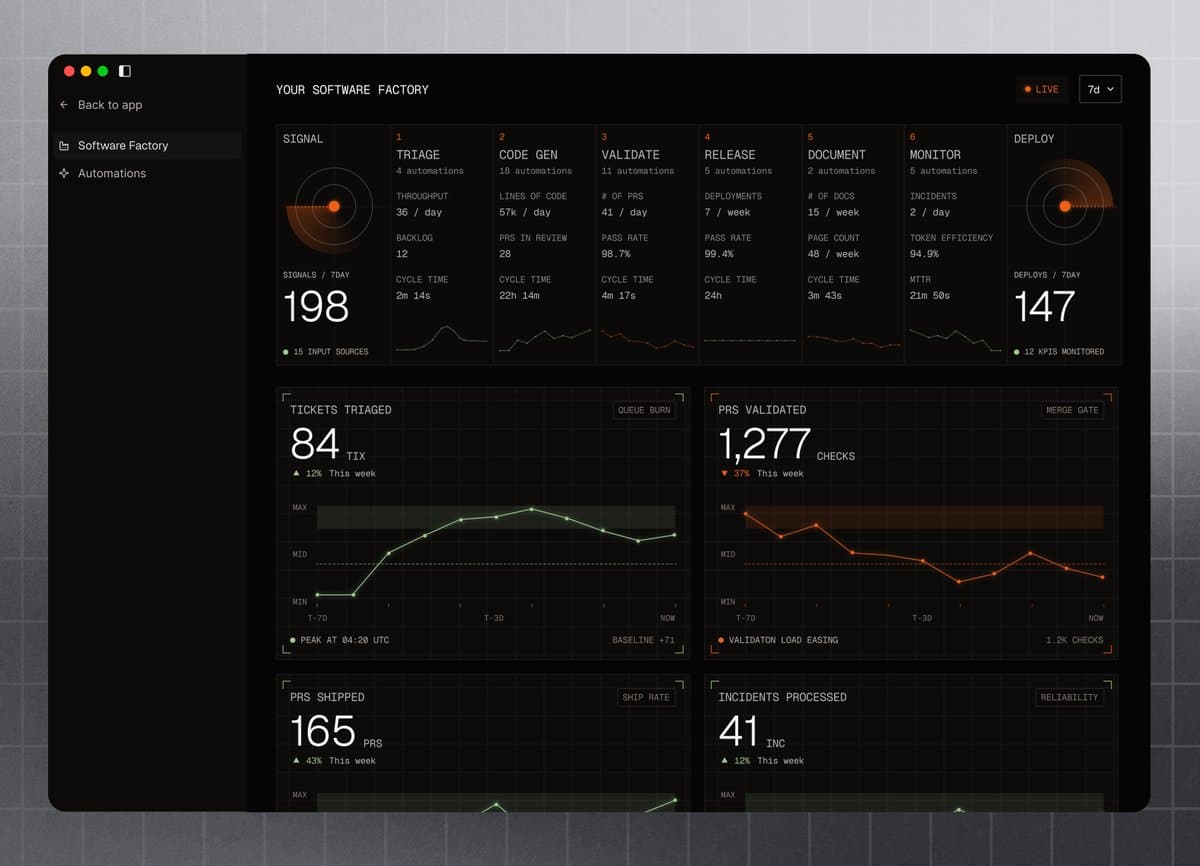
TL;DR
- In FactoryAI's launch post, Factory says version 2.0 expands its scope from coding agents to a "software factory" that starts from external signals and runs through the full software delivery loop.
- According to FactoryAI's architecture thread, the product is built around three bets: model independence, sovereign intelligence, and continual learning plus self-improvement.
- rohanpaul_ai's summary adds the operational detail missing from the teaser posts: Factory is wiring agents into tickets, requests, tests, security checks, reviews, deployments, docs, and production incidents.
- In FactoryAI's customer claim, the company says these software factories are already in production at organizations including EY, Wipro, Nvidia, Adobe, Blackstone, and Palo Alto Networks.
- FactoryAI's access post and FactoryAI's private-preview reply both frame the rollout as beta or private preview, with access gated through a form, direct outreach, or an account team.
You can read Factory's official announcement, skim the Factory 2.0 post on the company site, and the interesting bit is how much of the story lives outside code generation. FactoryAI's desktop-app post says the desktop app now exposes controls for managing the software factory directly, while FactoryAI's architecture thread makes model routing and organizational control first-class design goals instead of buried infrastructure choices.
End-to-end loop
Factory's pitch is that software automation should start earlier than code and end later than merge. The system ingests outside-world signals, triages work, writes code, runs tests, reviews changes, pushes deployments, watches incidents, and turns the result back into training signal, according to FactoryAI's architecture thread and rohanpaul_ai's summary.
That makes the product feel closer to an engineering control plane than a coding copilot. FactoryAI's product thesis explicitly contrasts the first wave of tools that made individuals faster with a second wave meant to raise output across the whole engineering organization.
Three design bets
Factory reduces the system design to three concrete requirements:
- Model independence. FactoryAI's architecture thread says the factory should pick the best trade-off of cost, performance, and speed, which implies per-task model choice or routing instead of a single-model stack.
- Sovereign intelligence. In FactoryAI's architecture thread, Factory says an organization should keep its context, learning, and agent capabilities under its own control.
- Continual learning and self-improvement. FactoryAI's architecture thread says every automation, integration, and customization should become shared intelligence for the whole system.
Those three choices line up with the broader argument around evals and harnesses in adjacent discussion. dbreunig's Satya thread argues that the durable enterprise asset is the eval loop, while omarsar0's orchestrator thread makes the case for owning the routing and orchestration layer so model swaps do not break the system.
Customer footprint and governance
Factory says the product is already live inside large enterprises, per FactoryAI's customer claim, which is a stronger claim than the usual waitlist-era launch language. The named list spans consulting, software, finance, and security, which suggests the company is selling the factory as an organizational layer rather than a developer-seat tool.
The governance story is tucked into the rollout language. In matanSF on high-agency engineers, Factory CEO matanSF says high-agency, high-ownership engineers become more important, a framing that fits the launch's shift from code generation to designing, supervising, and improving the system that generates software.
Desktop visibility
One concrete ship in this release is visibility inside the desktop app. FactoryAI's desktop-app post says users can now manage the software factory directly from the Factory desktop app, which turns the launch from pure positioning into an actual control surface.
The official Contact Factory flow shows how early the rollout still is. FactoryAI's access post, FactoryAI's beta-preview reply, and FactoryAI's private-preview reply all describe access as beta or private preview, with onboarding routed through a form, direct messages with a customer name or org ID, or an existing account team.