
OpenAI cuts GPT-5.6 Luna API prices by 80%
OpenAI said GPT-5.6 Luna is 80% cheaper and Terra is 20% cheaper, with lower usage burn in Codex and ChatGPT Work. Sol Fast adds up to 2.5x speed at 2x price, and gateways reflected the new pricing.
TL;DR
- GPT-5.6 Luna now costs $0.20 per 1M input tokens and $1.20 per 1M output tokens after an 80% cut, while Terra now costs $2 and $12 after a 20% cut, according to OpenAI's announcement and sama's price list.
- GPT-5.6 Sol got Fast mode in the API: up to 2.5x Standard speed at 2x Standard price, with priority-tagged requests still working, per OpenAIDevs' Fast mode note.
- Auto-review in the ChatGPT app and Codex CLI is moving from GPT-5.4 to GPT-5.6 Luna, making that workflow about 10x cheaper, according to OpenAIDevs' auto-review note.
- The cheap-token story has a cache caveat: teortaxesTex's pricing table shows Luna cache reads and long-context penalties can dominate long agentic sessions.
- Gateways reflected the cut immediately: OpenRouter's discount post adds a 50% promo on top, while vercel_dev's AI Gateway note says Vercel picked up the new Luna and Terra rates.
OpenAI's efficiency explainer credits Sol with rewriting production GPU kernels and improving its own speculator. The OpenAI pricing page now lists cache writes as a separate GPT-5.6 line item, and the prompt caching docs price those writes at 1.25x uncached input. Vercel's changelog says model IDs stay unchanged, while the HN thread went straight to agent orchestration: Luna for well-specified tool work, stronger models for architecture and judgment.
The new rate card
Christmas came early for coding-agent budget sheets.
The new short-context API prices are:
- GPT-5.6 Luna: $0.20 input, $0.02 cached input, $0.25 cache write, $1.20 output per 1M tokens, per the OpenAI pricing page.
- GPT-5.6 Terra: $2 input, $0.20 cached input, $2.50 cache write, $12 output per 1M tokens, per the same pricing page.
- GPT-5.6 Sol Standard: $5 input, $0.50 cached input, $6.25 cache write, $30 output per 1M tokens, per the same pricing page.
OpenAI framed the cut as a price-intelligence tradeoff across the lineup. Luna is now 25x cheaper than Sol on uncached input tokens, using sama's listed prices.
Sol Fast mode
Sol's update is speed, not a list-price cut. Fast mode gives API requests up to 2.5x Standard processing speed at 2x Standard price, with no stated intelligence change, according to OpenAIDevs.
Vercel added one buried delta: its AI Gateway changelog says Sol Fast is now 2.5x faster, up from 1.5x, and the openai/gpt-5.6-sol model ID is unchanged.
Codex and ChatGPT Work credits
The price cut also changes subscription accounting. OpenAI said Luna and Terra now burn less usage in Codex and ChatGPT Work, while WesRoth's follow-up noted that plan prices and quota budgets stay unchanged.
Auto-review gets the sharpest product-level delta:
- Old reviewer model: GPT-5.4, according to OpenAI's thread.
- New reviewer model: GPT-5.6 Luna, according to OpenAIDevs.
- Expected cost change: about 10x cheaper, according to OpenAIDevs.
The quota context was already messy. One day earlier, thsottiaux said Sol was using Codex limits faster than expected for some power users because it made longer runs, more tool calls, more web searches, and more code-mode responses per turn; OpenAI expected fixes to make typical Sol usage last around 18% longer.
Sol helped cut serving cost
The technical story is the self-optimization loop. OpenAI said GPT-5.6 Sol was applied after deployment to make the GPT-5.6 serving stack cheaper to run.
The reported mechanisms:
- Production GPU kernel improvements cut end-to-end serving costs by 20%, according to OpenAI.
- Speculative decoding improvements raised token-generation efficiency by more than 15%, according to OpenAI.
- Codex analyzed production traffic, improved load balancing, rewrote GPU kernels, and ran hundreds of speculative-decoding experiments, according to reach_vb's excerpt.
- Kernel work involved Triton and Gluon, with FpSan used to validate correctness, according to reach_vb's highlighted passage.
OpenAI's efficiency explainer puts the stack in three buckets: model improvements, inference systems, and the agentic harness that connects models to tools and context.
The price-performance charts
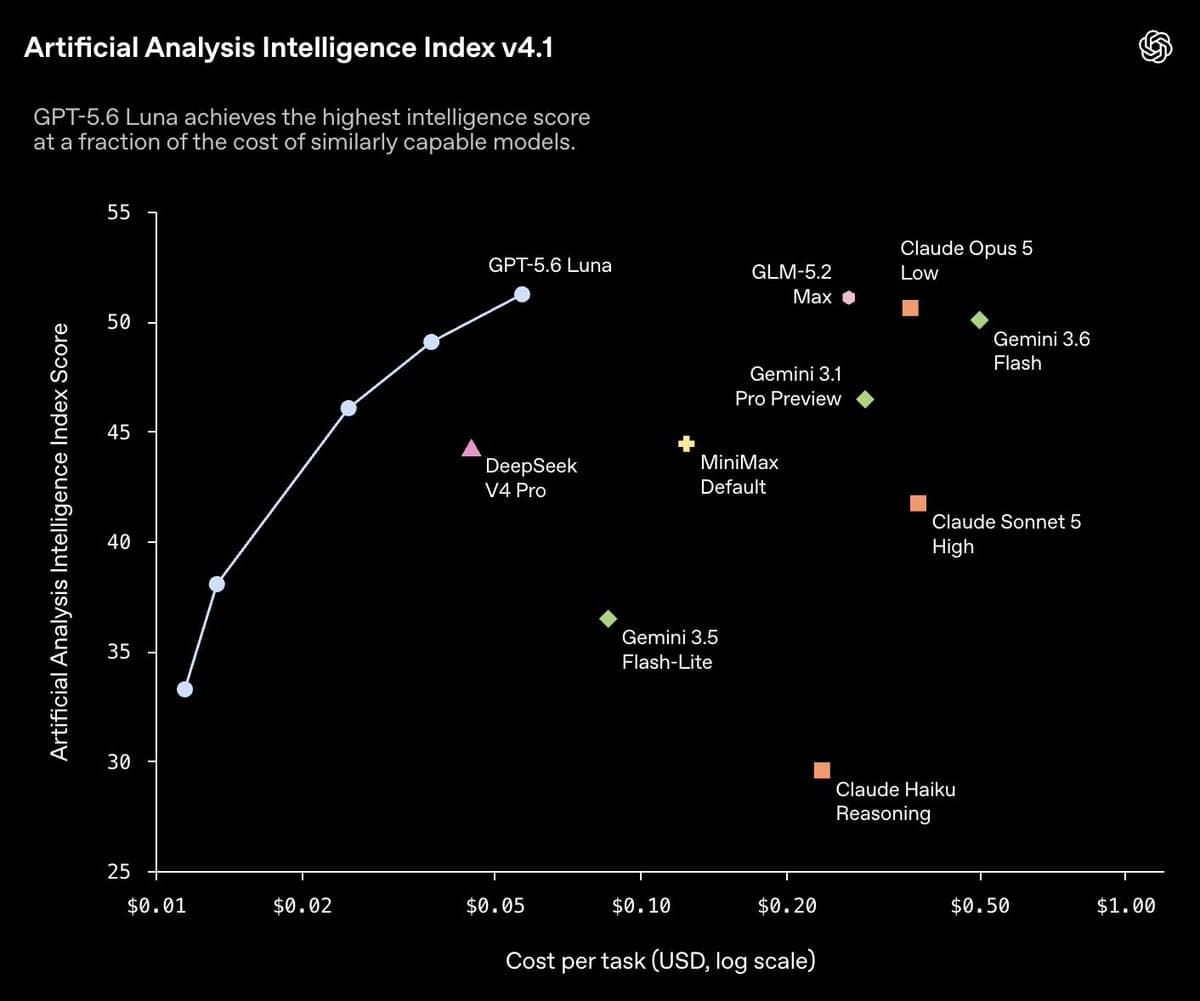
ArtificialAnlys said Luna's cost per task fell 80%, while Terra's fell 20%, but Terra still sat behind Luna and Sol on its Intelligence Index versus cost-per-task frontier.
The most aggressive Luna number in haider1's table is Luna Max at 51.2 Intelligence Index points for $0.053 per task. The same table lists GLM-5.2 Max at 51.1 for $0.237, Claude Opus 5 Low at 50.6 for $0.314, and Gemini 3.6 Flash at 50.0 for $0.430.
Cognition updated FrontierCode 1.1 after the discounts, and Cognition's leaderboard note said the GPT-5.6 series now sits on the price-performance Pareto curve for that coding benchmark.
OpenRouter, Vercel, and Nous
OpenRouter stacked its own 50% promotion on top of OpenAI's cut. OpenRouter lists Luna at $0.10 input and $0.60 output per 1M tokens, with Terra at $1 and $6.
Vercel's AI Gateway passed through the upstream rates with no markup, according to its changelog. vercel_dev announced the same 80% Luna and 20% Terra cuts for AI Gateway users.
Nous Portal also surfaced the OpenRouter discount. Teknium's pricing screenshot shows openai/gpt-5.6-terra and openai/gpt-5.6-luna highlighted at 50% off inside the model catalog.
Cache writes and 272K contexts
The list price is cleanest on short, uncached prompts. Long agentic sessions have different math.
OpenAI's pricing page prices GPT-5.6 Luna long-context input at $0.40 per 1M tokens, cached input at $0.04, cache writes at $0.50, and output at $1.80. The same page applies long-context pricing to prompts above 272K input tokens.
The prompt caching docs add the GPT-5.6-specific rule: cache writes cost 1.25x the uncached input token rate, while reads are reported as cached_tokens and writes as cache_write_tokens.
That is why teortaxesTex argued Luna can beat DeepSeek on capability while losing on token economics in some long agent sessions. His table puts Luna cache hits at $0.02 per 1M tokens versus $0.003625 for V4-Pro, and his 300-tool-call example turns repeated 120K-token contexts into the main bill.
Hands-on Luna reports
The first hands-on reports were mostly about whether Luna is good enough to become the cheap default.
- simonw switched a Datasette Agent instance from Gemini 3.1 Flash-Lite to Luna because Luna became cheaper, then reported fast SQL, HTML, and JavaScript generation.
- cto_junior found Luna at High+ effort strong for complex distributed-systems explainers, but said code generation often needed more than one attempt before compiling.
- kunchenguid said a full-stack app built with Luna had used 4% of a weekly quota before the cut, then extrapolated the new pricing to roughly 100 such apps per week.
- TheZachMueller said Luna had become the driver for 90% of his Codex work.
The multi-agent v2 gotcha
Luna has one Codex-specific limitation in the evidence pool: it is not multi-agents v2 compatible, according to pvncher. That means it cannot be used as a Codex subagent in that mode.