
Google ships Gemini Robotics 2 for whole-body robot control
Google released Gemini Robotics 2, ER 2, and On-Device 2 for humanoid control, embodied reasoning, and on-device adaptation. Demos showed sub-second streaming and multi-robot task handoffs.
TL;DR
- Google shipped a three-model robotics stack, with GoogleDeepMind's launch thread naming Robotics 2 for VLA control, ER 2 for embodied reasoning, and On-Device 2 for local adaptation.
- ER 2 is the public developer surface: _philschmid's quickstart post links the blog, Live API quickstart, and AI Studio, while the availability note says it is in the Gemini API and Google AI Studio.
- The demo leap is whole-body humanoid control plus fine manipulation, with GoogleDeepMind's garage demo showing Apollo and Duo handoffs and kimmonismus's caveat reporting uneven success rates across tasks.
- The developer hook is sub-second streaming orchestration, where _philschmid's ER 2 post cites 91.3% moment-finding accuracy, 57.4% five-stage progress tracking, and multi-robot handoffs.
- On-device is still gated: WesRoth's summary says local adaptation can use fewer than 200 examples, while Google's On-Device 2 model card limits access to trusted testers.
The Google DeepMind launch post says the same checkpoint controlled Apollo 2 with SharpaWave hands, Apollo 2 with Inspire hands, and Franka Duo with a Robotiq gripper. The Live API docs expose gemini-robotics-er-2-streaming-preview, raw 16-bit PCM audio, JPEG images at up to 1 FPS, text input, text output, and stateful WSS. The ER 2 model card says ER 2 is based on Gemini 3.5 Flash with 128k context and 64k output, while the On-Device 2 model card warns that out-of-distribution tasks and high-degree-of-freedom control remain limitations.
Three-model stack
Google framed Gemini Robotics 2 as a suite of three models. In the Google DeepMind launch post, the split is:
Gemini Robotics 2: a vision-language-action model that turns vision and language into motor control for humanoids, bi-arm robots, hands, and grippers.Gemini Robotics ER 2: a vision-language embodied reasoning model for human communication, physical-world understanding, multi-minute task planning, and multi-robot work.Gemini Robotics On-Device 2: a local VLA model optimized for robot hardware and few-hour adaptation to new embodiments.
ER 2 gets the public launch path. The same access story appears in osanseviero's overview and the developer-blog pointer: Gemini API and Google AI Studio for developers.
The VLA and On-Device models are early-access only, according to Google's launch post. The product boundary stays inside robotics; one reply answered a confused reader with the blunt version: "It is for robotics."
Whole-body control
The main hardware jump is from upper-body tabletop manipulation to full humanoid motion. Google's launch post says Apollo 2 can process a natural-language prompt, walk, bend, pick up a watering can, and place it into a shelf bin.
GoogleDeepMind's demo thread shows the same Apollo 2 reach-and-grasp sequence, while demishassabis's milestone note calls out knot tying and multi-robot teaming as examples of tasks that previously sat outside the system.
The caveat is in the task spread. kimmonismus's caveat reported whole-body success rates from 45.7% to 76.3%, plus five-finger manipulation ranging from 32% for dustpan use to 92% for unscrewing a bulb.
ER 2 streaming loop
The boring WebSocket loop is the shippable part of the launch. In the Live API docs, a robotics agent follows this pattern:
- Endpoint:
gemini-robotics-er-2-streaming-preview. - Inputs: raw 16-bit PCM audio at 16 kHz, JPEG images at up to 1 FPS, and text.
- Output: text.
- Protocol: stateful WebSocket connection.
- Setup: declare robot capabilities such as
navigate,grasp, andspeakas function tools. - Session: keep a
live.connectsession open for the task. - Loop: execute
tool_callmessages against the robot SDK, then sendtool_responseresults back to the model. - Physical-action behavior: use
"behavior": "BLOCKING"so the model waits for the robot to finish before choosing the next tool.
The GitHub live-api examples include an agent server, a Boston Dynamics Spot integration, and Tinybot hardware controller. The Spot package exposes navigation, manipulation, REST APIs, and a hydration delivery app.
Progress tracking
ER 2's robotics-specific evals focus on task state, not just scene labels. Google's developer post defines two core temporal tasks:
- Progress classification: each video frame is assigned to one of five completion bands, 0 to 20%, 20 to 40%, 40 to 60%, 60 to 80%, or 80 to 100%; ER 2 scores 57.4%.
- Moment finding: the model identifies the exact frame where a critical event occurs; ER 2 scores 91.3% accuracy with 0.96s mean absolute distance and 4x execution speed versus larger model categories.
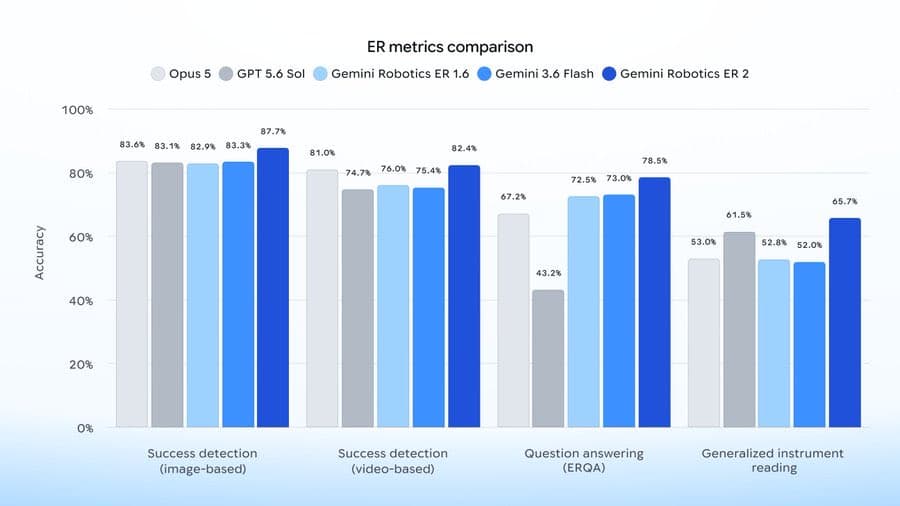
In testingcatalog's benchmark chart, ER 2 leads the shown set on image-based success detection, video-based success detection, ERQA, and generalized instrument reading. DynamicWebPaige's AI Studio screenshot shows the more visceral version: a construction video segmented into 32 pick-and-dump actions with timestamps and durations.
Multi-robot handoffs
Multi-robot collaboration was the demo the ER 2 availability note told readers to pay attention to. The garage task pairs Apollo and Duo, with ER 2 breaking down what to do, where to go, and when to hand control to another robot.
Google's developer post describes the mechanism as shared semantic understanding across diverse machines. The Live API docs expose the same idea as a tool pattern: a send_message function can target user or a peer agent name such as duo.
On-device adaptation
On-Device 2 handles the latency and offline side of the stack. The launch post says it can adapt to new bi-arm robot embodiments with a few hours of data, typically fewer than 200 examples, including platforms with different shapes, sensors, and degrees of freedom.
The model interface is lower-level than ER 2. Google's On-Device 2 model card lists text, images, and robot proprioception as inputs, with numerical robot actions as outputs.
The same split appears in fofrAI's three-model summary: Robotics 2 is the VLA for action, ER 2 is the embodied reasoner, and On-Device 2 is the local adaptation model.
Safety and access limits
The launch hit the top of Hacker News, and the Hacker News thread quickly moved from demo enthusiasm to tactile data limits, cloud dependence, benchmark credibility, and weaponization concerns. That debate matches Google's conservative access posture.
The ER 2 model card says API users need no required hardware or software, but tells users not to use Robotics Models for safety-critical work such as healthcare, transportation, or other settings where malfunction could reasonably cause death, injury, or property damage.
The On-Device 2 model card confines distribution to trusted testers and says its safety evaluations primarily covered standing bi-arm manipulation tasks. Risks from mobile platforms or whole-body control are outside its current scope.
Google's launch post adds ASIMOV-Agentic, a benchmark for unsafe VLA tool-call refusal, physical-feasibility prediction, and human-intervention requests. The same post says ER 2 can detect nearby humans, trigger safety tool calls, and bring a robot to a safe stop.