
Z.ai releases GLM-5.3-Flash, identifies it as Ox Alpha
Z.ai identified the formerly anonymous Ox Alpha as GLM-5.3-Flash and released it under an MIT license. The native multimodal model has 320B total parameters, 18B active parameters, and a 1M-token context window.
TL;DR
- Ox Alpha is GLM-5.3-Flash, an MIT-licensed open-weight model with 320B total parameters and 18B active per token, according to Z.ai's launch.
- The release combines native multimodal input with a 1M-token context window, low/high/max reasoning controls, and a 131K-token output ceiling, per OpenRouter's pricing post.
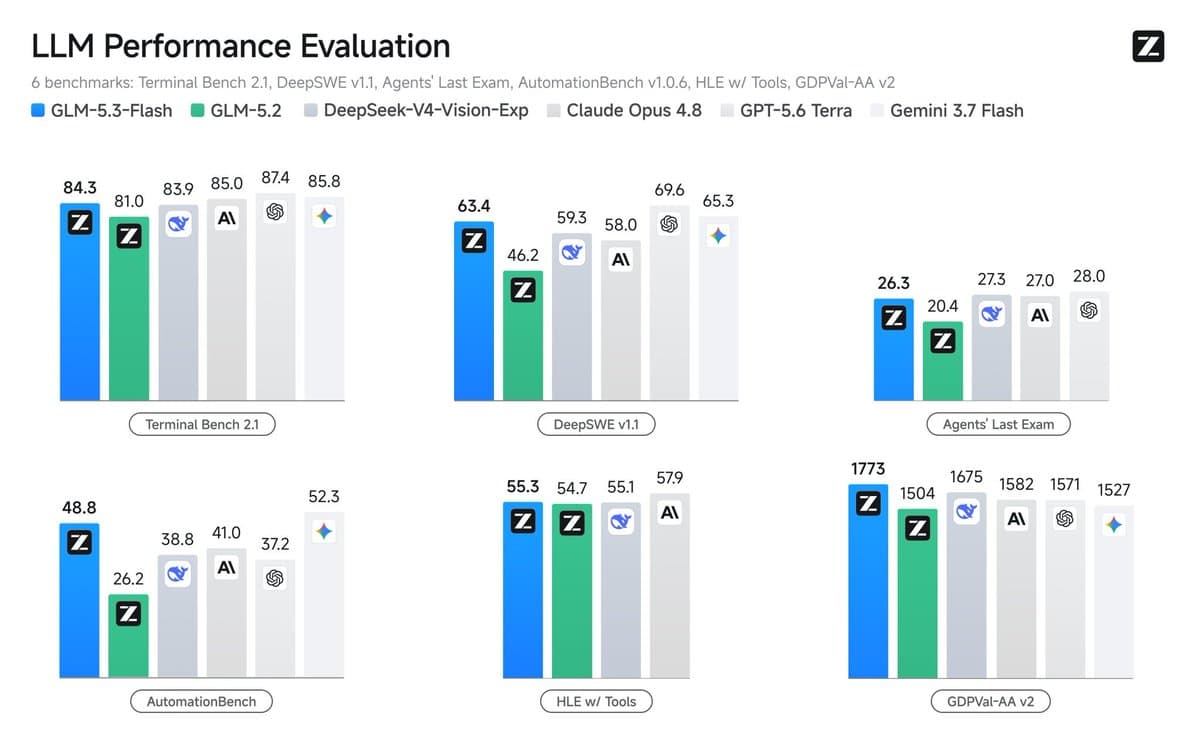
- Z.ai reports a large agentic-coding jump over GLM-5.2: DeepSWE rose from 46.2% to 63.4%, according to Z.ai's benchmark chart.
- Independent testing puts the model at 57 on the Artificial Analysis Intelligence Index, three points behind GLM-5.3 at max reasoning, in Artificial Analysis' evaluation.
- Native vision has a sharp caveat: one community Roboflow comparison put GLM-5.3-Flash at 1.5% mAP@50 on banana-tree detection, versus 99.9% for Gemini 3.7 Flash, in skalskip92's test.
Z.ai's release post pairs the Ox Alpha reveal with a 3.01× attention-compute reduction and a 4.44× KV-cache reduction against GLM-5.3. Its developer guide lists SGLang and vLLM deployment paths. Artificial Analysis found a 57 score at $0.09 per task, but also unusually high output volume.
What shipped
- GLM-5.3-Flash, formerly the anonymous Ox Alpha preview, ships as MIT-licensed weights with 320B total parameters and 18B activated per token, according to Z.ai's launch.
- The model accepts text and images, has a 1M-token context window, exposes low/high/max reasoning modes, and defaults to max, per OpenRouter's model post.
- Standard API pricing is $0.15 per million input tokens, $0.50 output, and $0.03 cached input; launch pricing halves those rates through September 9 at 16:00 UTC, per OpenRouter's pricing post.
- Z.ai made the model available through its weights, API, Coding Plan, ZCode, Chat, and AutoClaw surfaces in its release post.
Benchmarks that moved
First-party
- DeepSWE v1.1: GLM-5.2 46.2% → Flash 63.4%, +17.2 points, according to Z.ai's chart.
- AutomationBench v1.0.6: GLM-5.2 26.2% → Flash 48.8%, +22.6 points, according to Z.ai's chart.
- Terminal-Bench 2.1: GLM-5.2 81.0% → Flash 84.3%, +3.3 points, according to Z.ai's chart.
- GDPval-AA v2: GLM-5.2 1504 → Flash 1773, +269 Elo, according to Z.ai's chart.
Third-party evaluators
- GDPval-AA v2: GLM-5.3 (max) 1766 → Flash 1770, +4 Elo, per Artificial Analysis' evaluation.
- Terminal-Bench v2.1: GLM-5.3 83.9% → Flash 84.3%, +0.4 points, per Artificial Analysis' evaluation.
- Code Arena WebDev, early AutoEval: GLM-5.3 Max 1599 → Flash 1634, +35 points, in Code Arena's early result.
Customer-reported
- DeepSearchQA, GPT-5.6 Luna with native web search 65% → GLM-5.3-Flash with Parallel Fast 76%, +11 points, in p0's comparison.
- Cline's real-bug run, Fable 5 root-cause declarations 7 → Flash 1, -6 repetitions, according to Cline's test.
Where it regressed
Artificial Analysis scored Flash at 57 against 60 for GLM-5.3 at max reasoning. It also measured 50.2 output tokens per second against a 67-token-per-second median, and 150M output tokens for the index against a 100M median.
Its AA-Omniscience result shows 28% accuracy versus 34% for GLM-5.3, a six-point decline, although Flash's 28% hallucination rate improved on the parent model's 30%.
At 128K context, DillonUzar's needle test measured 75.3% AUC for high reasoning and 71.6% for max reasoning. The same test found max used roughly 34% more tokens at 64K while scoring 70.1% versus high's 75.8%.
A community comparison in skalskip92's Roboflow test reported 1.5% mAP@50 for GLM-5.3-Flash and 99.9% for Gemini 3.7 Flash on one banana-tree detection task.
Vibe Check
Cline gave Ox Alpha and Fable 5 the same bug. Both fixed it, but Cline reported that Ox stated its root cause once before editing while Fable did so seven times.
Using Ox Alpha on structured Beads projects, doodlestein called it surprisingly good but said they would not use it for planning. omarsar0 found it useful for visual explainers through an /eli5 workflow.
A frontend tester said in bridgemindai's early report that Ox Alpha was strong at frontend design but too slow before the formal release.
Where it shows up
- Vercel AI Gateway added
zai/glm-5.3-flashwith vision support, as Vercel's announcement states. - Cline made the model free across its CLI, VS Code, and JetBrains clients; it said Flash reached more than 11% of Cline traffic in under a week in Cline's post.
- Baseten made the model available through its Model APIs on day zero, according to Baseten's launch post.
- Modal added GLM-5.3-Flash to Auto Endpoints in Modal's announcement.
- vLLM added day-zero support for the combined attention design and verified it on NVIDIA and AMD GPUs, per vLLM's support note.
- OpenCode Go added the model with double usage for a limited period in OpenCode's post.
Under the hood
Z.ai's long-context design couples linear attention, which tracks local dependencies as state, with sparse attention that retrieves selected global context through an indexer. IndexPool then pools four indexer key vectors into one. The company reports 3.01× lower per-layer attention compute and 4.44× less per-layer KV cache than GLM-5.3, while noting its KV cache remains larger than Kimi K3's and DeepSeek-V4-Flash's.
The released design uses 45 layers, down from 92 in GLM-4.5, and mHC residual connections. The 18B figure describes activated parameters per token; local inference still stores all 320B weights, as kimmonismus noted.
Z.ai says the Ox Alpha preview ran entirely on Chinese AI chips. Its serving stack used a custom SGLang inference engine, intra-node tensor parallelism for linear attention and the LM head, ReplaySSM, W8A8 quantization, hybrid INT8/FP8/BF16 cache quantization, and Layer Split.
For cluster operation, Z.ai separated multimodal encoding, prompt prefill, and decoding into independently scheduled Encode-Prefill-Decode worker pools. It reports a 3× end-to-end serving-performance improvement over its initial baseline on the same hardware, with per-token cost comparable to mainstream NVIDIA GPU systems.