
Artificial Analysis puts GPT Image 2.5 at the top of its image arena
Artificial Analysis says GPT Image 2.5 Flare and Sunburst now hold the top two spots in its image arena. Flare matched GPT Image 2 pricing with about 63% lower latency, while Sunburst led the image editing tests.
TL;DR
- OpenAI split GPT Image 2.5 into Flare, its lower-latency variant, and Sunburst, its higher-control variant, as Artificial Analysis's arena report describes.
- Flare took the Text to Image lead and Sunburst took the Image Editing lead in Artificial Analysis's evaluation at
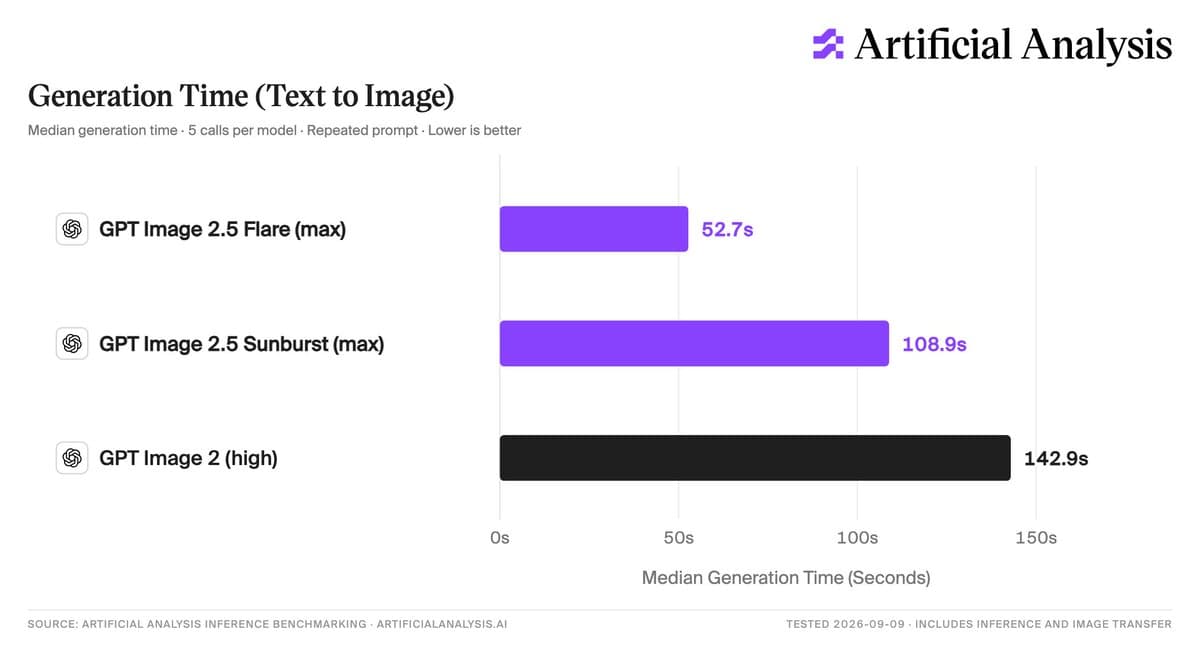
maxquality Artificial Analysis's arena report. - Flare cut median 1024px generation time from 142.9 seconds to 52.7 seconds, roughly 63% lower, in Artificial Analysis's latency test.
- API output pricing stayed at GPT Image 2's $30 per million image-output tokens, according to Artificial Analysis's pricing comparison.
Both models handle generation, editing, and transparent backgrounds, per OpenAI's image prompting guide. OpenAI says ChatGPT Images and the GPT-Image API models now produce more than 3 billion images a week in its launch post.
Arena split
Artificial Analysis evaluated both variants at max quality and put Flare first for text-to-image, Sunburst first for image editing.
Flare leads five of the site's nine text-to-image capability dimensions, and Artificial Analysis's capability breakdown names its largest margins as:
- Knowledge: landmarks, species, scientific facts, and common-sense details.
- Material: surface properties, transparency, subsurface scattering, and texture realism.
- Physics: gravity, support, collision, and changes of state.
Flare latency
OpenAI's API guide calls Flare the smaller, speed-optimized model. Artificial Analysis measured median end-to-end time, including inference and image transfer, across several 1024 × 1024 PNG runs.
The 90.2-second reduction is the sharpest measurable separation between the two variants. In the same test, Sunburst reached 108.9 seconds, a 24% reduction from GPT Image 2.
Sunburst editing
Sunburst led six of seven editing actions and eight of 10 editing use cases in Artificial Analysis's test. Enhancement and restoration was the sole action still led by Microsoft's MAI-Image-2.5-Pro.
Its largest reported margins were in:
- Composition and framing: camera changes, zoom-outs, and layout changes while preserving the scene.
- Object-level edits: adding, removing, replacing, or changing a single object.
- Text or symbol edits: changing words, numbers, logos, and symbols in an existing image.
Human anatomy and spatial constraints
Contra Labs put Flare second overall in its Human Creativity Benchmark, close to Muse Image and ahead of ChatGPT Images 2.0 and Nano Banana Pro, across ideation, mockup, and refinement phases Contra Labs's benchmark post.
Its testing separated a clear strength profile from a failure profile:
- Stronger: material and lighting effects, plus isolated product scenes.
- Weaker: humans, wearables, unusual camera perspectives, and prompts carrying many spatial constraints.
Sketch and API controls
ChatGPT Images 2.5 is rolling out across ChatGPT, ChatGPT Work, and Codex on desktop, mobile, and web, while Flare and Sunburst are the API model choices. The consumer product also adds Sketch, image templates, in-image comments, and prompt sharing, according to OpenAI's launch post.
OpenAI says it continues to attach C2PA metadata and invisible watermarking to identify images made with its tools.