
Hermes Agent reports 10,000 GitHub stars with memory and delegation tools
Nous Research said Hermes Agent crossed 10,000 stars, while users reported easy migrations from OpenClaw and stable long-running use. If you test it, focus on persistent memory, MCP browser control, and delegation behavior under real workloads.
TL;DR
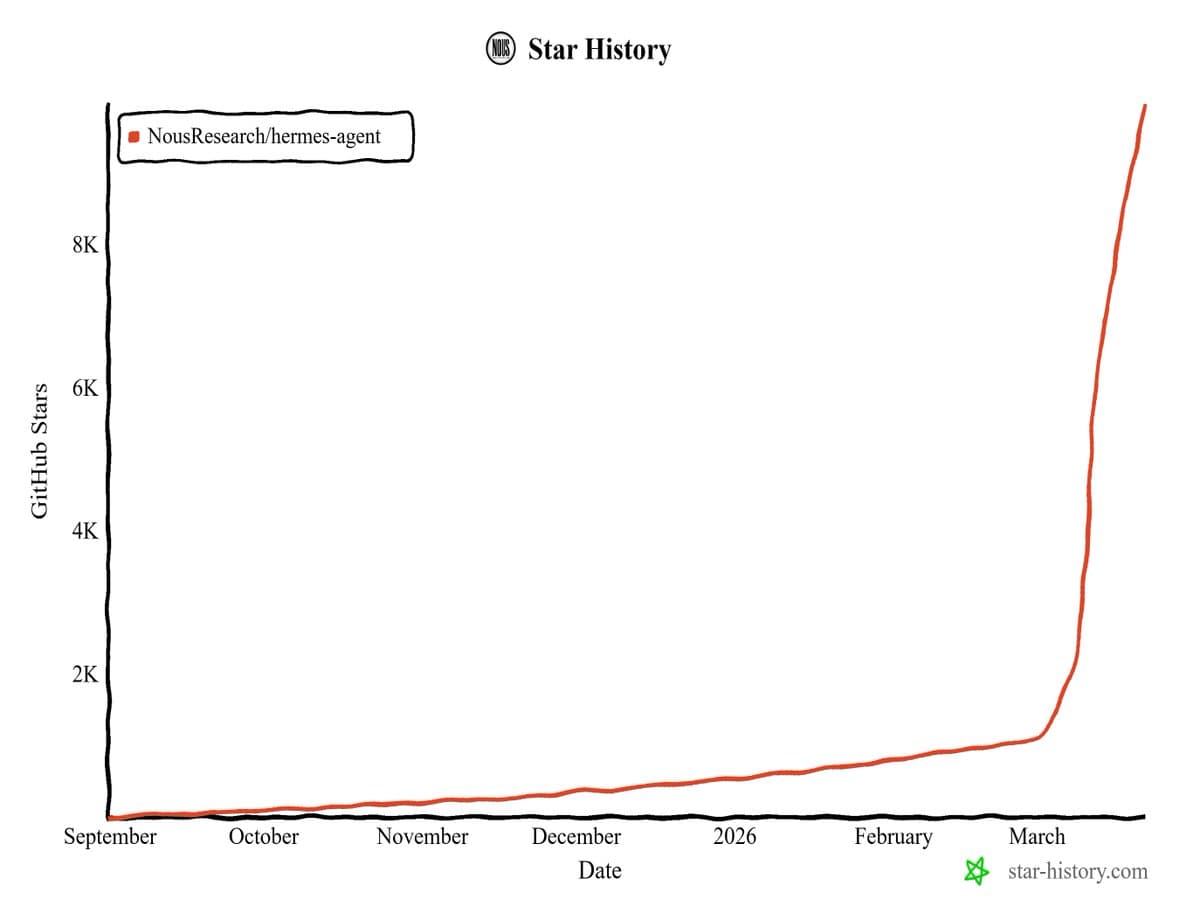
- Nous Research says Hermes Agent has now crossed 10,000 GitHub stars, calling it its “most adopted open source project yet,” with the repo growth chart in the milestone post showing a sharp acceleration late in the cycle.
- The technical pitch behind that adoption is persistent, self-improving memory: Teknium pointed engineers to an explainer video that describes “experiential knowledge,” memory compression, and recursive skill discovery rather than a stateless chat loop.
- Early practitioner reports center on operational behavior, not just demos: users quoted in one migration post and one uptime report said Hermes was easy to move over to and ran for days without a restart.
- The agent surface is broader than a single chat shell. A capability screenshot in the v0.4.0 terminal view lists browser, code execution, cron, file, delegation, and Home Assistant tools, while one user report says they connected it to a Chromium browser through built-in MCP.
What actually shipped into the 10,000-star moment
Nous framed the news as an adoption milestone, with the announcement saying Hermes Agent is now its biggest open-source project and linking to the GitHub repo. The repo summary attached to that post describes an agent designed for VPS, GPU clusters, and serverless deployment, with support for multiple providers and interfaces including CLI, Telegram, Discord, Slack, WhatsApp, and Signal.
That same repo description says Hermes includes a “built-in learning loop,” knowledge persistence, parallel subagent spawning, and autonomous scheduling via cron-like automation repo summary. That matters more than the star count itself: the project is being presented as a long-running agent framework with state, tooling, and orchestration primitives, not just another prompt wrapper.
How Hermes handles memory, skills, and tool use
The clearest architectural detail comes from the explainer video, which breaks Hermes into an entry point, the main agent, and state-management systems. Teknium’s summary points to “continual learning capabilities through experiential knowledge,” while the linked video summary describes memory nudging, flushing, and compression, plus recursive skill discovery and guarded system-prompt construction.
A separate screenshot of Hermes Agent v0.4.0 makes that abstraction concrete. The visible toolsets include browser control, code execution, cron jobs, delegation, file operations, Home Assistant integrations, and Honcho functions, while the skills list references items such as “claude-code,” “codex,” “hermes-agent-spawning,” and “jupyter-live-kernel.” Another user report says Hermes was connected to a native Chromium browser “via built in MCP” MCP browser post, which suggests the project is already being used as an MCP-capable operator rather than only a CLI agent.
What early users are saying about migration and reliability
Most of the practitioner feedback in this evidence set is anecdotal, but it is unusually specific. One user said they had “set up Hermes Agent to replace my OpenClaw” and found it “very reliable” and “very easy to migrate and set up” migration report. Another said they “depend on Hermes more than openclaw” because it was “more consistent in my experience” consistency report.
The strongest operational claim is uptime: one user said they had been “running hermes agent for eight days” without needing “to restart it a single time” uptime report. There is also ecosystem evidence beyond direct usage; the Paperclip adapter repo points to a TypeScript adapter for running Hermes as a managed employee inside Paperclip, exposing its persistent memory, multi-provider model support, delegation, and session continuity through another automation stack.