
Hermes Agent ecosystem adds `/xurl`, `/baoyu-infographic`, and Desktop v0.5.0
Hermes Agent added a native Mac desktop app, new `/xurl` and `/baoyu-infographic` skills, AgentMail onboarding, and a Kimi-backed creative hackathon. The release expands the project into a broader skill and integration platform for agent workflows.
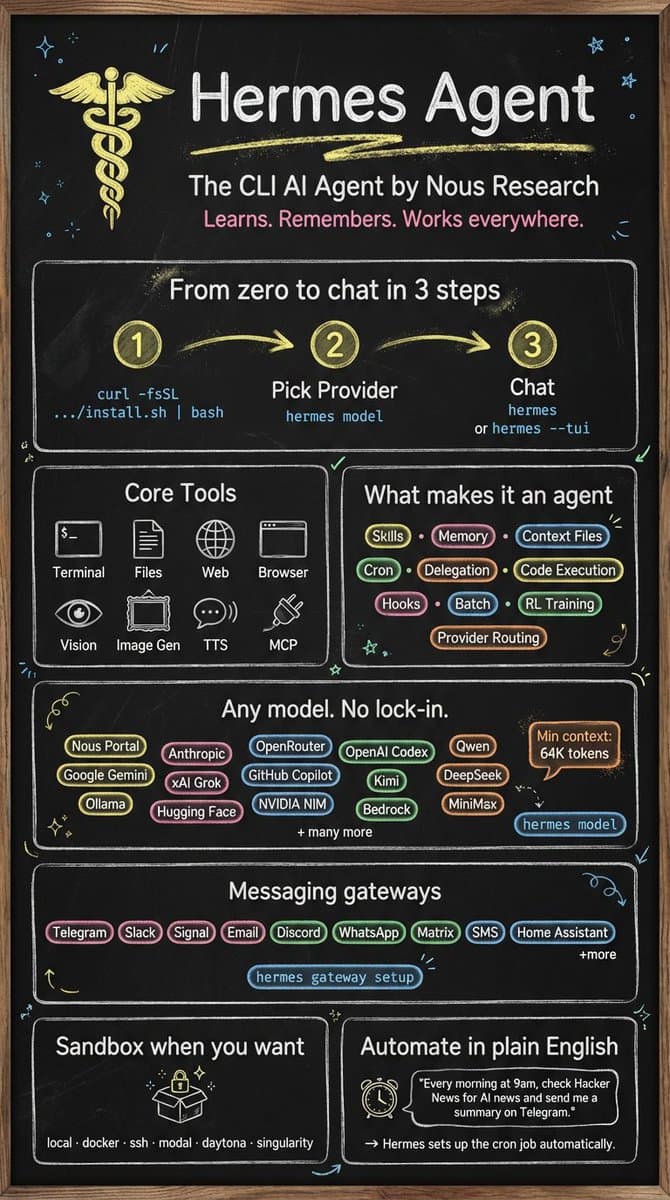
TL;DR
- Hermes Agent's week of add-ons looked less like a point release and more like a platform push: Teknium's Hermes Desktop repost surfaced a native Mac companion, while Teknium's xurl announcement and NousResearch's infographic-skill post shipped new first-party skills.
- According to Quickstart, Hermes still starts from the same one-line installer and provider picker, but the chalkboard feature map now pitches a much fatter stack, including cron, delegation, provider routing, messaging gateways, browser tools, and image generation.
- The xurl rollout replaced the older xitter integration with X's own CLI, and the baoyu-infographic PR link brought in a large design skill port with 21 layouts and 21 styles.
- The surrounding ecosystem is moving fast too: adisingh's AgentMail demo showed one-prompt inbox signup, NousResearch's image-model table expanded image generation choices inside Hermes and the Tool Gateway, and Ollama's Hermes integration page now documents
ollama launch hermesfor local or gateway-backed runs. - NousResearch's hackathon announcement and the submission-rules post turned all of that into a public brief, with $25,000 in prizes, a separate Kimi track, and demos due May 3.
You can browse the Hermes Desktop repo, skim the Quickstart, and read the two key PRs for xurl and baoyu-infographic. There is also an Ollama integration page for local setups, a Jim Liu skills repo behind the new design port, and even a same-day signal from NousResearch's discount-code update that the hackathon promo burned through its first 250 redemptions almost immediately.
Hermes Desktop v0.5.0
Hermes Desktop is a separate native macOS companion, not a new mode inside the main CLI. The GitHub repo describes it as a focused SSH-based workspace for Hermes sessions on Mac, and the v0.5.0 release highlighted multi-profile support plus a full cron manager.
That lines up neatly with the main product pitch in NousResearch's feature map, which puts cron, memory, delegation, and messaging gateways at the center of Hermes rather than treating them as side features. A desktop shell around those long-running workflows makes sense when the agent is meant to live on remote machines, not just in one terminal tab.
The official Quickstart still keeps onboarding simple: run the install script, reload your shell, then use hermes model, hermes tools, or hermes setup. The interesting shift is what that setup now unlocks, because the product surface around the installer is getting much broader.
xurl and baoyu-infographic
The new /xurl skill is a meaningful plumbing upgrade. According to the linked xurl PR, Hermes replaced the older xitter skill with X's official xurl CLI, which brings OAuth 2.0 PKCE, multi-app and multi-user auth, and wider endpoint coverage, including DMs, media upload, streaming, and raw v2 access.
The practical change is that Hermes now leans on a maintained upstream CLI instead of a community wrapper. Teknium's follow-up post suggested the integration was already seeing real use a few hours later.
The /baoyu-infographic addition pushes in the opposite direction, away from infrastructure and toward creator tooling. Teknium's PR link points to a large port of Jim Liu's design skill into Hermes, and the PR says the built-in version ships with 21 layouts and 21 styles while adapting the original workflow to Hermes conventions.
The source material is public in Jim Liu's baoyu-skills repo, which helps explain why this matters: Hermes is no longer just accumulating tools, it is becoming a host for portable skills ecosystems that started elsewhere. Teknium's repost of a first user test showed someone already feeding an article URL into the new skill and getting shareable output back.
Tool Gateway, onboarding, and local surfaces
The most revealing ecosystem demos were about reducing setup friction. In adisingh's AgentMail demo, Hermes signs up for an inbox from a plain-language prompt, while the confirmation email screenshot shows the service explicitly framing that inbox as infrastructure for AI agents.
That sits alongside a broader Tool Gateway story. NousResearch's image-model announcement expanded built-in image generation choices to ChatGPT Image, Nano Banana, z-Image, FLUX, Ideogram, Recraft, and Qwen Image, with a model table covering speed, strengths, and pricing. A day earlier, Wes Roth's Tool Gateway clip described the Portal subscription as bundling model access with web scraping, browser automation, image generation, text-to-speech, and a cloud terminal backend.
There is also a local-first angle under the ecosystem sprawl. The Ollama integration page documents ollama launch hermes, model autodetection, and a setup path that can point Hermes at a local Ollama endpoint with no API key. Teknium's repost about Ollama support amplified that one-line launch as native support rather than a community workaround.
Creative hackathon rules
Nous and Kimi wrapped the whole week's shipping energy into a 16-day creative hackathon. According to the main announcement and the prize breakdown post, the structure is:
- Main track: $15,000 total, with $10,000 for first place
- Kimi track: $5,000 total, with $3,500 for first place
- Additional credits: $5,000 in Kimi credits across winners
- Eligible domains: video, image, audio, 3D, long-form writing, creative software, and interactive media
The submission mechanics are unusually public. the rules post says entrants need to tweet a demo video tagging @NousResearch, add a short writeup, then drop that post into the creative-hackathon-submissions Discord channel by end of day on May 3. To qualify for the Kimi track, the demo has to prove Kimi model usage.
One small but telling detail came a few hours later: NousResearch's discount-code update said the HERMESAGENT0010 promo for Nous Portal subscriptions was already exhausted. For an agent project still shipping core surfaces in public, that is a pretty direct read on how much attention the ecosystem is pulling right now.