
Hermes Agent ranks #1 on OpenRouter for coding apps
Nous said Hermes became the top coding app on OpenRouter while shipping an OpenClaw migration patch, Telegram agent-to-agent messaging, and new memory controls. If you run long-lived agents, watch the migration path and memory settings before moving chats or skills hubs.
TL;DR
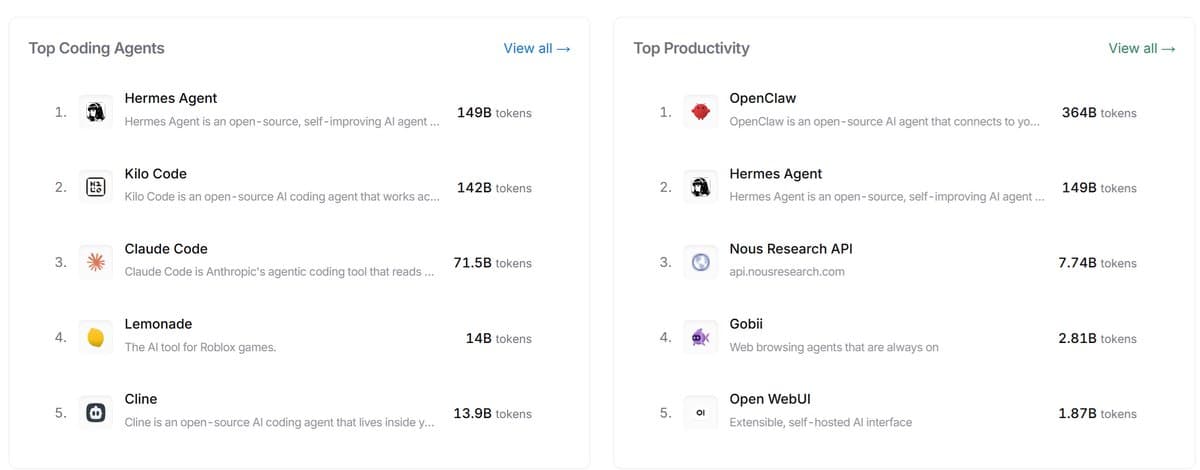
- Teknium’s OpenRouter screenshot showed Hermes Agent at No. 1 in the coding-app ranking and No. 2 in OpenRouter’s broader productivity list, while the OpenRouter app page describes Hermes as a tracked public app built around GitHub-hosted usage.
- According to the official README, Hermes’ pitch is a built-in learning loop that turns experience into reusable skills, and coreyganim’s summary claims the agent writes a new skill roughly every 15 actions.
- Nous Research’s migration note said
hermes claw migratehad been patched after path-reference breakage, and the migration guide says the command imports OpenClaw settings, memories, skills, and optionally secrets. - Teknium’s Telegram post added agent-to-agent messaging on Telegram, while the messaging gateway docs show Hermes already spans Telegram, Discord, Slack, WhatsApp, Signal, SMS, email, Matrix, and more from one background gateway.
- Teknium’s /compress thread introduced a focused compression mode for keeping a chosen topic in memory, and the slash-command reference documents
/compressas the manual context-flush and summarization control.
You can read the migration guide, browse the skills hub docs, and check the messaging gateway matrix. The odd bit is how fast the team was shipping around the ranking spike: a migration fix, Telegram agent-to-agent messaging, and then a focused memory compaction PR a few hours later.
OpenRouter ranking
The screenshot in Teknium’s post put Hermes ahead of Kilo Code and Claude Code in OpenRouter’s coding category, with 149B tokens on the chart. On the productivity side, the same image still showed OpenClaw in front at 364B tokens, so the migration story is happening inside a market OpenClaw still dominates overall.
OpenRouter’s app listing separately identifies Hermes as a public tracked app and ties it to the GitHub project. Nous Research’s follow-up was basically a victory lap, but the more useful detail is that the ranking arrived alongside several same-day product changes, not after a quiet stabilization phase.
Skills hub
The official skills guide makes the architecture pretty explicit. Skills are markdown-based knowledge modules, installed locally, exposed as slash commands, and loaded with progressive disclosure so Hermes starts from a compact catalog and only pulls full skill text when needed.
That gives the “self-improving agent” claim a concrete shape:
skills_list()loads a compact skills catalog at session start.skill_view(name)loads the fullSKILL.mdonly when Hermes needs it.hermes skillscan browse, install, publish, audit, and configure skills, according to the CLI reference.- Users can create custom skills as markdown files with YAML frontmatter, according to the skills docs.
The Yonah_x retweet is the most interesting field report in the evidence pool because it describes Hermes creating an openclaw-gateway-diagnosis skill on its own after a prior troubleshooting session. coreyganim’s overview frames that loop more aggressively, claiming new skill files appear every roughly 15 actions and improve over time.
OpenClaw migration patch
This was the sharpest operational detail of the day. Nous Research said some migrations from OpenClaw went sideways because OpenClaw’s config format had changed enough that Hermes’ path references lagged behind, so fresh installs were sometimes cleaner until the patch landed.
The official migration guide says hermes claw migrate can preview changes with --dry-run, read from ~/.openclaw plus older ~/.clawdbot and ~/.moldbot locations, and import settings, memories, skills, and optionally API keys. A separate open GitHub issue about session history import shows one thing the migration path still did not fully cover, old chat history.
When in doubt, hermes update landed later the same day, and the timing makes sense. The official update docs say hermes update does a git pull, reinstalls dependencies, and runs config migration prompts for newly added options.
Messaging gateway
Hermes has been built around remote, long-lived usage from the start. The README pitches a cloud VM plus Telegram chat workflow, and the messaging gateway docs describe one background process that handles sessions, cron jobs, and delivery across Telegram, Discord, Slack, WhatsApp, Signal, SMS, email, Matrix, Mattermost, Home Assistant, WeCom, Feishu/Lark, and browser chat.
That makes Teknium’s Telegram agent-to-agent post less of a random addon and more of a gateway-layer extension. bridgemindai’s demo and the setup screenshot both leaned on the same always-on pitch, with Hermes running on an NVIDIA DGX Spark and then sending outreach from a remote workflow.
One platform note surfaced outside the docs. Teknium said Hermes was built Linux first, while the official installation guide supports Linux, macOS, and WSL2, and explicitly says native Windows is not supported.
Focused compression
The base slash-command reference describes /compress as manual context compression that flushes memories and summarizes the conversation. Teknium’s merged-PR screenshot adds a more specific behavior: /compress <topic> tells the summarizer to spend about 60 to 70 percent of its summary budget preserving one focus area while compressing the rest more aggressively.
That is a small feature with a very agent-shaped target. The examples in the PR screenshot use database schema and authentication flow, and the note says the behavior is shared across CLI and gateway platforms, including Telegram and Discord.