
Hermes ecosystem ships Web UI, Control Room, and 14% lower read_file tokens
Builders released a chat-first Web UI and a multi-agent Control Room template around Hermes Agent, while core updates cut read_file input tokens by 14% and fixed TUI startup hangs. Use the new controls to manage local multi-agent setups while reducing routine token burn.
TL;DR
- A community-built Hermes Web UI repo, introduced in _avichawla's Web UI overview and linked in _avichawla's repo post, gives Hermes Agent a chat-first browser UI that reuses the existing
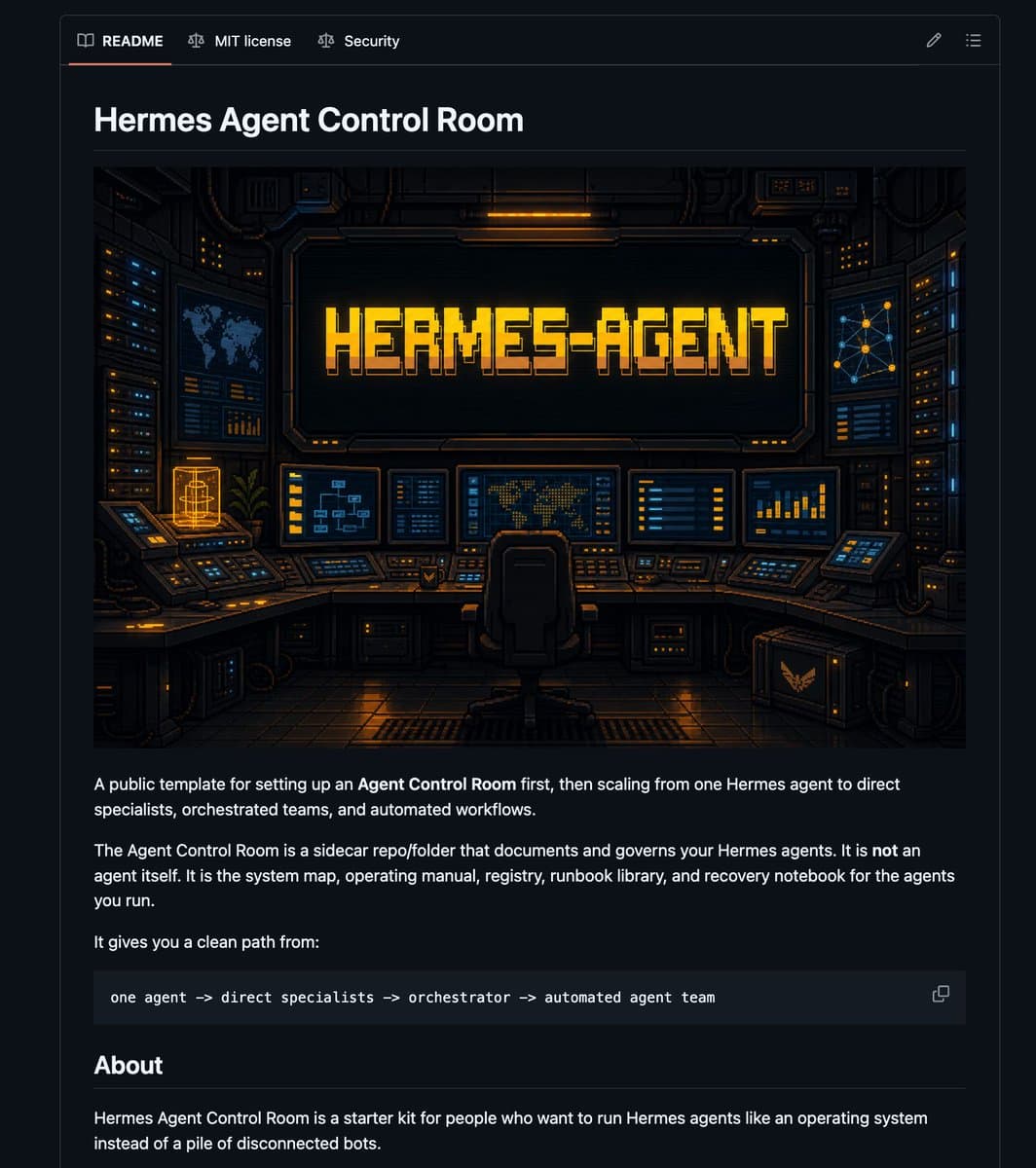
~/.hermesstate instead of standing up a separate control plane. - A separate Hermes Agent Control Room template, outlined in AlphaSignalAI's control room post and linked in AlphaSignalAI's repo post, packages a multi-agent VPS setup around specialists, an orchestrator, and cron jobs.
- Core Hermes updates landed at the same time: Teknium's token-cut post says read-file operations now use 14% fewer input tokens on average, while Teknium's TUI startup fix post says a startup hang triggered by MCP loading is gone.
- The broader v0.15.0 release notes, announced in NousResearch's release post and summarized by Teknium's highlight thread, also added skill bundles, an MCP catalog, Bitwarden integration, prompt-injection defense, and large speedups in load time and session search.
You can browse the full v0.15.0 release, open the community Web UI, and inspect the Control Room template. The odd part is how much of the week's motion was not one flagship feature, but a stack settling into shape: UI on top, fleet orchestration around it, and token and startup fixes underneath.
Hermes Web UI
The Web UI is a community project, not an official Nous release. Its pitch is simple: replace Hermes' browser-wrapped terminal chat with a native web chat that reads the same local state.
According to _avichawla's feature list, the UI exposes more than chat:
- date-grouped sessions with a context ring
- Kanban views for the agent task board
- workspace management in Spaces
- a skills catalog
- cron job visibility in Tasks
- usage and activity views in Insights
- MEMORY and SOUL file views
- log tails for agent, gateway, and error logs
The operational detail is the useful bit. _avichawla's post says it runs 100% locally, binds to localhost by default, and is meant to be reached over SSH tunneling or Tailscale from another device.
Control Room
The Control Room template is a different layer. It packages Hermes as a small agent fleet on a VPS, with one control plane for config, secrets, and runbooks, and separate specialist agents doing the work.
[Src:2|AlphaSignalAI's rollout outline] breaks the setup into four stages:
- one agent on a VPS, with docs
- specialist agents for SEO, dev, and ops
- an orchestrator routing across them
- cron jobs running the team on schedule
The setup thread also claims the bundled skills can take a Hetzner API key, provision the server, install tooling, clone the repo, and register a first agent in about ten minutes. It routes through the Hermes gateway, which AlphaSignalAI's post says can target 300-plus models.
Runtime fixes
The most concrete core improvement was cost, not UI. Teknium's token-cut post says Hermes now saves 14% on input tokens on average during read-file operations, and that the change is already on main behind hermes update.
The other fix hits a different pain point. Teknium's TUI startup fix post says MCPs could previously trigger a laggy startup hang in the terminal UI, and points to a merged PR for the patch.
Together, those changes land in the boring-but-important category: less context wasted on file reads, less waiting for the interface to boot.
v0.15.0 baseline
The new ecosystem pieces are landing on top of a very large Hermes release. Teknium's highlight thread put v0.15.0 at 747 PRs from 321 contributors, while NousResearch's release-notes link points to the full tagged release.
The release highlights called out in Teknium's highlight thread are worth scanning as a list:
- skill bundles and an MCP catalog
- more model support, including Krea 2, Opus 4.8, and Qwen 3.7
- deeper xAI integrations
- 50% faster load times
- 750x faster session search
- Bitwarden native integration
- Brainworm prompt-injection defense
- automatic supply-chain defense
A hotfix followed fast. Teknium's hotfix post says v0.15.1 fixed a dashboard load loop, adjusted Kanban behavior, and bundled several other bug fixes for platforms that depend on tagged releases.
Batteries included
Teknium used the weekend to make the product philosophy explicit. Teknium's design-position post says Hermes is intentionally not a minimalist agent that starts empty and forces users to assemble capabilities from scratch.
That stance explains a lot of this week's surface area. The same post says users can disable built-in tools with hermes skills config or hermes tools, package an entire agent setup as a GitHub repo, and extend Hermes through a large extension interface. The pitch is a broad default setup first, then trimming or tinkering later.