
Hugging Face Papers serves Markdown to agents and adds a paper-pages skill
Hugging Face now serves Markdown when agents fetch Papers pages and published a skill for searching papers plus linked models, datasets, and Spaces. Research agents can cut token waste and retrieve paper context in a format that is easier to parse and ground.
TL;DR
- Hugging Face Papers now serves Markdown automatically when AI agents fetch a paper page, which the launch thread says saves tokens and makes the content easier to parse; the same behavior is echoed in the repost.
- Hugging Face also published a paper-pages skill that lets coding agents search papers by title, author, or semantic similarity, according to the feature thread and the skill repost.
- The skill extends beyond paper text: agents can also discover linked Hub assets including models, datasets, and Spaces from a paper page, as shown in the announcement.
- Hugging Face framed the change as making it “dramatically easier” for agents to read trending research on the platform, in the company repost.
What changed for agent access to Papers
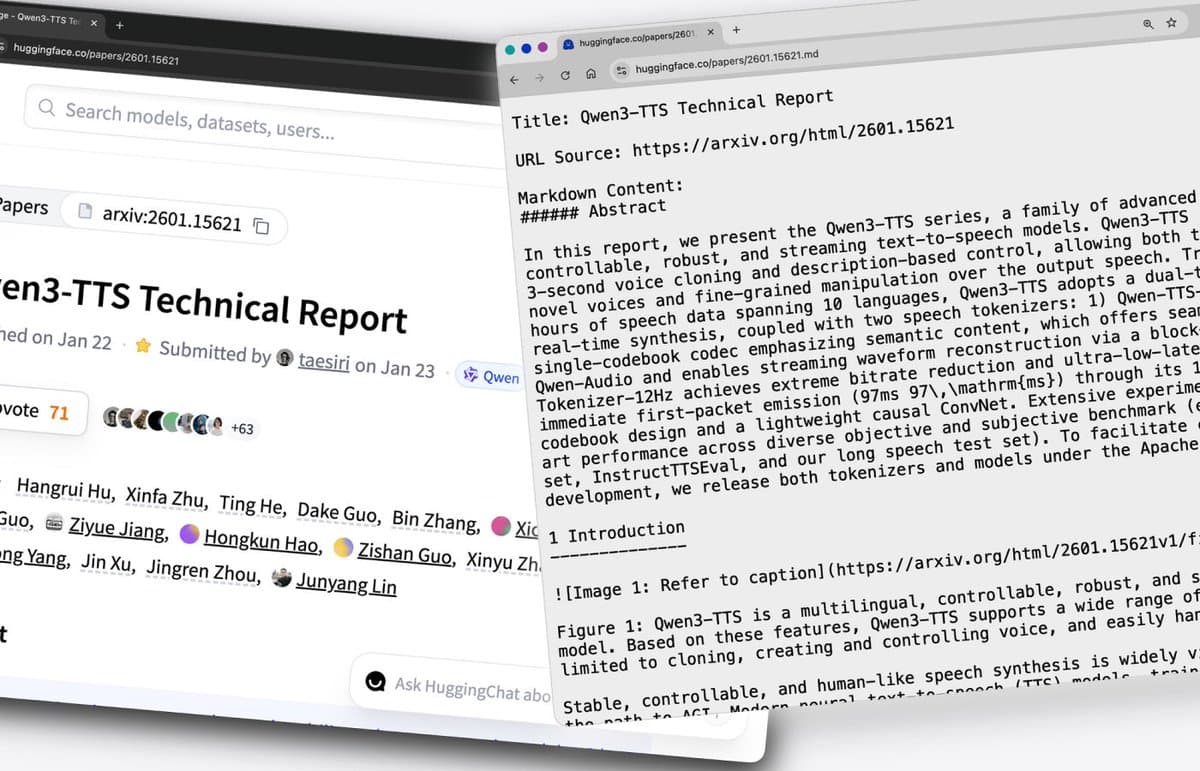
When an agent such as Cursor or Claude Code requests a Hugging Face Papers page, Hugging Face now serves a Markdown version automatically. In the feature thread, the product claim is explicit: this is meant to cut token use and improve efficiency, while a matching repost describes the output as improving “content clarity” for agents as well.
The attached [img:1|Markdown paper view] shows the practical difference: the normal paper page is paired with a raw Markdown rendering that exposes the abstract and section structure directly. That matters for research and coding agents that would otherwise spend tokens pulling a full web page and stripping UI before they can extract the paper body.
What the new skill lets coding agents do
The second change is a new paper-pages skill for agents. According to the launch thread, the skill lets an agent search papers by title, by author, or by semantic similarity, then read the paper content and follow related assets connected to that paper.
Those related assets include linked models, datasets, and Spaces on the Hub, which turns a paper page into a lightweight retrieval surface for implementation context rather than just a reading view. The same thread demonstrates that flow with MolmoPoint and links out to the paper, a model page, and a demo Space via the paper, the model, and the demo. Hugging Face's company repost positions the update as part of “AI powered research,” while the skill repost says agents can use a SKILL.md entry to learn how to work with Papers pages.