
Google launches Lyria 3 Pro API at $0.08 per song
Lyria 3 Pro and Lyria 3 Clip are now in Gemini API and AI Studio, with Lyria 3 Pro priced at $0.08 per song and able to structure tracks into verses and choruses. That gives developers a clearer path to longer-form music features, with watermarking and prompt design built in.
TL;DR
- Google's launch thread puts Lyria 3 Pro and Lyria 3 Clip into the Gemini API and Google AI Studio today, with Pro priced at "$0.08/song" for full tracks and Clip at "$0.04/song" for 30-second generations.
- According to DeepMind's rollout, Lyria 3 Pro can structure tracks into "intros, verses, choruses, and bridges" and generate compositions up to 3 minutes long.
- Google's Gemini post says every Lyria 3 and Lyria 3 Pro output carries SynthID, and Gemini can check uploaded files for that watermark.
- The API docs thread and Gemini's app demo show this is shipping both as a developer API and as a product surface in Gemini, with prompt controls for tempo, time-aligned lyrics, and image-conditioned generation.
What shipped in Gemini API and AI Studio
The launch is two separate music endpoints, not one tiered mode. Google's product intro calls them "our full song and 30 second music models," and the more detailed launch thread says Lyria 3 Pro is for multi-minute songs while Lyria 3 Clip is for short-form generation. Google also published music docs alongside the rollout and linked a broader launch blog for implementation details.
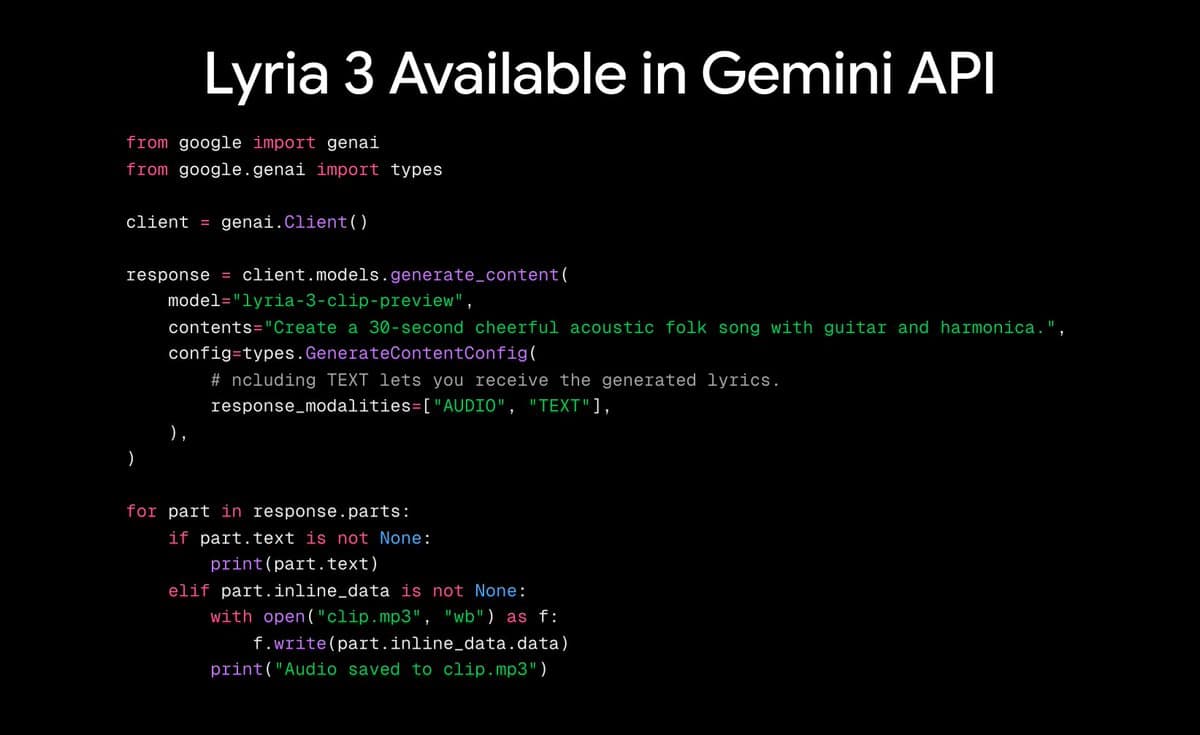
The API surface already looks like standard Gemini model invocation. In the
, the Python example calls client.models.generate_content with model="lyria-3-clip-preview", asks for response_modalities=["AUDIO", "TEXT"], and writes the returned inline audio bytes to an MP3. That matters for teams already using Gemini SDK patterns: music generation lands as another model call rather than a separate stack.
What developers can control and what it costs
Google's pricing and controls are unusually concrete for a first-day media API: Pro costs $0.08 per generated song, Clip costs $0.04, and prompts can control tempo, request time-aligned lyrics, and use image-to-music inputs. The same post says Pro generates "full songs" while Clip is tuned for 30-second outputs.
The differentiator for Pro is track structure. DeepMind's longer tracks post says developers can "map out intros, verses, choruses, and bridges" and extend compositions to 3 minutes, which moves the model beyond loop-like background snippets. Gemini's reference image tip adds a practical prompt trick: when you upload a reference image with a Pro prompt, the image becomes context for both lyrics and cover art.
What safeguards and rollout details come with it
Google is shipping provenance with the model. The SynthID details say all outputs are embedded with SynthID, described as an "imperceptible watermark," and that users can upload a file to Gemini and ask whether it was generated with Google AI. That gives product teams a built-in detection path if they need origin checks in moderation or publishing flows.
Rollout is split between developer and consumer surfaces. DeepMind's rollout note says developers can build with the API in Google AI Studio, while paid Gemini subscribers get access in the app; Gemini's app demo shows the mobile flow under "Create Music" with "Thinking" and "Pro" model options. The result is a new API for music features, plus an end-user interface that can double as a fast prompt-testing environment.