
NVIDIA launches NemoClaw for OpenClaw: single-command install with OpenShell guardrails
NVIDIA introduced NemoClaw, a reference stack that installs OpenShell and adds sandbox, privacy, and policy controls around OpenClaw. Use it if you want always-on agents on RTX PCs, DGX Spark, or cloud without building the security layer yourself.
TL;DR
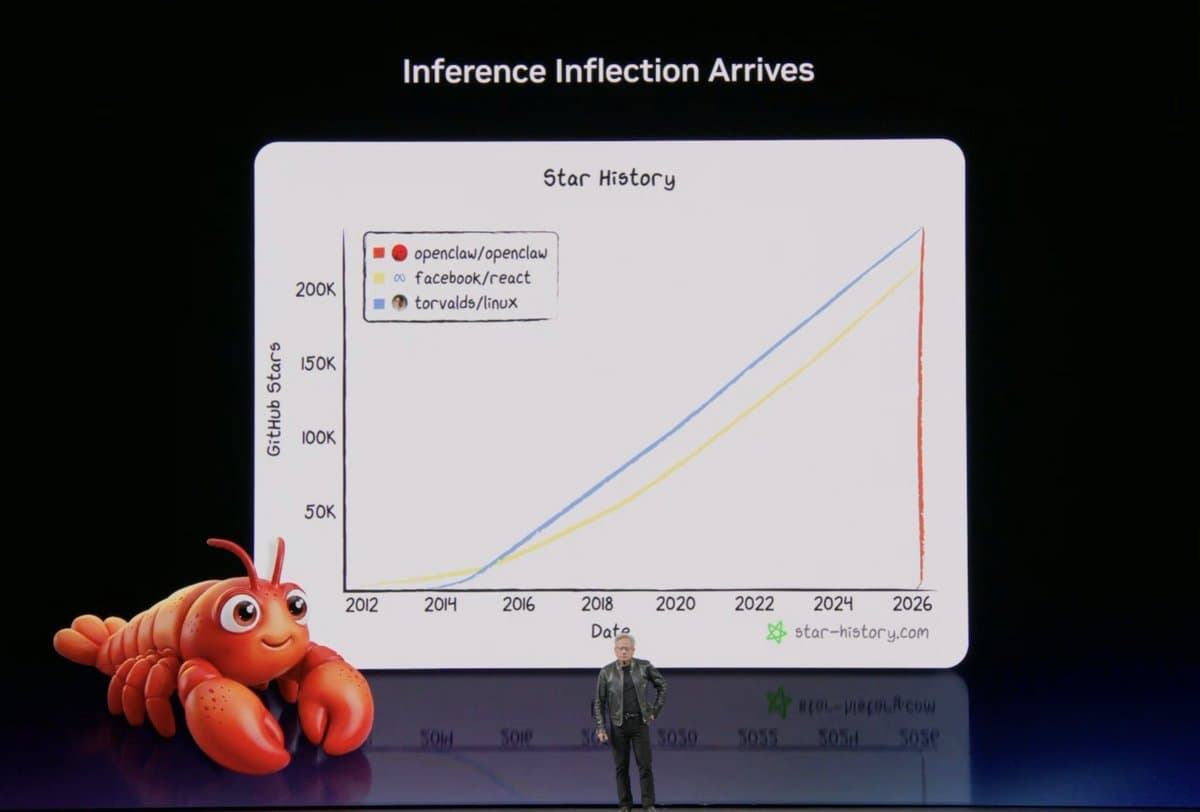
- NVIDIA used its GTC keynote to introduce NemoClaw as a reference stack for OpenClaw, with Jensen Huang calling OpenClaw "the most popular open source project in the history of humanity" and multiple attendees capturing the on-stage launch keynote post stage clip.
- The practical pitch is a faster path to enterprise deployment: NVIDIA's announcement summary says NemoClaw installs in a single command, adds security and privacy controls, and wraps OpenClaw with OpenShell as a secure runtime.
- The architecture NVIDIA showed is broader than a shell wrapper. The architecture slide and repo summary describe multimodal prompts, file access, computer use, CLI and MCP tools, memory, sub-agents, and model/runtime components connected through NemoClaw and OpenShell.
- This is still early software. NVIDIA's GitHub repo says NemoClaw is "currently in alpha," and at least one attendee reported the launch site "doesn't work yet for me" during the keynote rollout launch-day reaction.
What exactly shipped?
NVIDIA announced NemoClaw as a reference implementation for running OpenClaw with enterprise controls layered in. The keynote slides showed a stripped-down onboarding path — curl ... | bash followed by nemoclaw onboard — and attendee photos repeatedly framed it as "NVIDIA NemoClaw for OpenClaw" rather than a new agent framework replacing OpenClaw outright install slide.
The positioning is consistent across the launch materials. NVIDIA's newsroom post describes NemoClaw as a software stack that "simplif[ies] the secure deployment" of OpenClaw, while the GitHub repo calls it an open-source platform that installs OpenShell and handles sandbox orchestration for always-on assistants. On stage, NVIDIA also presented NemoClaw as a "reference OpenClaw" and an "agent toolkit for building specialized agents," which is closer to a packaged deployment baseline than to a closed managed service reference stack slide.
How do the guardrails and runtime work?
The core engineering change is the addition of OpenShell as the execution layer around OpenClaw. According to the repo summary, OpenShell is a "secure runtime environment" for autonomous agents, and NemoClaw's job is to make that runtime easier to stand up while routing inference through configured providers. The newsroom summary adds the deployment model NVIDIA is aiming for: agents operate inside policy, network, and privacy guardrails rather than getting unrestricted host access feature summary.
The keynote architecture slide filled in the stack boundaries. NemoClaw sits between multimodal prompts and downstream components including files, computer-use actions, CLI and MCP tools, memory, LLMs, sub-agents, and skills, with OpenShell shown directly underneath as the sandbox boundary architecture slide. That same slide also placed NemoTron, NeMo, Dynamo, NIM, AI-Q, and cuOpt beside the core agent loop, suggesting NVIDIA wants NemoClaw to be the integration point between OpenClaw-style agents and its broader inference and orchestration stack stack diagram.
Practitioner reactions focused on the same point: "secure agents you can trust" is how Peter Steinberger, who said he had been "cooking OpenShell and NemoClaw with the NVIDIA folks," summarized the launch builder reaction. Another attendee described the package as "enterprise grade secure Openclaw" with "network boundaries" and "security baked in," which tracks with the published descriptions even if it adds no deeper implementation detail thread recap.
Where can it run, and how production-ready is it?
NVIDIA is pitching NemoClaw across local and cloud footprints instead of tying it to one serving environment. The launch summary says it is intended for cloud, RTX PCs, and DGX Spark, and the newsroom post expands that to GeForce RTX PCs, RTX PRO workstations, DGX Station, and DGX Spark. The same material says agents can run open models locally through OpenShell or reach frontier models in the cloud through a privacy router platform details.
The install story is simple, but the maturity story is mixed. The GitHub repo says NemoClaw is "currently in alpha" and lists a fairly standard self-hosted prerequisite set: Ubuntu 22.04+, Node.js, Docker, and OpenShell. During the keynote, one attendee posted that the launch site "doesn't work yet for me," a useful reminder that this was announced as an early reference stack, not as a finished enterprise product with all edges smoothed out launch hiccup.
That said, NVIDIA's messaging is explicit about the target use case: always-on autonomous agents with inspectable boundaries instead of ad hoc agent installs. For teams already experimenting with OpenClaw, the new part is not the agent loop itself but the packaged sandbox, policy, and deployment layer NVIDIA is putting around it alpha repo security pitch.