
OpenAI acquires Astral and adds uv, Ruff, and ty to Codex
OpenAI agreed to buy Astral and bring the uv, Ruff, and ty team into Codex while pledging continued support for Astral’s open-source tools. It deepens Codex’s Python workflow integration as OpenAI says Codex has passed 2 million weekly active users.
TL;DR
- OpenAI said it has "reached an agreement to acquire Astral," with the deal announcement and OpenAI's acquisition post both stating the plan is to bring Astral into the Codex team after closing.
- The technical payload is Astral's Python toolchain: OpenAI's announcement names uv, Ruff, and ty as "widely used open source Python tools" that already sit inside modern developer workflows.
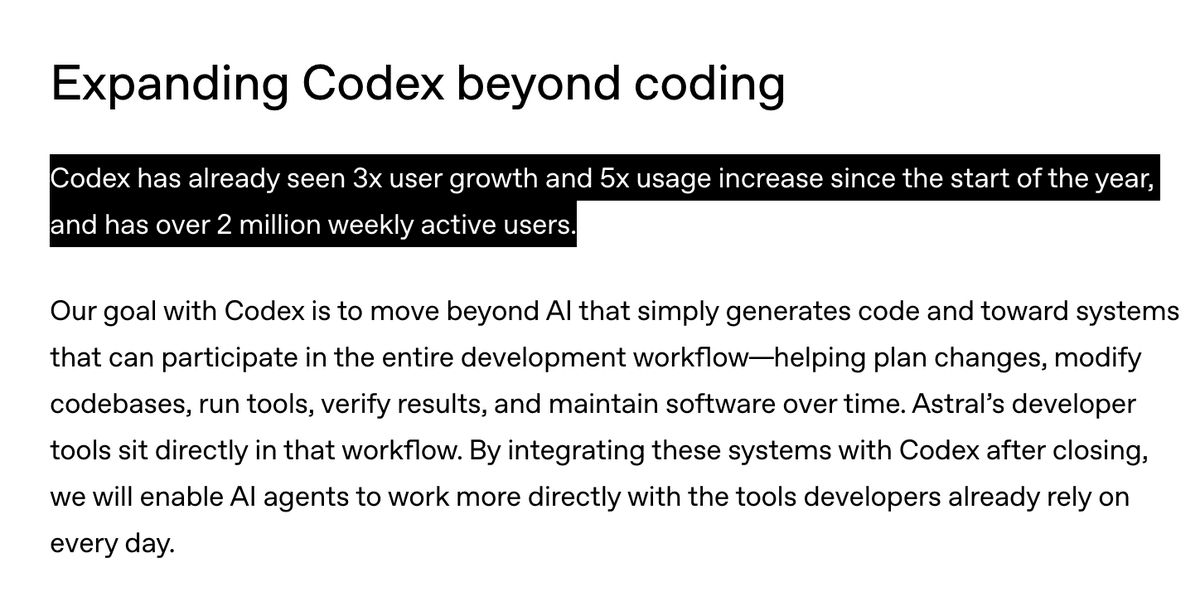
- OpenAI is positioning this as a Codex expansion beyond code generation; the Codex growth slide says Codex has seen "3x user growth" and "5x usage increase" this year and now has "over 2 million weekly active users."
- OpenAI also says it will keep backing Astral's open-source products after the deal closes, according to the company post, which matters because these tools are already embedded in Python packaging, linting, and type-checking pipelines.
What exactly did OpenAI buy?
OpenAI said it will acquire Astral and, after closing, have the Astral team join Codex to bring "powerful open source developer tools" into that ecosystem, as described in OpenAI's acquisition post. The company explicitly named uv, Ruff, and ty as the assets and projects at the center of the deal, framing them as part of "the foundation of modern Python development."
The narrower legal point is that this is still pending close: the agreement post says OpenAI has "reached an agreement to acquire Astral," not that the transfer is already complete. OpenAI's full announcement also says both companies will operate independently until regulatory approval and other closing conditions are done.
Why does this matter for Codex?
OpenAI is using the Astral deal to argue that Codex should participate in the whole software lifecycle, not just write snippets. The Codex growth slide says the goal is to help agents "plan changes, modify codebases, run tools, verify results, and maintain software over time," which is exactly where package management, linting, and type checking live.
That context also shows why OpenAI is buying tooling instead of only improving models. The same growth slide says Codex has already reached "over 2 million weekly active users," with 3x user growth and 5x usage growth since the start of the year, giving OpenAI a large installed base for tighter tool integration.
Simon Willison's analysis adds concrete ecosystem context: uv alone saw more than 126 million downloads in the prior month, which helps explain why owning the team behind it could matter more than a typical acqui-hire. His writeup also notes that Ruff and ty are useful for agentic workflows because fast linting and type checking are natural checkpoints when a coding system needs to verify its own edits.
What changes for Python developers and open source?
OpenAI's public line is continuity, not shutdown. In the company post, it says it plans to "support Astral's open source products" after closing, and OpenAI engineer Thomas Sottiaux's thread says the combined teams aim to "build awesome things," reinforcing that the tools are expected to remain part of a broader developer-facing strategy rather than becoming internal-only infrastructure.
That pledge matters because Astral's tools are already deeply embedded in Python workflows. Practitioners reacting to the deal described uv as "the tooling I wish Python would have always had" in a developer reaction, while Willison's analysis points out that uv in particular addresses Python environment management, one of the language's most persistent operational pain points.