
OpenAI says de-identified product-use data may have improved its models
OpenAI said it cannot rule out whether de-identified data derived from product usage improved its models. The disclosure does not establish that raw prompts were used for training, and discussion distinguishes direct prompt training from synthetic data derived from use.
TL;DR
- OpenAI said its researchers and agents did not see Levent Alpöge and Tristan Buckmaster's work before it was released, and did not access specific user data for its Navier-Stokes effort. But OpenAI's statement also says it cannot rule out that de-identified data derived from their product use improved its models.
- The qualifier separates a problem-specific access claim from a broader improvement pipeline. In the data-use clarification, OpenAI distinguished people or agents looking at user data for the effort from using feedback and de-identified data to improve products holistically.
- The system at the center of the dispute was a large inference-time search, with about 10,000 coordinating agents reaching a proposed resolution in 88 hours, according to OpenAI's research announcement. Those figures describe the run, not a training-data audit.
- Individual-service content may be used for model improvement depending on settings, while business offerings default out, according to OpenAI's consumer FAQ. The Data Controls screenshot shows the consumer switch labeled
Improve the model for everyone.
OpenAI's announcement says the agents could read a cached internet and run code. The consumer FAQ explicitly includes prompts, responses, images, and files in the individual-service data pool, while OpenAI's privacy explainer says eligible conversations pass through its Privacy Filter at multiple training stages.
Direct access and model improvement
OpenAI placed the disclosure in its discussion of concurrent work on Navier-Stokes. Its two clauses set boundaries on different systems:
- Researchers and agents did not see the mathematicians' work before public release, and no specific user data was accessed to solve the problem.
- De-identified data derived from their product use might still have improved OpenAI models.
The statement does not say that either mathematician's raw prompts entered a training corpus, that a particular conversation affected a model, or which training stage could have involved derived data. It leaves those provenance questions unanswered.
The qualifier prompted yacinelearning to ask OpenAI to inspect whether relevant Navier-Stokes traces existed in the de-identified data in yacinelearning's question.
The agent run
OpenAI says it began training the internal model on August 28, then began evaluating it on Millennium Prize problems on September 1 after hearing rumors. The company describes coordinating agent groups with a cached internet and code execution.
- Search group: about 10,000 concurrent agents worked on the Navier-Stokes result.
- Time: the agents reached a resolution after about 88 hours; Lean formalization and verification took another 17 hours.
- Scale: the Navier-Stokes run used about 2.7 million messages and 130 billion output tokens; all attempted problems totaled 4.9 million messages and 300 billion output tokens, according to willdepue's post.
- Isolation: polynoamial said the evaluation had no live web access and ran on heightened-security clusters with monitors in polynoamial's reply.
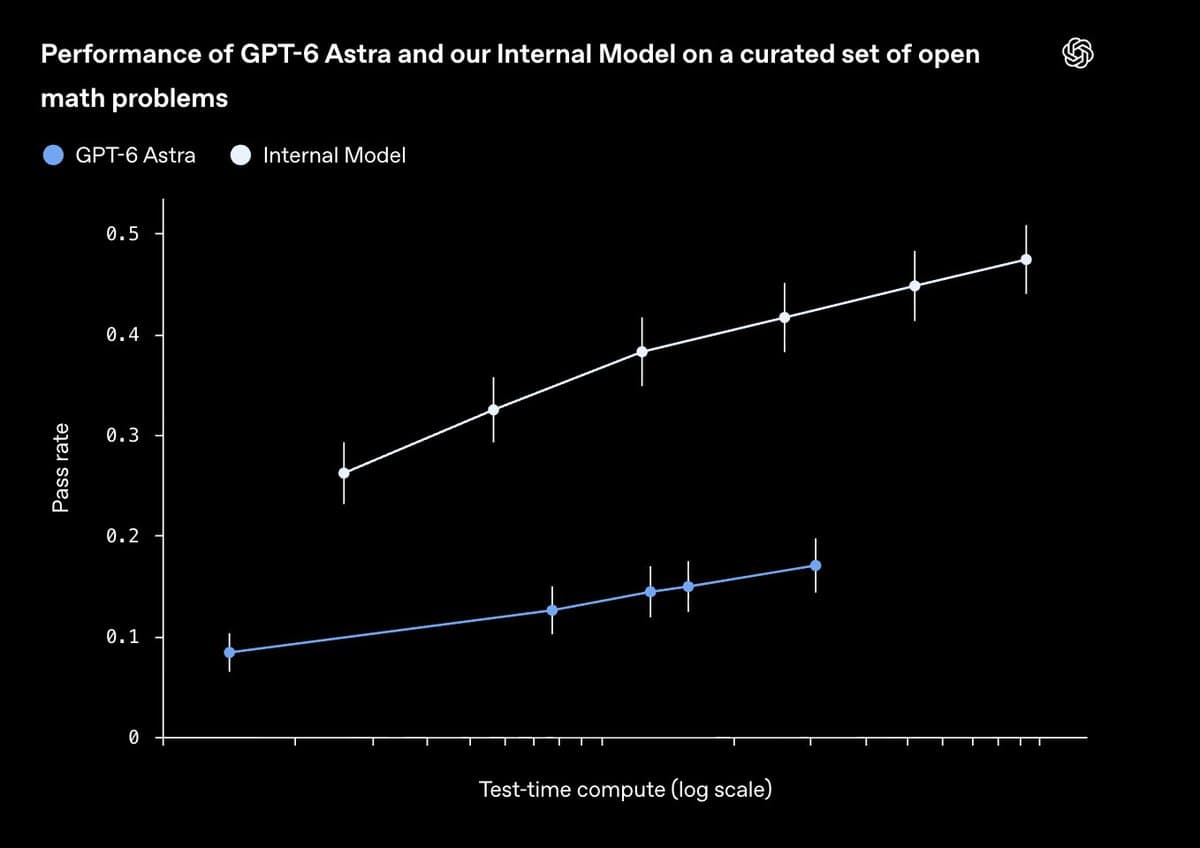
A polynoamial performance chart places the internal model above GPT-6 Astra across OpenAI's curated open-math benchmark and test-time-compute range. A separate mobav0 team account describes a cross-team effort that monitored runs, checked and simplified the proof, and formalized it in Lean. Those are capability and process claims, not evidence tracing the model's training inputs.
Codex drafts
The data question arose because Alpöge and Buckmaster had used AI tools during a long-running adjacent research project. Their accounts and OpenAI's responses disagree on the surrounding conversations, while neither supplies a corpus-level audit.
- Buckmaster's account said their project drafts had been entered into Codex and that he did not receive an answer when he asked whether the model had been trained on those sessions.
- Sébastien Bubeck said OpenAI began from viral rumors, had not seen the other team's work before release, and that the proofs differed in SebastienBubeck's technical explanation. In a longer response, Bubeck denied trying to remove Alpöge from authorship and apologized for one phrase used in the call in SebastienBubeck's response.
- sama said OpenAI heard internet rumors, initially believed the other team had solved Navier-Stokes too, and sought a coordinated release in sama's account.
The question in suchenzang's post was whether a frontier provider can see a customer's unpublished work when the stakes are high. That question is separate from an allegation that a person or agent retrieved a private chat during the run.
Three data paths
The phrase "training on user data" covers materially different technical operations. johnschulman2 separated them into three paths in johnschulman2's taxonomy:
- Pretraining on raw user tokens: user text becomes prediction targets, which he characterized as carrying the highest regurgitation risk.
- Distillation: user prompts elicit output from a larger model, then that output trains a smaller one.
- RL tasks from traces: usage becomes feedback, a reward-model example, or an environment for reinforcement learning.
Only the first path makes the original user text a prediction target. The latter two can preserve useful task structure without producing an obvious verbatim echo, which is why the announcement's word "derived" carries more technical ambiguity than a simple yes-or-no question about prompt training.
De-identification and IP
OpenAI describes its Privacy Filter as a system that identifies and masks personal information in text. Its privacy explainer says the internal filter is used on public training data and on user conversations when Improve the model for everyone is enabled.
That is a PII safeguard. johnschulman2 argued that de-identification does not resolve IP-leakage questions, particularly for long, information-dense traces in johnschulman2's breakdown.
Aidan Gomez went further, saying he had heard from employees at large labs that synthetic data derived from consumer production data was used for training, and that derivative data could fall outside a zero-data-retention promise. He presented that as a rumor, not documentation of OpenAI's pipeline in aidangomez's thread.
Consumer and business data policies
OpenAI's consumer FAQ says it may use content from ChatGPT and other services for individuals, including prompts, responses, images, and files, depending on settings. The same page says API, ChatGPT Business, and ChatGPT Enterprise content is not used for model improvement by default unless the customer explicitly opts in.
OpenAI's privacy explainer says new conversations are not used to train ChatGPT after the consumer control is switched off. It also says Temporary Chats are not used for improvement, are retained for 30 days for safety, then deleted.
The FAQ adds a separate retention caveat: cleared chats are deleted within 30 days unless they had already been de-identified and disassociated from the account, or need retention for security or legal reasons.