
OpenAI updates GPT-Live with continuous audio and one-round-trip WebRTC startup
OpenAI says GPT-Live can listen while speaking using continuous audio, async reasoning and tool use, one-round-trip WebRTC startup, and async context compaction. Staff said the rebuilt stack removes a separate turn detector.
TL;DR
- GPT-Live now listens while speaking, and OpenAI says the rebuilt stack keeps audio flowing while reasoning and tool use run asynchronously, according to OpenAI's launch note and OpenAI's fast-path note.
- Voice-session startup dropped from six network round trips to one, according to OpenAI's fast-path note, while juberti's WARP note names the WebRTC rework behind the startup path.
- Long calls get async context compaction: juberti's compaction note says a new instance is initialized from a compacted snapshot and takes over after prefill finishes.
- OpenAI removed the separate turn detector from the audio path; juberti's answer quoted the post saying GPT-Live removes the turn detector.
- Live API pricing is still open, per juberti's pricing reply; current Realtime API docs price existing realtime models separately.
The OpenAI engineering post says the rebuild took six months and moved GPT-Live to a full-duplex voice model. The WARP draft puts the lower-level WebRTC target at 6 RTTs to 2 RTTs, while OpenAI's voice thread says session startup went from six network round trips to one. The current Voice agents docs still frame developer architecture as live speech-to-speech versus chained STT, reasoning, and TTS.
Full-duplex audio
OpenAI says GPT-Live keeps audio flowing continuously, from client to model and back, so conversation is not gated on a separate end-of-turn classifier. In the OpenAI engineering post, Justin Uberti and Zahan Malkani say earlier voice systems relied on small turn detectors that could cut users off when they guessed early or feel slow when they guessed late.
OpenAI's follow-up used the deep-dive pointer as the build write-up for the new voice path. In gdb's architecture note, GPT-Live is described as "a new architecture and stack for realtime audio."
OpenAI staff made the turn-detector point bluntly. In juberti's turn-detector riff, the large model no longer takes orders from a roughly 100K parameter turn detector, and juberti's listening reply defines "listening" as audio being continuously propagated through all layers of the neural network.
Async reasoning and tools
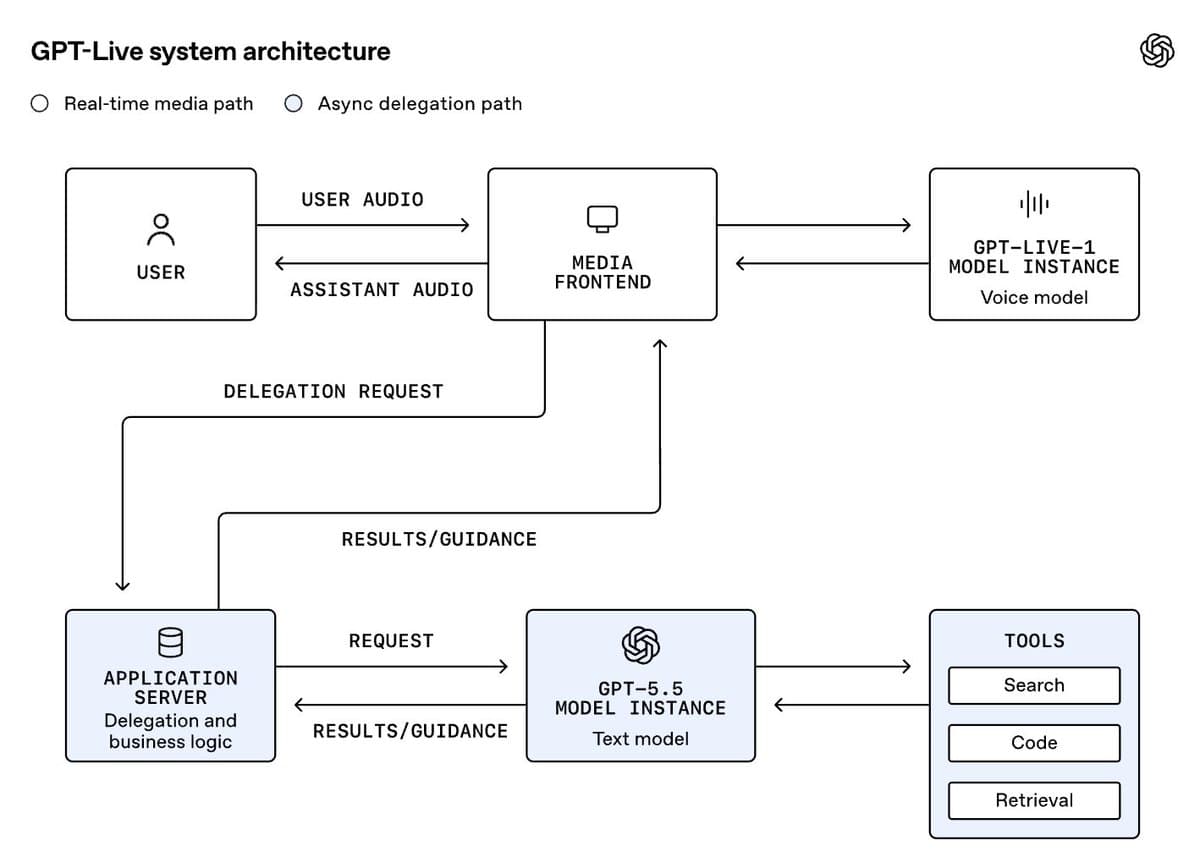
The cleanest engineering reveal is the split path: audio gets dedicated low-latency handling, while deeper reasoning and tool calls happen asynchronously. The OpenAI engineering post says GPT-Live can consult frontier models, including GPT-5.5, without interrupting conversation flow.
In juberti's detail list, the technical spread is realtime inference, dynamic compaction, and WebRTC optimization. The current server-side controls docs describe a related Realtime API pattern: a sideband connection lets an application server handle tool calls and business logic while the client stays connected over WebRTC or SIP.
The developer pull is already obvious. simonw's MCP request asked for ChatGPT Voice on iPhone to voice-activate custom MCPs.
One-round-trip WebRTC startup
OpenAI's public thread says voice-session startup moved from six network round trips to one. juberti's WARP note identifies the underlying WebRTC setup work as WARP, the WebRTC Abridged Roundtrip Protocol.
The IETF WARP draft describes the generic protocol target differently: current WebRTC setup can take 4 RTTs before media and 6 RTTs before data channels, while WARP's combined optimizations can reduce setup latency from 6 RTTs to 2 RTTs.
The implementation details Uberti highlighted:
- DTLS handshake runs in parallel with ICE.
- SCTP handshake is collapsed.
- WARP began as a broader rework of the WebRTC setup flow, according to juberti's handshake note.
Live context compaction
Long realtime sessions hit the usual context-window wall, but a voice call cannot pause for a synchronous summarize-and-reload step. juberti's compaction note describes the handoff sequence:
- As the call nears the context limit, start async compaction.
- Initialize a new model instance with the compacted result.
- Wait for prefill to finish.
- Switch the call to the new instance.
The diagram labels the phases as compact snapshot, prefill snapshot, and catch up. Christmas come early for realtime inference nerds.
Transcripts and mid-sentence updates
GPT-Live generates an input transcript alongside output text and audio. Existing ASR evals can be applied to that transcript, according to juberti's eval reply.
Mid-sentence correction is also part of the behavior. juberti's mid-sentence reply says GPT-Live can update mid-sentence with new understanding, similar to how people revise while speaking.
API surface and pricing
Live API pricing has not been announced. In juberti's pricing reply, OpenAI said existing Realtime API pricing is competitive with premium TTS and STT, but gave no Live API price sheet.
The public pricing docs list current gpt-realtime-2.1 audio pricing at $32 input and $64 output per 1M tokens, plus text pricing at $4 input and $24 output per 1M tokens. The gpt-realtime-2.1 model page describes a 128K context window, up to 32K max output tokens, configurable reasoning effort, tool use, and text/audio I/O with image input.
V1 rough edges
OpenAI staff described the system as a v1 of an all-new architecture with "a lot of low hanging fruit" in juberti's v1 reply. That caveat showed up in the support thread too: juberti's feedback reply asked whether a reported issue happened around 10 minutes into a call or randomly.
User requests are already product-shaped. nptacek's toggle request asked for a mode that lets the user keep speaking without being derailed by encouragement mid-thought.