
OpenClaw-RL releases fully asynchronous online training with OPD for live agents
OpenClaw-RL released a fully asynchronous online training stack that turns live interaction feedback into ongoing agent updates with binary rewards and token-level OPD corrections. Use it as a starting point for online agent improvement only if you can score rollouts reliably and manage privacy risk.
TL;DR
- Princeton-affiliated researchers have published OpenClaw-RL as a paper and open-source repo, with the launch thread describing a stack where an agent "improves just by being used" and the repo post pointing to both the paper and code.
- The core idea in the technical thread is to mine the next state for two signals: a scalar judgment of whether the last action was good or bad, and directive hints about what should have changed, which the paper calls Hindsight-Guided On-Policy Distillation, or OPD.
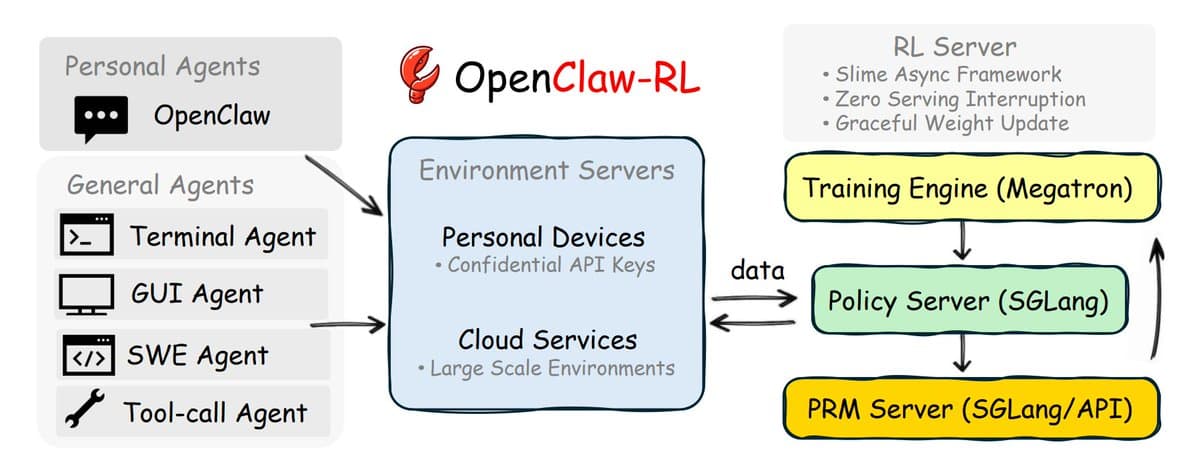
- According to the architecture outline, OpenClaw-RL splits serving, environment collection, judging, and policy training into parallel components, while the async note says those loops run without blocking one another.
- The framework is positioned in the applicability post as a general online-training setup for chat, coding, terminal, GUI, SWE, and tool-call agents, with the linked repo emphasizing self-hosted deployment and live background optimization.
What shipped
OpenClaw-RL is out as both a research paper and a public codebase, with the paper and the GitHub repo linked directly from the release post. The project frames itself as a fully asynchronous reinforcement-learning system for live agents, rather than an offline RL recipe that waits for a batch of trajectories before updating.
The headline claim from the announcement thread is that the agent can "improve just by being used." That is a stronger claim than standard posthoc fine-tuning because the training signal comes from ordinary interaction flow: the model acts, the environment responds, and that response becomes training data. In the repo summary attached to the GitHub card, the system is described as intercepting live multi-turn conversations through an OpenAI-compatible API and optimizing in the background without interrupting ongoing use.
How the training loop works
The technical novelty is not just online RL, but what the system extracts from the next state. In the signal breakdown, the next state carries both "evaluative signals" and "directive signals": one can be collapsed into reward, while the other tells the model what it should have done differently. The method summary says those become two learning paths: binary RL for simple good/bad credit assignment, and OPD for token-level corrections.
The OPD path is the more implementation-relevant detail. As the OPD explanation describes it, the system pulls a correction hint from the next-state feedback, appends that hint to the prompt, reruns the model to obtain a hint-aware teacher distribution, and then uses the difference from the original output as a token-level training signal. That gives denser supervision than a single trajectory reward. Combined with the four decoupled components in the architecture post—policy serving, environment collection, PRM judging, and policy training—the design lets judging and updates happen while the model is still serving new requests.
What this means for deployed agents
The paper's scope is broader than chatbot personalization. The applicability post explicitly lists chat assistants, coding agents, terminal agents, GUI agents, SWE agents, and tool-call agents, arguing that any setup that produces a meaningful next state can feed the same loop. That matters for engineering teams because it treats environment reactions, tool outputs, and user corrections as one training interface instead of separate pipelines.
The operational promise is low-overhead continuous learning. The async description says the system can serve one request while a previous response is being judged and a trainer applies updates simultaneously, so "no part of the system blocks another." The repo summary in the GitHub card adds two practical constraints behind that promise: OpenClaw-RL assumes you can run judges and trainers on your own infrastructure, and it leans on self-hosting for privacy and data security because the training loop is built from live user interaction data.