
Perceptron releases Isaac 0.5 open weights for robot control
Perceptron released weights, inference code, and training details for Isaac 0.5, an embodied model for video perception, reasoning, and robot control. The 36B dynamic-MoE model was trained on 1 million hours of video.
TL;DR
- Isaac 0.5 puts video perception, embodied reasoning, and robot control in one 36B dynamic-MoE backbone, as the launch announcement described.
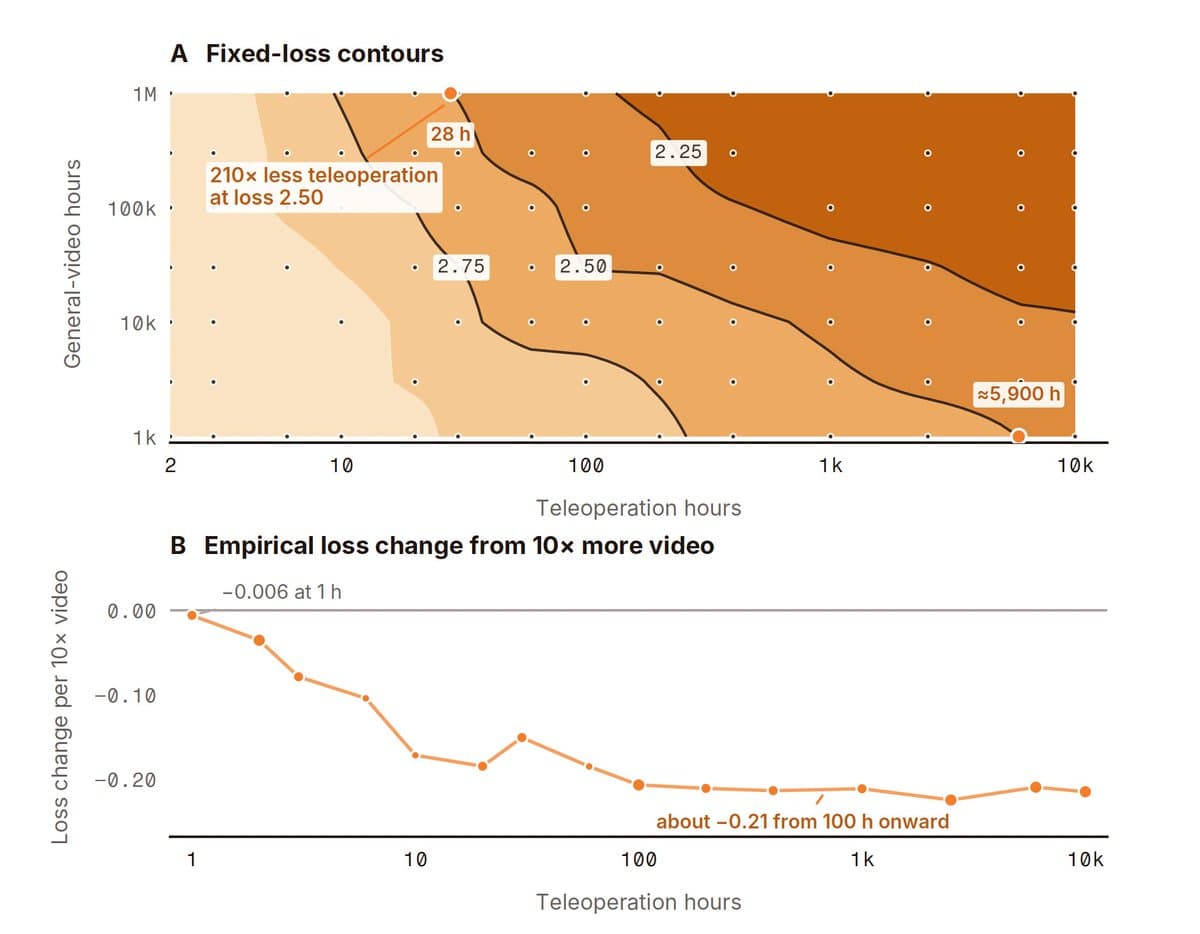
- Perceptron's central data result moves a calibrated action-loss crossing from roughly 5,900 teleoperation hours to 28 after scaling general video from 1,000 to 1 million hours, according to the scaling-law post.
- The router can select a zero-compute null expert, letting individual tokens use zero to eight routed experts, as AkshatS07's routing post explains.
- Perceptron says the package includes open weights, LeRobot training and inference code, evaluation settings, and robot-specific configurations in AkshatS07's release note.
The technical report contains a $1 million data-and-training plan that prices 30,367 hours of general video at $3,000 and 3,037 hours of task-specific teleoperation at $303,700. Its repository README contains a more mundane reveal: the advertised LeRobot extra does not install the mHarmony runtime.
36B sparse backbone
Isaac accepts images, video, language instructions, robot state, and prior actions, then produces text, normalized coordinates, task-state outputs, or robot actions, according to its model card.
- The technical report specifies 36B total parameters, 2.5B active per token, and 256 routed experts. Null-expert routing lets each token invoke zero to eight experts.
- Continuous actions come from a Flow expert plus a 36-block diffusion transformer; discrete actions use a 2,048-token FAST vocabulary, per the repository README.
- During closed-loop control, the model predicts the next action chunk while the current chunk executes, using fresh observations and previously sent commands.
Data mixture
Perceptron trained on more than 35 robot systems, 100,000 hours of robot experience, 1 million hours of general video, and 3 trillion multimodal tokens, as ArmenAgha's data post summarized.
The report's 529-stream ledger separates scheduler probability from the tokens that actually reach optimization:
- Scheduler mass: perception and embodied reasoning receive 69.7%; robotics receives 30.3%.
- Packed-token exposure: perception and embodied reasoning fall to 20.4%; robotics rises to 79.6% because its examples occupy more packed positions per draw.
- Robot-source hours: 10,000 curated teleoperation hours, 40,000 heterogeneous robot-trajectory hours, and 50,000 interactive or simulated hours.
The 100,000-hour figure therefore spans more than direct teleoperation, while perceptroninc says the release covers 35-plus embodiments.
210x teleoperation curve
At a held-out action-loss threshold of 2.50, the technical report moves the within-grid teleoperation crossing from 5,884 hours to 28 by scaling general video from 1,000 to 1 million hours while holding the general-video, egocentric-video, and UMI mix at 80:30:30.
Adjacent measured teleoperation rungs put the reported reduction between 83× and 300×. The paper also finds a tenfold video increase has nearly zero loss effect with one teleoperation hour, then settles near a 0.21 loss reduction from roughly 100 teleoperation hours onward; the reported curve is a calibrated offline action-loss measurement.
Semantic future percepts
Isaac learns a proprietary self-supervised video target called a future percept, a semantic description of task-relevant visible change such as a drawer opening, an object becoming grasped, or contact about to occur. The technical report says the targets are built automatically from future observations, with no human annotations or action labels, while the target construction and loss implementation remain proprietary.
Perception, embodied visual reasoning, future-percept prediction, and control all update the shared backbone, rather than sending visual features into an isolated downstream policy.
mHarmony and TensorStream
Perceptron uses mHarmony as a typed compiler for heterogeneous multimodal events, then converts those structures into packed TensorStream tensors for training. perceptroninc's pipeline post says the same interface spans pretraining, inference, and reinforcement-learning pipelines.
The architecture has to preserve concurrent images, video, time, robot state, and past actions as one sequence, while the data path distinguishes a missing action field from a negative action label.
24% MFU on the H100 cluster
The million-hour training system avoids network file system reads for petabyte-scale multimodal data. AkshatS07's systems post lists the machinery behind it:
- Predictive shard streaming and node-shared downloads
- Process-isolated video decoding
- Best-fit multimodal packing
- Distributed vision balancing to reduce rank skew
- Compacted sparse execution
The technical report reports 24% model FLOPs utilization for the released sparse configuration. It separately reports 48% for a dense configuration whose recipe and weights are outside this release.
First-party benchmark table
Perceptron says Isaac leads spatial, physical, and grounding benchmarks at lower inference FLOPs in the benchmark announcement. A separate one-epoch adaptation study reports 3× greater elasticity than MolmoAct2 and pi0.5, where elasticity means adapting to an unseen real-world task after one epoch.
The developer's matched-size rows put Isaac ahead of Qwen3.6 35B-A3B on all seven listed tests at a 1.0 versus 1.2 cost multiple. The same table records two useful exceptions: Cosmos 3 Super scores 74.5 to Isaac's 72.8 on MV Bench, and Cosmos 3 Nano ties Isaac at 92.7 on BLINK Depth. These are Perceptron-reported evaluations.
The clean-checkout gap
Perceptron said weights, inference code, and training code were fully open in perceptroninc's access post, while AkshatS07's release note identifies LeRobot as the integration path.
The repository README names the policy perceptron_isaac and starts with:
CUDA uses a separate perceptron_isaac_cuda extra; fine-tuning adds training and peft. The README says perceptron_isaac does not yet declare the mHarmony runtime, leaving a clean checkout unable to render, train, or run inference.
The repository licenses its code under Apache 2.0, while the Hugging Face model card sets artifact terms and currently displays “Download the weights (COMING SOON).”