
Perceptron releases 35B Mk1.5 model for embodied agents
Perceptron released its 35B Mk1.5 model for drones, quadrupeds, smart glasses, and tool-using agents. The company says the model adds audio, egocentric-video understanding, tracking, and structured outputs, with execution up to 5x faster than Mk1.
TL;DR
- One model is being offered for drones, quadrupeds, smart glasses, and phones without per-platform retraining: the launch thread says Mk1.5 is an intelligence layer for those embodied agents.
- Persistent video output is a first-class feature: the tracking announcement says Mk1.5 emits timestamped geometries and leads three of four measured video-segmentation benchmarks.
- Web calls join physical controls in the agent loop: the tool-use demo lists search, image search, page reading, and zoom; the sub-agent demo says larger jobs fan out in parallel and merge their results.
- Perceptron claims a substantial latency cut, with the company’s speed post putting Mk1.5 at roughly 5x faster on the same hardware; OpenRouter’s announcement identifies the deployed interface as a multimodal API that returns spatial and temporal annotations.
Perceptron’s launch post specifies timestamped geometry tracks rather than frame-by-frame detections. OpenRouter’s API reference requires audio analysis on video to be enabled request by request, and exposes point, box, polygon, track, and clip annotations.
Control surfaces
The control contract is tool-mediated: a platform exposes actions, Mk1.5 observes camera feeds, selects an action, and actuates. Perceptron describes that loop for short drone missions such as inspection, construction mapping, and search and rescue.
Tracks and egocentric video
Mk1.5’s tracking primitive is a timestamped geometry, designed to preserve an object identity through video instead of returning a sequence of independent detections. Perceptron says the representation reduces downstream re-identification work for applications such as inventory tracking and sports analytics in its launch post.
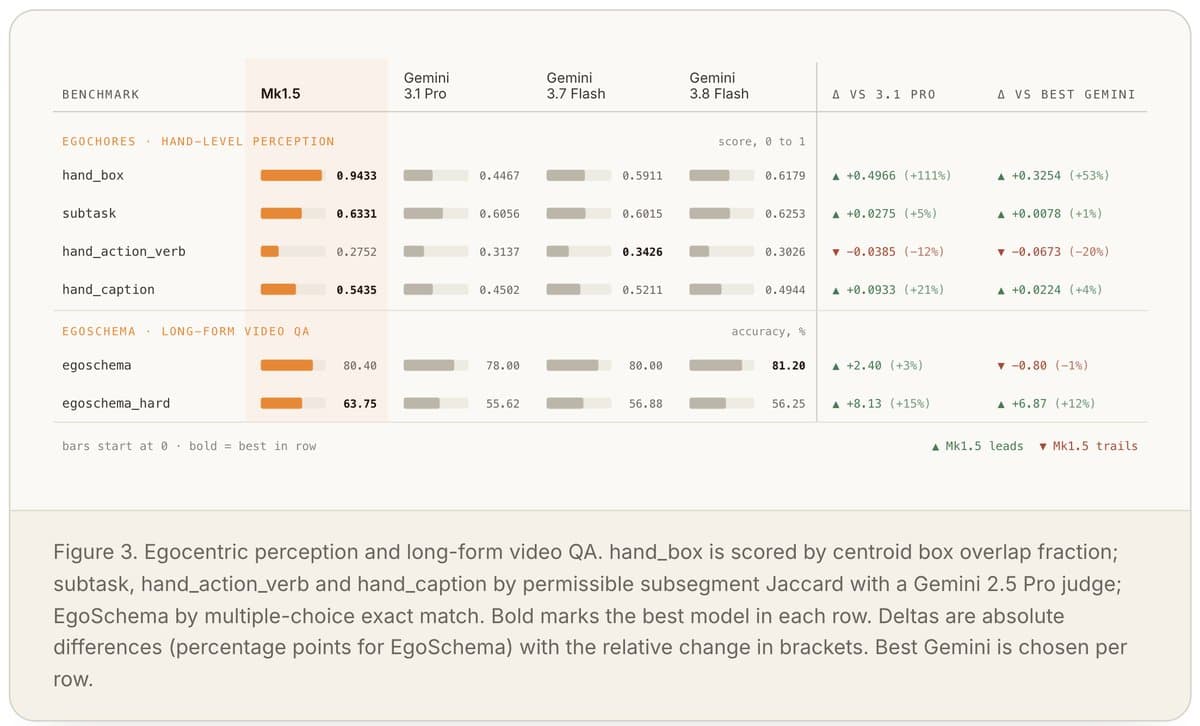
- EgoSchema hard split: Perceptron reports a 12% lead for long-horizon temporal reasoning.
- EgoChores, its internal household-task benchmark: it reports 50% better hand localization than the strongest Gemini model it tested, Gemini 3.8 Flash.
- Video object segmentation: it reports leading Molmo2-Track, Ref-DAVIS17, and ReasonVOS, three of four measured benchmarks.
Audio and structured output
Audio is new as a first-class modality, according to ArmenAgha’s launch post. Perceptron says its native audio encoder can estimate proximity to a sound source without visual cues in the audio demonstration.
The model accepts text, images, video, and audio, then can return text alongside points, boxes, polygons, tracks, and clips. The API also supports graded reasoning, function calls, and JSON Schema structured output, as documented in OpenRouter’s model page.
Tool calls and sub-agents
Perceptron supports arbitrary functions declared in OpenAI-style JSON Schema, with the model deciding which tool to invoke and when. Its demo environment supplies web search, page reads, zoom, and reverse-image search.
MMSearch contains 300 manually collected multimodal-search instances across 14 fields. rohanpaul_ai’s breakdown puts Perceptron’s tool-enabled MMSearch result at 54.3 F1, up from 18.2 without tools, a 36.1-point vendor-reported gain.
Latency and API access
Perceptron’s launch chart reports up to 4.7x faster end-to-end completion than Mk1, measured from request to final token as a median of three runs on one H100. A configurable reasoning mode is intended to trade more computation for accuracy, while the reasoning update says time to first token and completion time remain low.
Mk1.5 is available through Perceptron’s platform and SDK, according to the availability post, under the model ID perceptron-mk1.5. OpenRouter’s pricing post lists $0.15 per million input tokens and $1.50 per million output tokens, matching the company’s published price.
Context-window figures conflict across public surfaces: the official announcement lists 32K, OpenRouter’s page lists 37K, and OpenRouter’s launch post said 36K. The official announcement leaves parameter count unstated; rohanpaul_ai’s breakdown calls Mk1.5 a 35B model.