
Perplexity releases Decider v1.3 with Locate text-span extraction
Perplexity released open weights for Decider v1.3 and its Flash variant. The new Locate feature returns matching text with character offsets for tasks such as PII detection, and Flash can run locally.
TL;DR
- Perplexity released Decider v1.3 and Decider Flash v1.3, with a free week on OpenRouter in the release announcement.
- Locate extracts instruction-matched text with character offsets for NER, PII detection and extractive QA, as the feature announcement describes.
- Production classification reached 91.6% mean accuracy across 63 tasks, beating existing classifiers by 6.54 percentage points in Perplexity's evaluation.
- Flash supports local deployment, according to the self-hosting follow-up.
The Flash model card buries a sharp gotcha: fast=True disables Locate. A developer's benchmark postmortem includes an equally blunt finding: choosing the longest answer beat every evaluated model on the HLE slice of the Artificial Analysis Decision Index.
Models and pricing
Decider v1.3 uses a Qwen3.8-27B backbone; Flash distills it into Qwen3.5-4B. Both support text and image classification, produce probabilities over answer options, and ship under Apache 2.0.
The Decisions API charges $0.02 per million input tokens for Decider and $0.01 for Flash, with no output-token charge. Flash's cheaper rate carries a billing multiplier: it evaluates questions separately and bills the shared state once per question.
The documented local Flash runtime requires Python 3.12+, CUDA, and room for about 8.5 GiB of BF16 weights plus working memory.
Locate
A Locate question describes what to extract using either a short label or a full instruction. Results contain verbatim text, Unicode-character offsets start and end, and a score; end is exclusive, and no matches produces an empty spans list.
Under the hood, a <|locate|> token and span head score span starts, ends and start-end pairings. The token also predicts field-specific thresholds, according to the implementation notes.
Locate limits
The Locate API contract specifies:
- Text only:
statemust be a string. Images, objects and arrays are rejected. - 128 questions maximum: the cap covers all questions in a request containing Locate.
- No web grounding: grounded Locate requests return HTTP 400.
- Limited long-input evaluation: Locate was trained on inputs up to 8K tokens and evaluated up to 32K. Longer inputs are accepted, but extraction quality there is unmeasured.
Locate retains a separate adapter because merging it into the backbone degraded ordinary decisions. The local runtime executes mixed Locate and decision requests in separate forward passes, adding latency even when they arrive in one API-shaped request.
Question isolation
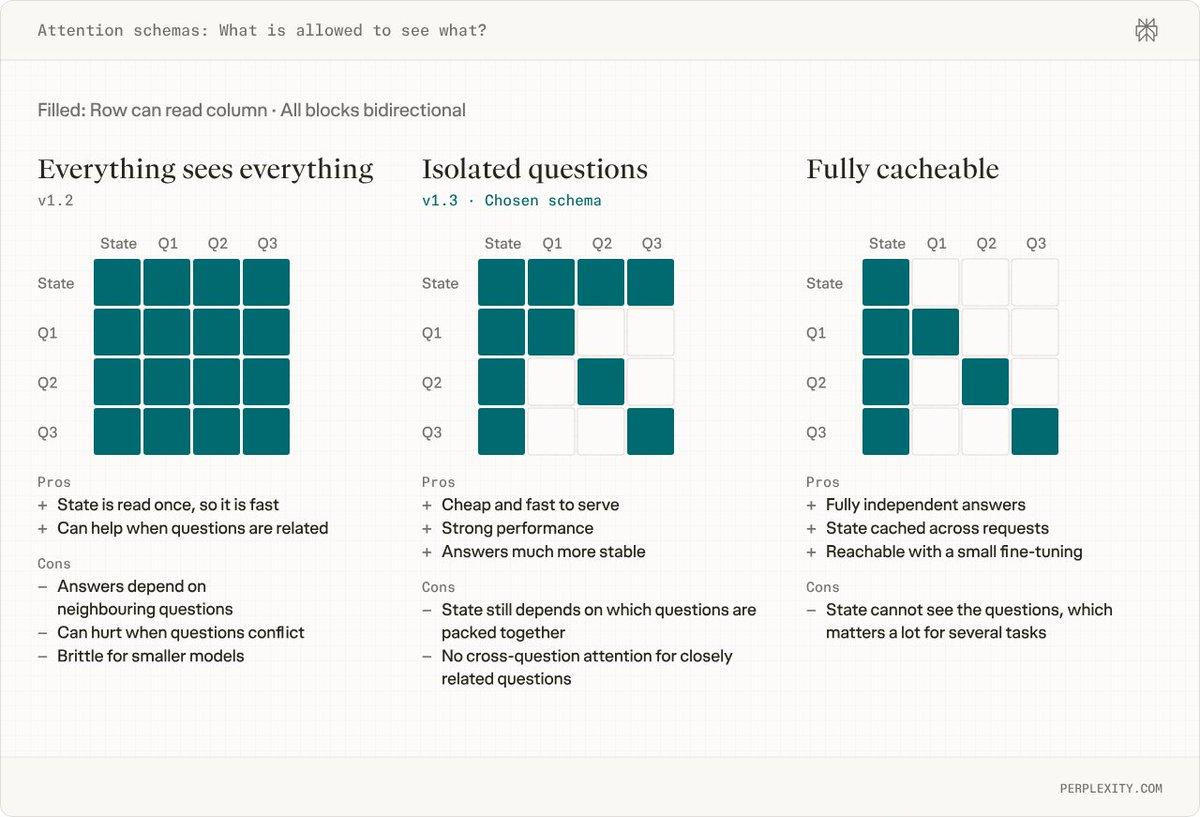
Batch companions could change answers under v1.2, Decider developer antoine_chaffin reported. Perplexity's architecture write-up compares three attention patterns:
- v1.2, everything sees everything: the state and every question attend bidirectionally to one another.
- v1.3, isolated questions: each question sees the state and itself. The state still sees all questions, leaving an indirect route for interference.
- Fully cacheable: the state sees only itself and becomes reusable across requests. This is not the default because question-conditioned state processing improves several tasks.
Flash's local runtime defaults to mode="separate", giving each decision question its own sequence. Optional mode="isolated" reads the state once, but its top answers differed from separate mode on 1.5–2.2% of the model-card sample.
Three-stage training
Both sizes follow the same three-stage recipe:
- Generalist fine-tuning: update the full model using broadly helpful data, excluding benchmark training splits.
- Domain specialization: train LoRA adapters, then merge with a weight chosen to favor held-out performance over narrow in-domain gains.
- Vision specialization: use another weighted LoRA merge, prioritizing text performance when vision improvements introduce a trade-off.
The larger model learns with cross-entropy. Flash minimizes KL divergence against the teacher's answer distributions, improving held-out performance while sacrificing some in-domain benchmark points, according to the distillation account.
For each text stage, the team averages weights from three random-seed runs to improve robustness.
Production evaluations
Perplexity's zero-shot evaluation suite reports several different kinds of result:
- 63 production classification tasks: Decider reaches 91.6% mean accuracy, 6.54 points above the existing classifiers. References were independently relabeled by a frontier LLM.
- One million API requests: agreement with frontier LLM judges rises from 93.68% for v1.2 to 93.98% for v1.3, +0.30 points. The sample contains 2,318,887 questions from opted-in, PII-masked requests.
- 17 out-of-domain extraction tasks: Decider averages 69.0 and Flash 63.6, versus 43.3 for Liquid d1. That aggregate mixes each task's primary metric: exact-span F1, character-level F1 or field accuracy.
- 72 retrieval tasks: Decider reaches 83.99 mean nDCG@10, 1.81 points above Qwen3-Reranker-8B, using pointwise relevance scoring.
Agent security and RL monitoring
Perplexity's internal deployment report describes an offline security pass over one billion tokens from 7,000 agent sessions in a day. It produced 14 proposed rule fixes; six were approved and shipped within two days.
Replaying the fixes over a week of logs reduced the busiest rule's alert volume by 52%.
RL-rollout monitoring is already another internal use. In an internal usage report, Decider delivered more reliable results than smaller API models such as Luna or Haiku at lower cost.
Five benchmark shortcuts
Five failure modes surfaced during training and evaluation, according to antoine_chaffin's account:
- Numeric-answer position: generated distractors often surround the correct numeric value. Some high-scoring models deteriorated when the correct answer was an extreme.
- Benchmark memorization: replacing MMLU-Pro answer options with distractors from other questions hurt some models despite making the problems easier, suggesting familiarity with exact option sets.
- Answer length: apparent Habermas gains came from selecting the longest answer. The team accepted lower benchmark scores to remove that bias.
- Phishing shortcuts: a free-hosting link nearly determined the PhishNChips label. Learning that shortcut degraded results on other phishing datasets.
- Option position: long answer lists favored the first option. Training with offset letters failed to fix the problem and was dropped.
Threshold calibration
Changing only the operating point substantially changed apparent model quality:
- iSarcasmEval: Flash and Decider had nearly identical AUCs, 94.4 and 94.7, but Flash trailed by 5.5 accuracy points at the default cutoff. After fitting the operating point, the gap shrank to 0.7 points.
- 32 Decision Index benchmarks: fitting the operating point on a development half raised test accuracy by about two points on average, without changing ranking or AUC. Some internal production tasks gained around five points.