
Perplexity launches Portable Computer on DGX Spark with a 27B model
Perplexity’s Portable Computer runs its orchestrator, subagents, and harness locally on NVIDIA DGX Spark with a post-trained 27B model. Frontier-model escalation requires user approval and flags PII before text is sent externally.
TL;DR
- Perplexity’s Portable Computer runs the orchestrator, subagents, and agent harness on an NVIDIA DGX Spark, with no cloud dependency for normal operation: Perplexity’s launch post describes the local runtime, while WesRoth’s launch summary confirms the plan and hardware boundary.
- The local model is a post-trained PPLX 27B built on Qwen 3.8 27B, with Qwen 3.8 27B available directly and Nemotron 3.5 Lightning promised next: AravSrinivas’s model post explains the co-design.
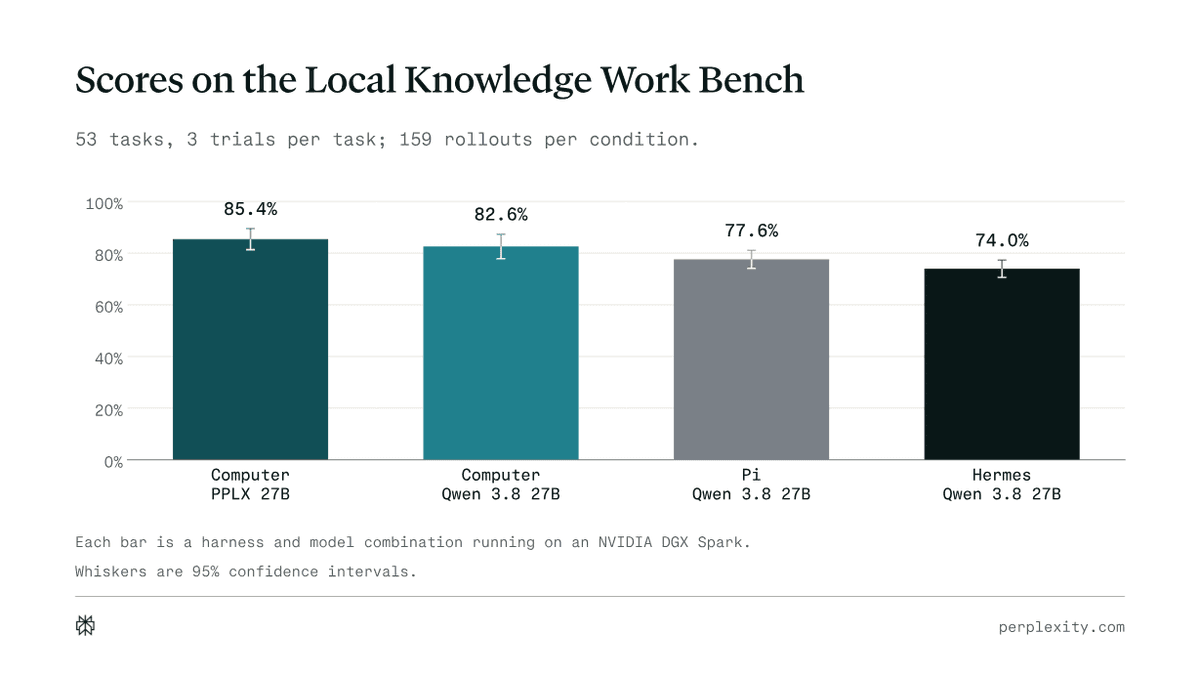
- Perplexity’s harness scored 82.6% on its Local Knowledge Work Bench with Qwen 3.8 27B, versus 77.6% for Pi and 74.0% for Hermes; PPLX 27B reached 85.4%: Perplexity’s benchmark post supplies the comparison.
- Cloud escalation lifts Terminal Bench 2.1 from 59.6% to 73.0% at an estimated $0.415 per rollout, compared with 82.4% for Claude Opus 5 alone at $0.65: AravSrinivas’s escalation result gives the cost-performance split.
- “Portable” currently means a dedicated local AI machine. Perplexity’s launch hardware is a 128 GB unified-memory DGX Spark, with RTX GPU PCs next; AravSrinivas’s NVIDIA post frames the hardware partnership and theo’s hardware critique calls out the roughly $5,000 appliance requirement.
The launch post names a durable task queue and local search index among the components that stay on device. The research post says Qwen 3.8 27B has a 260K context window but begins to struggle beyond 100K, while the product page puts more than 15 frontier models behind the approval gate.
Local runtime
Portable Computer is Perplexity Computer repackaged as a local-first runtime. The model, harness, conversation, and trajectory live on the user’s machine, alongside the orchestrator, planner, tool router, scheduler, durable task queue, and local search index.
The local path covers file analysis, document synthesis, code and shell actions, and long-running jobs. Work handled by local models does not consume Perplexity credits, according to the official launch description.
The system still reaches outward for web search, connected apps, or stronger reasoning. Those calls are opt-in rather than part of the default execution path, and the local run retains its state when the external result returns.
The architecture was described from both sides of the launch: AravSrinivas’s research link points to the technical note, while AravSrinivas’s launch link points to the product announcement.
Harness co-design
Perplexity tuned the harness around the constraints of a 27B model instead of giving a small model the full tool surface and context assumptions of a frontier agent.
The design choices are concrete:
- A minimal system prompt and small core-tool set keep the effective context manageable; skills load on demand and stale context can be compacted.
- Gmail, GitHub, Outlook, and Google Calendar connectors are exposed as compact command-line tools rather than large MCP definitions.
- The orchestrator is deterministic code that assembles context, enforces policy, and executes tools; the local model proposes the next action.
- Self-verification can be requested by the model or triggered by trajectory-health hooks.
- Tool calls run inside an OS-level sandbox. If sandboxing is unavailable, the harness disables tool use instead of falling back to the user’s unsandboxed permissions.
The co-design is also reflected in the model roadmap. AravSrinivas’s model post says post-training lets the orchestrator decide when to escalate, while AravSrinivas’s benchmark note attributes the local results to the harness-model pairing.
Escalation gate
Local inference handles the routine path, but difficult tasks can invoke a remote advisor. The boundary is explicit: the local model requests help, the harness selects context, and the user approves what crosses the device boundary.
Perplexity says the request is PII-flagged and text-guidance only. The remote advisor has no direct access to local files or tools, and the local orchestrator remains the authority that executes the returned advice, according to the technical research post.
The product supports web search, connectors, and more than 15 cloud models through the same gate. The Portable Computer product page illustrates a GitHub-to-Slack workflow where the local run prepares the work and only the outbound step leaves the machine.
On Terminal Bench 2.1, Perplexity’s local Qwen 3.8 27B baseline scored 59.6%. Advisor escalation raised it to 73.0% at $0.415 per rollout, while Claude Opus 5 running the same harness scored 82.4% at $0.65 per rollout, per AravSrinivas’s escalation result.
Benchmarks
Perplexity compared Computer with the open-source Pi and Hermes harnesses using the same Qwen 3.8 27B model on a DGX Spark for the harness comparisons.
- Local Knowledge Work Bench: 82.6% for Computer with Qwen 3.8 27B, 77.6% for Pi, 74.0% for Hermes, and 85.4% for Computer with PPLX 27B across 53 tasks and three trials per task.
- BrowseComp: 66.7% for Computer, 50.2% for Pi, and 43.9% for Hermes across 1,266 tasks. Computer averaged 402.1 seconds and 852K tokens per task, versus 826.0 seconds and 2.82 million tokens for Pi.
- ParseBench-100: 65.1% for Computer, 34.6% for Hermes, and 13.9% for Pi. Computer averaged 60.6 seconds and 20.1K tokens per task, compared with 410.5 seconds and 829.1K tokens for Pi.
The benchmark story has an important boundary. Perplexity’s Computer used its own search infrastructure on BrowseComp, while Pi and Hermes used Brave, so the result measures a harness plus search stack, not only the model. The same research says Computer led all five ParseBench categories, but layout was difficult for every harness.
PPLX 27B’s base model also had external momentum before this launch: kimmonismus’s Arena post placed Qwen 3.8 27B at number nine in Code Arena’s WebDev ranking, near models with substantially larger parameter counts.
Hardware boundary
The first release is available to Pro and Max subscribers with an NVIDIA DGX Spark. Perplexity’s launch post describes the Spark as a Grace Blackwell GB10 system with a 20-core Arm CPU, NVIDIA GPU, and 128 GB of unified memory; Linux ships first and Windows is planned next.
Perplexity says RTX GPU PCs are coming, but the official launch post does not give a consumer GPU minimum. The New Stack reported an Ubuntu ARM or x64 path with an NVIDIA RTX card carrying at least 24 GB of VRAM, and priced a DGX Spark at $4,800 in its launch coverage.
That makes “local” technically accurate but materially narrower than laptop-local. theo’s hardware critique described the DGX Spark as a roughly $5,000 dedicated AI supercomputer without traditional software support, and theo’s follow-up asked what “on device” means for a normal computer.
The hardware roadmap is expanding alongside the software. Srinivas said an early demo led Jensen Huang to provide a DGX Station, which he described as capable of serving frontier models, in AravSrinivas’s DGX Station post. A separate “Built for machines” post from pierrecomputer’s post captures the wider hardware-first mood, while Portable Computer’s current shipping target remains NVIDIA’s DGX Spark.