
Unsloth releases Studio: local training UI for 500+ models with 70% less VRAM
Unsloth Studio launched as an open-source web UI to run, fine-tune, compare, and export local models, with file-to-dataset workflows and sandboxed code execution. Try it if you want to move prototype training and evaluation off cloud notebooks and onto local or rented boxes.
TL;DR
- Unsloth has launched Studio as an open-source web UI for running, training, comparing, and exporting local models on Mac, Windows, and Linux, with support for GGUF plus vision, audio, and embedding models according to the launch thread.
- The main implementation claim is efficiency: Unsloth says Studio can train "500+ models" at "2x faster" speed with "70% less VRAM," a positioning repeated in both the announcement and an early walkthrough.
- Studio also adds a built-in data prep path: Unsloth's data thread says PDFs, CSVs, DOCX, TXT, and other files can be turned into structured synthetic datasets through a visual graph workflow powered by NVIDIA DataDesigner.
- On the inference side, Unsloth's tool-use post says models can run Python and bash in a sandbox for calculation, file generation, and answer verification, while the launch post also highlights side-by-side model comparison and export back out to GGUF.
What shipped in Studio
Studio packages several pieces of the existing Unsloth stack into one local web app. In the launch thread, Unsloth describes it as a UI to "train and run LLMs" locally, search and compare models side by side, and export results to GGUF; the linked Studio docs add that exports are meant to interoperate with runtimes such as llama.cpp, vLLM, Ollama, and LM Studio.
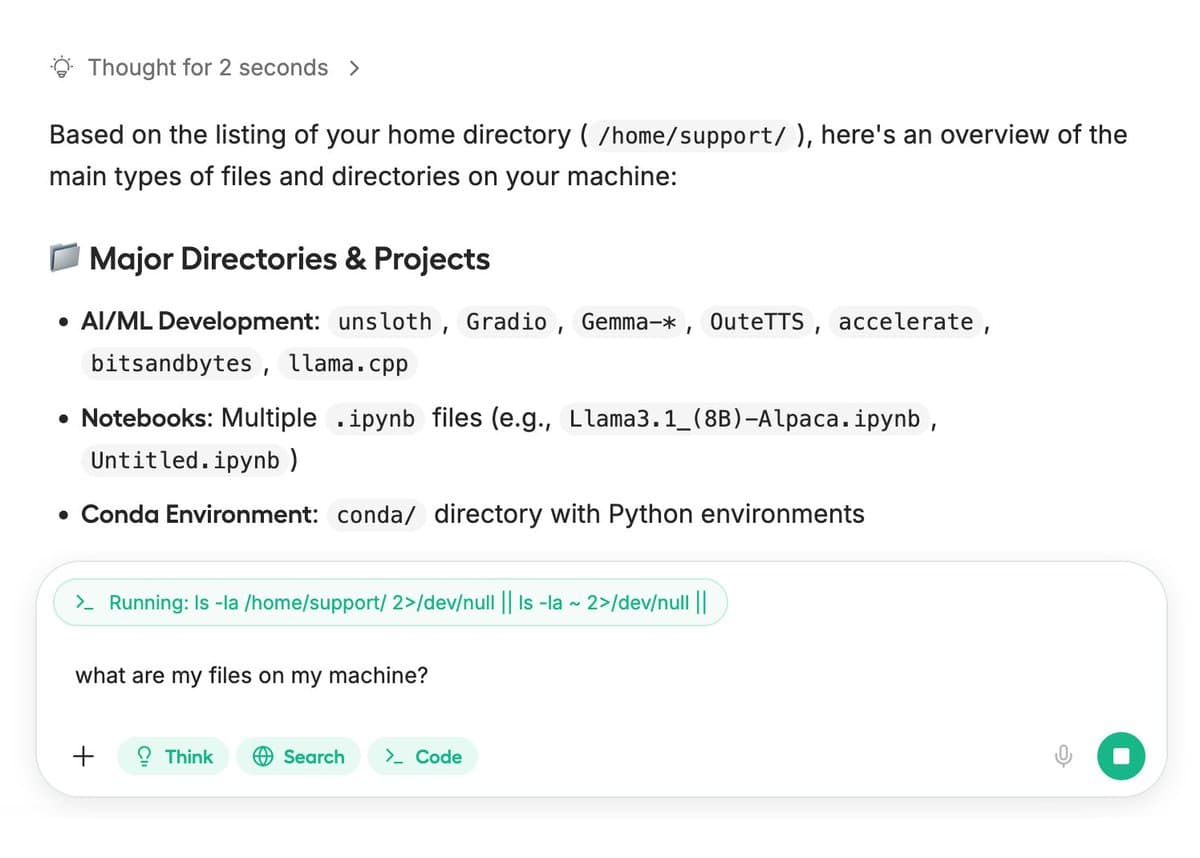
The scope is broader than a chat frontend. Unsloth's GitHub page says Studio handles inference, fine-tuning, pretraining, live training monitoring, and multiple model formats including GGUF, safetensors, and LoRA adapters. A practitioner screenshot from Matthew Berman's post shows the beta chat surface already exposing prompts for coding, math, SVG generation, and model playground use.
How the data and training workflow is changing
The most practical workflow change is that dataset prep is now part of the UI. In Unsloth's data thread, the company says users can transform "PDFs, CSV, DOCX, TXT or any file" into structured synthetic datasets, then edit them in a visual graph-node workflow before fine-tuning. The documentation ties that flow to NVIDIA DataDesigner and says users can also start from uploaded documents or YAML configs.
Unsloth is also framing Studio as a way to move small-team fine-tuning off cloud notebooks and onto local or rented hardware. The launch materials in the main announcement and a third-party walkthrough repeat the same core claim: training for 500-plus models with optimized kernels and memory reuse, delivering faster runs without a stated accuracy tradeoff.
What changes in local inference and eval
Unsloth is trying to make local inference more agentic, not just cheaper. In its feature post, the company says models can execute code in a sandbox so they can "calculate, analyze data, test code, generate files, or verify an answer with actual computation," which it argues makes outputs more reliable.
That feature sits alongside self-healing tool calling and side-by-side model comparison from the launch thread, giving Studio a built-in loop for trying a model, checking tool behavior, and exporting the one that works. The product pitch from an early reaction video post captures the developer-facing angle: one local app for running, training, comparing, and exporting hundreds of models with lower VRAM overhead.