
Vercel Emulate adds programmatic API for creating, resetting, and closing local emulators
Vercel Emulate added a programmatic API for creating, resetting, and closing local GitHub, Vercel, and Google emulators inside automated tests. That makes deterministic integration tests easier to wire into CI and agent loops without manual setup.
TL;DR
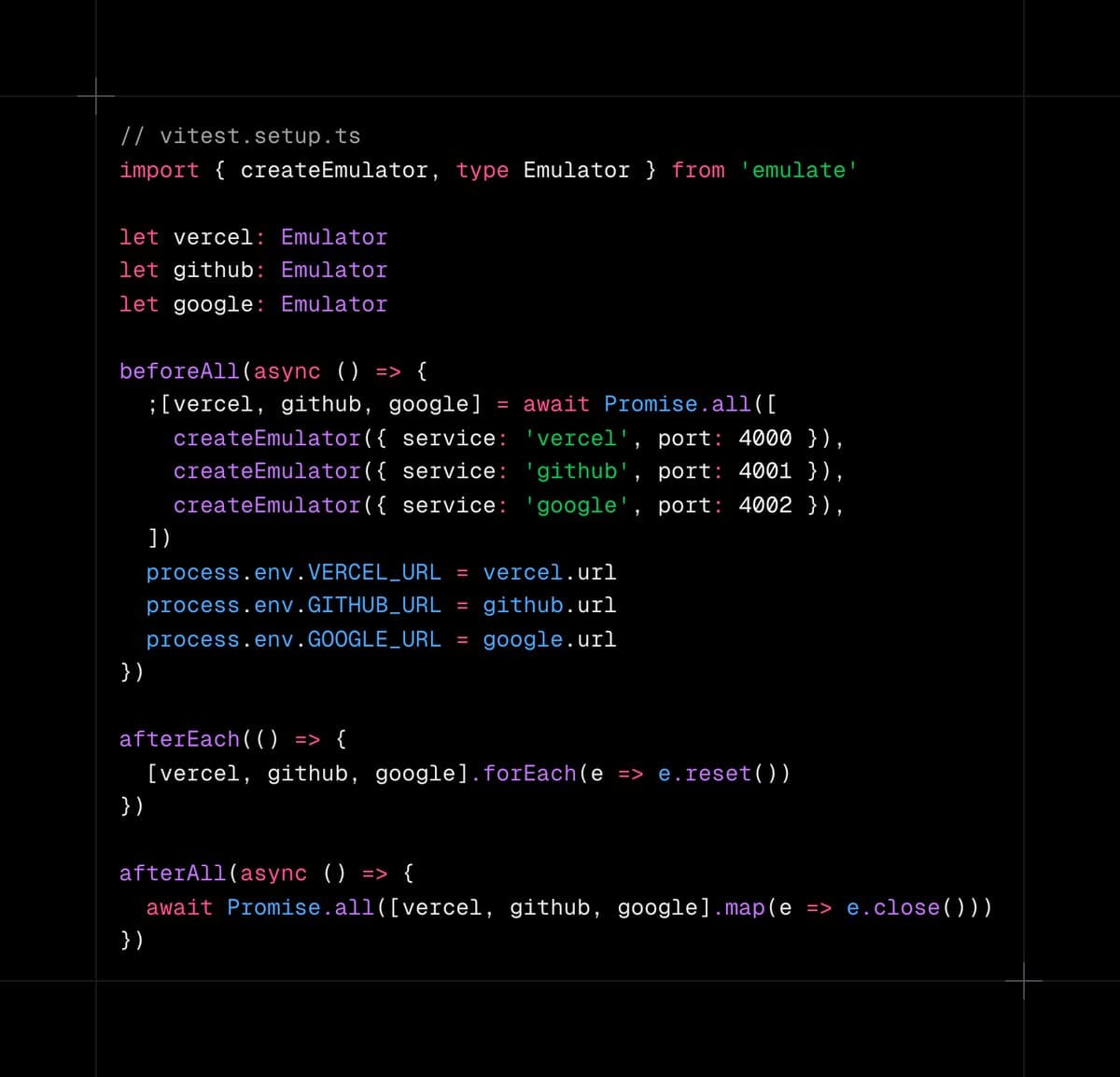
- Vercel Emulate added a programmatic API for automated tests, with the launch post describing a flow to create a local emulator, set an env var or pass it to an SDK, then reset data and close the service when the test is done.
- The initial targets are GitHub, Vercel, and Google, and the repo overview frames Emulate as a local, stateful substitute for external APIs rather than a thin mock.
- That shifts Emulate from manual local setup toward CI-friendly test orchestration, where the thread positions it for “automated test suites + local emulators” and a follow-up post says determinism matters for agents and CI.
- The linked GitHub repo also says the tool supports zero-config startup, seed data, and service resets, which makes reproducible integration tests easier to wire into no-network or sandboxed environments repo overview.
What shipped
The new API adds lifecycle controls around Emulate inside test code: create an emulator for Vercel, GitHub, or Google; inject it through environment variables or directly through an SDK; then reset and close it as part of the suite. In the announcement, that sequence is the entire pitch for using Emulate in automated tests.
According to the repo overview, Emulate is meant to be “fully stateful” and “production-fidelity,” which is a stronger claim than a fixture-based mock server. The same source says developers can start all supported services with zero configuration, control individual services programmatically, and load custom YAML or JSON seed data for users, orgs, projects, tokens, and OAuth clients.
Why this matters for CI and agent loops
The practical change is that external-service test dependencies can now be managed as part of the suite itself instead of as preconfigured infrastructure. In the follow-up, Emulate is described as making integrations “easy to test, stable to run, and predictable” anywhere determinism matters, including agents and CI.
That matters because emulator lifecycle hooks reduce leftover state between runs. The repo documentation says services can be reset or closed programmatically, which is the kind of control needed for parallel test runs, repeatable failures, and hermetic CI. A separate supporting comparison also points to broader demand for faster, more controllable CI execution beyond stock GitHub Actions, though Emulate addresses the integration-dependency side rather than runner performance itself.