
AgenticSeek guide ships local agent stack with Ollama, SearXNG, and Docker
Hasantoxr documents AgenticSeek with Ollama, SearXNG, and Docker, including install steps, model config, and a locked WORK_DIR. The stack keeps models, chats, and files on the user's machine.
TL;DR
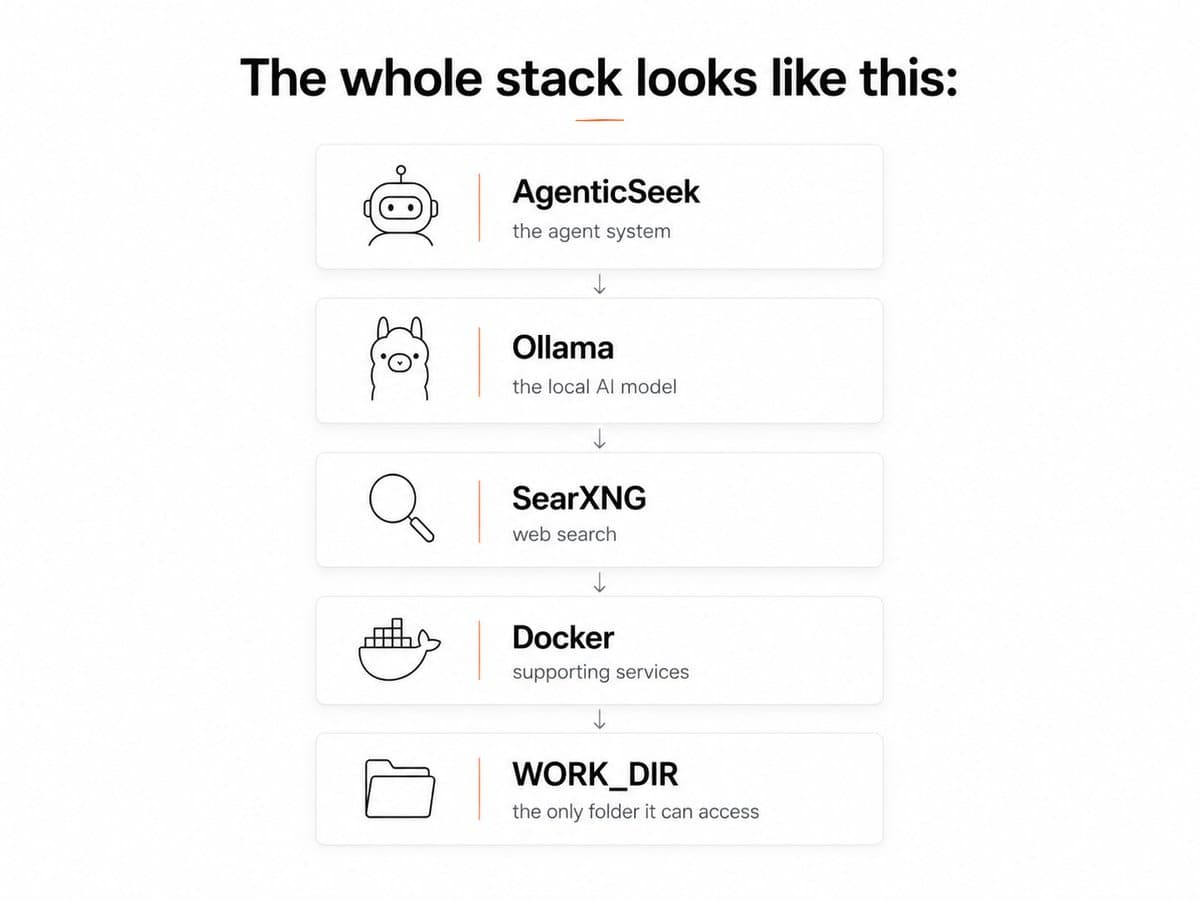
- The local stack is five pieces: AgenticSeek, Ollama, SearXNG, Docker, and a locked WORK_DIR, according to hasantoxr's stack list.
- The model setup centers on
deepseek-r1:14bthrough Ollama, while the model step says AgenticSeek can also use LM Studio and OpenAI-compatible servers. - The file boundary is explicit: the workspace step sets WORK_DIR to a dedicated folder instead of the user's whole home directory.
- The sample workflows are artifact-driven: one prompt saves a research report as Markdown, and another prompt asks the coding agent to build, run, debug, and save a Python app.
- Local still touches the internet when browsing: hasantoxr's privacy caveat says web research contacts search engines and websites.
The thread points readers to the AgenticSeek repo, then wires it to Ollama, SearXNG, and Docker. The concrete move is the WORK_DIR fence: the agent gets one folder, not the whole machine. The oddest line is the privacy caveat, because the local model can keep chats and working files on-device while its searches still leave the box.
Local agent stack
Hasantoxr framed the setup as an "AI employee" that can browse websites, write code, and complete tasks without an API key or a $200 subscription.
The stack in the guide is small enough to copy into a notebook:
- AgenticSeek: agent system
- Ollama: local model runner
- SearXNG: web search
- Docker: supporting services
- WORK_DIR: the only folder the agent can access
The useful part is the boundary. The agent has web search, code execution, and file writes, but the file system scope is a named workspace.
14B local brain
The prerequisite step lists Git, Python 3.10.x, Docker Desktop, Ollama, and enough RAM or VRAM for a capable model. The thread says the official guide recommends hardware that can run a 14B reasoning model.
The model command is specific:
AgenticSeek is not locked to that one path. The same model step says it also supports local models through LM Studio and OpenAI-compatible servers, with the selected model controlling speed, reasoning quality, and memory requirements.
Config files and locked workspace
The setup starts with a clone and environment file:
The workspace step creates a dedicated folder and points .env at it:
Hasantoxr's thread is blunt about the scope: do not give the autonomous agent access to the whole home directory.
The model config then flips AgenticSeek into local mode:
The guide leaves cloud API keys empty. It also warns not to paste comments into config.ini, a tiny gotcha that usually only appears after someone has broken the config parser once.
Local services and browser UI
The services step starts Ollama on all interfaces, launches the bundled services, then opens the app at localhost:3000.
The command sequence in the thread is:
Then a second terminal runs the project services before the browser UI comes up. This is the part where the stack stops being a repo and turns into a local agent workspace.
Artifact tasks
The two sample tasks both end with a saved artifact, which is the right shape for testing a local agent.
- Research task: compare five open-source social media schedulers by features, pricing, licenses, and GitHub activity, then save
social-tools.mdinside the workspace. - Coding task: build a Python expense tracker with a simple web interface, run it, inspect errors, fix them, and save the working project inside the workspace.
Hasantoxr says the coding agent can write code, execute it, debug failures, and retry. The report task adds browsing and synthesis, so the pair covers the two creator workflows people actually test first: research into a file, and code into a working folder.
Local privacy boundary
The ownership claim is local model, local files, local memory, local workspace, and local rules. The final post also links the repo through the thread's Repo: line.
The privacy boundary is narrower than the slogan. Hasantoxr's caveat says the AI model, conversations, and working files can stay on the machine, but web research still contacts search engines and websites.
"Local AI" in this guide means the intelligence runs locally. The browsing trail still exists wherever the agent sends requests.