
Claude Fable 5 builds award-style websites in 12-minute creator tutorial
Fable 5 demos moved into landing pages, brand tools, launch-video editing, and scriptwriting with Higgsfield MCP. The pattern matters because design direction is becoming promptable, but creators still need structured prompts and tool chaining to finish work.
TL;DR
- Creator demos around Claude Fable 5 snapped to concrete production work fast, especially landing pages, promo sites, visual tools, and launch-video editing, as MengTo's landing-page demo, 0xCharlota's brand-tool prototype, and trq212's editing deck post showed within a day of launch.
- The website pattern was not just “one prompt and done.” In replies to MengTo's demo, MengTo said Fable still drifts toward generic gradients without design context, works best with long requirement-heavy prompts, and usually takes 5 to 30 minutes of iteration loops MengTo on design context MengTo on prompt density MengTo on iteration time.
- Video was the clearest workflow leap: according to trq212's deck link and trq212's Claude Code reply, Fable wrote code and tool calls for transcription, ffmpeg edits, color grading, Figma MCP, Remotion UI, and rendering, with no traditional video editor in the loop.
- Prompt libraries and tool bridges are already forming around the model. viktoroddy's tutorial linked to a website prompt pack, while Higgsfield's scriptwriting comparison and Higgsfield's fruit-slicing demo pushed Fable through Higgsfield MCP for scripts, assets, and interactive builds.
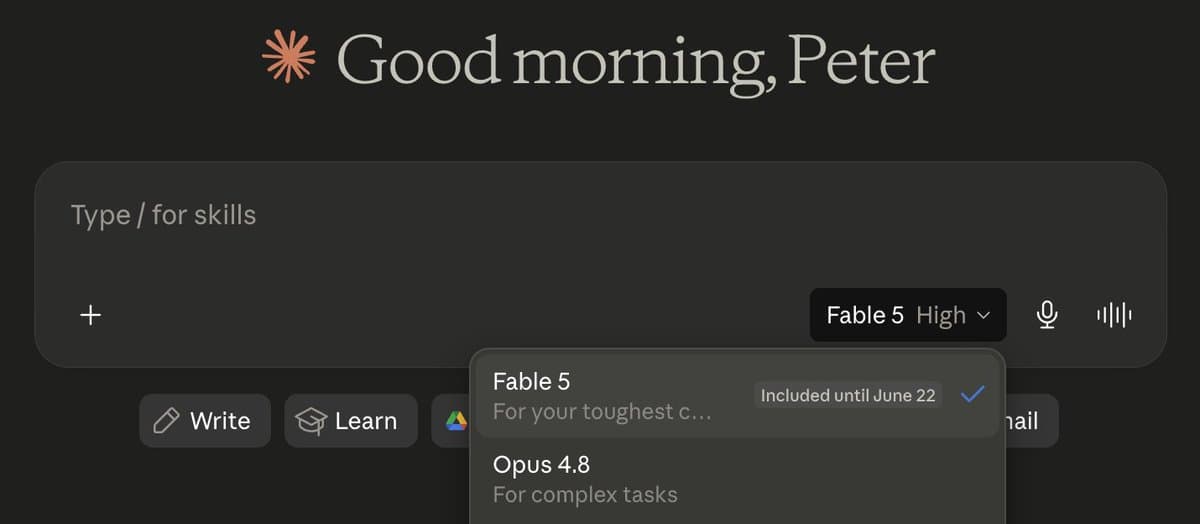
- The catch is cost and setup. trq212's cost breakdown put one video workflow at about $100 in Fable usage plus about $10 for transcription and cutting, while ClaudeDevs' access note said some users needed the
/model claude-fable-5slug and Claude Code 2.1.170 to get in.
You can read Anthropic's launch post, skim the API docs on Fable 5 and Mythos 5, browse trq212's full video-editing deck, and poke through viktoroddy's MotionSites prompt library. The weirdest detail came from the launch-video workflow: Fable was not just storyboarding the cut, it was calling transcription services, building JSON edit decisions, grading footage, and generating Remotion UI in code trq212's deck link.
Landing pages
The first creator wave was web work. MengTo's landing-page demo framed Fable 5 as a landing-page machine, and viktoroddy's 12-minute tutorial turned that into a repeatable “animated award-style website” recipe.
The useful detail sat in the replies. According to MengTo on design context, Fable still defaults to “purple gradients” when the brief is vague. According to MengTo on prompt density, the value shows up when the prompt carries heavy context and constraints.
That makes the website demos look less like magic and more like a new prompt format for creative direction:
- strong design constraints, per MengTo on design context
- a long “super prompt” with requirements, per MengTo on prompt density
- copywriting skills layered in, per MengTo on copywriting skills
- 5 to 30 minutes of prompt loops, per MengTo on iteration time
- reusable prompt packs like MotionSites, linked from viktoroddy's prompt-pack post
Every's weeklong vibe check described the same ceiling in broader terms: advanced users got paradigm-shifting results on hard tasks, while less AI-native users struggled to find the right grip on it.
Brand tools
The next tier up from landing pages was small internal tooling for design direction. 0xCharlota's visual-tool prototype showed a throwaway app that exported looping brand visuals with controls for color, grain, and direction, built in about five prompts.
What matters in that example is the deliverable. The output was not a polished campaign asset, it was a brand-direction instrument. Charlota said it gave a “massive head start” on identity exploration 0xCharlota's visual-tool prototype, which is a different job than asking a model for a finished logo or homepage.
That same pattern appears in Fable's own creator chatter. According to danshipper on ambition, the model rewards ambitious prompting, and according to Dan Shipper's vibe check thread, teams at Every used it for coding, writing, marketing, and editing, but called it best suited to power users and heavy jobs.
Video editing in Claude Code
The strongest evidence in the whole batch came from Anthropic engineer trq212, who said Fable edited its own launch video by writing code and tool calls for transcription services, ffmpeg, color grading, Figma MCP, Remotion UI, and rendering, without touching a video editor trq212's deck link trq212's Claude Code reply.
The linked deck, How Fable Edited Its Own Video, turns that into a concrete pipeline:
- 17 takes across 4 scenes
- one kickoff prompt against a folder of recordings and a script file
- transcription first
- best-shot selection into a JSON edit plan
- ffmpeg stitching and scene assembly
- color work on Sony S-Log3 footage
- Figma MCP for design assets and review
- Remotion for code-based motion UI
- final 4K, 24 fps render
Two follow-ups made the economics clearer. According to trq212 on deck timing, the deck itself took about an hour to generate from transcripts and the screen recording took about 10 minutes. According to trq212's cost breakdown, the workflow cost about $100 in Fable usage, with most of that spent on UI iteration, plus about $10 for transcription and cutting.
There was one visible miss, too. In trq212 on launch-video quality, trq212 said his team thought the result was only “okay,” and that a tighter color-grading flow plus staying more in the loop might have improved it.
Higgsfield MCP
Fable's other creative lane ran through Higgsfield. Higgsfield's scriptwriting comparison claimed Fable 5 beat Opus 4.8 at scriptwriting inside Higgsfield MCP, while Higgsfield's fruit-slicing demo showed the pair building a webcam-controlled fruit-slicing game from a single prompt.
That pairing matters because Higgsfield already has production-facing surfaces outside Claude chat. Its DaVinci Resolve plugin, announced the day before, bundles AI video and image generation, reframing, background removal, upscaling, draw-to-edit controls, and natural-language shot generation inside Resolve. The MCP demos suggest Fable is getting used as the planning and scripting brain on top of those media tools.
The evidence pool split that into two jobs:
- scriptwriting and cinematic prompt direction, per Higgsfield's scriptwriting comparison
- asset and interaction generation, per Higgsfield's fruit-slicing demo
The creator examples clustered around fast prototypes
The broadest community threads converged on the same thing: Fable's first 24 hours were full of websites, games, visual toys, and world-builders, not polished end products. techhalla's 11-example roundup and minchoi's 10-example roundup both read like prototype inventories.
Across those threads, the recurring formats were:
- animated websites and landing pages, via techhalla's roundup and MayorKingAI's website-design example
- browser games, via Higgsfield's fruit-slicing demo, minchoi's Minecraft example, and om_patel5's zombies-clone post
- 3D worlds and city sims, via minchoi's roundup and MayorKingAI's 10-example thread
- one-off internal tools, via 0xCharlota's visual-tool prototype
- video recreation and remix workflows, via AmirMushich's promo-video recreation thread and AmirMushich on mp4-to-video experiments
That cluster makes the “creative” story pretty concrete. Fable did not arrive first as a better text box. It arrived as a code-first production layer for assets, scenes, sites, and rough cuts.
Access and limits
Anthropic's own docs filled in the operational details the demos skipped. The company says in its launch post that Fable 5 is the public, safeguarded version of Mythos 5, and that some cyber, bio, and chemistry requests get auto-rerouted to Claude Opus 4.8, with safeguards triggering in under 5% of sessions. The API docs say Fable 5 has a 1M token context window by default and adaptive thinking is always on in this model family, with effort controlling depth instead of a separate thinking toggle in the model docs.
The setup details mattered on day one:
- use
/model claude-fable-5in Claude Code, per ClaudeDevs' getting-started thread - upgrade Claude Code to 2.1.170 if access is missing, per ClaudeDevs' access note
- expect slower responses because thinking is always on, per ClaudeDevs on always-on thinking
- expect simpler prompts to work better than older over-scaffolded ones, per ClaudeDevs on simpler prompting
- expect some sensitive requests to reroute to Opus 4.8, per ClaudeDevs on rerouting
That last point helps explain why the most convincing creative demos all lived inside tool-rich environments like Claude Code, Figma MCP, Remotion, Higgsfield MCP, and DaVinci, where the model could spend tokens turning a brief into files, edits, and runnable artifacts instead of just describing them.