
Codex App Server adds Fedora RPM support for Linux installs
Codex App Server added a Fedora RPM package for Linux installs as users pushed Codex into browser control, 3D-print setup, and rapid game prototypes. Watch for more repeatable desktop workflows as Codex moves beyond chat-only experiments.
TL;DR
- LLMJunky's Linux demo LLMJunky's Linux install post points to the codex-app repository, and a follow-up from LLMJunky's RPM note says the project now ships a Fedora RPM package.
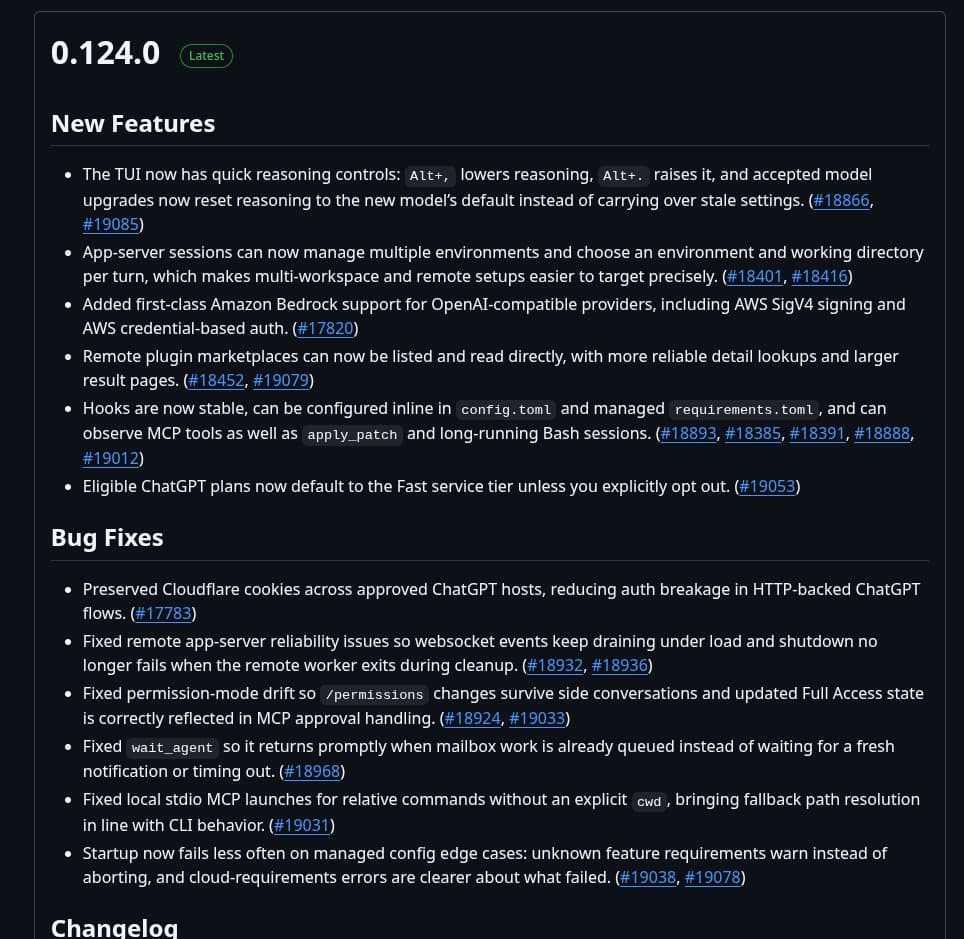
- The bigger Codex backdrop is LLMJunky's 0.124.0 update roundup, which ties GPT-5.5 access, stable Hooks, fast service defaults for business and enterprise plans, and in-TUI plugin marketplace rendering to OpenAI's rust-v0.124.0 release.
- People are already treating Codex like a desktop operator, not just a code chat, according to thekitze's 3D print run and CharaspowerAI's mini-game test.
- Small interaction details are starting to matter too, because LLMJunky's link-handling tip shows Codex now splits single-click external browsing from Ctrl+click internal browsing.
You can grab the Linux app wrapper, inspect OpenAI's latest Codex release notes, and the interesting part is how fast the workflows are getting weird: thekitze had Codex find an email, locate an STL, set print options, and start a 3D print, while CharaspowerAI's first GPT-5.5 test claims a small game came together in under two minutes.
Fedora RPM
The headline here is simple: the Linux Codex App wrapper moved one step closer to feeling native.
The main post says the latest app server was updated for Linux, and LLMJunky's GitHub link post sends users to the community codex-app repository. A follow-up from LLMJunky's RPM note adds the concrete distro-level change, a Fedora RPM package.
That matters mostly because Linux support keeps turning Codex from a Mac-first curiosity into a tool people can actually slot into their existing machine setup. Fedora packaging is not glamorous, but it is the kind of detail that decides whether a workflow gets tried once or kept around.
The 0.124.0 release
The RPM note landed in the middle of a much broader Codex update cycle.
According to LLMJunky's release summary, version 0.124.0 brought five notable changes:
- GPT-5.5 support
- Alt+, and Alt+. shortcuts for lowering or raising reasoning level
- Hooks promoted to stable release
- apply_patch monitoring for EDIT and WRITE matchers
- Remote custom marketplaces rendered directly under /plugins in the TUI
The same thread links to OpenAI's rust-v0.124.0 release notes. Separately, LLMJunky's Hooks post frames the apply_patch change as the unlock, because deterministic scripts can now run whenever Codex edits files.
Desktop workflows
The creative angle is less about packaging than about what people are already doing once Codex can drive more of the machine around it.
Thekitze's post says Codex handled an entire 3D-print prep chain: it found the purchase email, located the STL, loaded the file, set print settings, and started the print. CharaspowerAI's first GPT-5.5 test claims Codex built a playable mini game in under two minutes.
Those are very different tasks, but they point in the same direction. Codex looks more interesting when the output is a finished action on the desktop, or a runnable artifact, not just a code diff in a panel.
Link handling
One small UI detail rounds out the picture.
LLMJunky shows a split browser behavior inside Codex: single-click opens links in an external browser, while Ctrl+click opens them in an internal browser. That is a tiny feature on paper, but it fits the same trend as the Linux packaging and desktop-control demos. Codex is accumulating the boring interface decisions that make an agent feel like an everyday app.