
Kling AI launches 4K Short Film contest with $25,000 prize pool
Kling paired its native 4K rollout with a global short-film contest and partner availability across tools like OpenArt and Zopia. Try the updated model for sharper skin, fabric, logos, and color transitions, but clips still max out at 15 seconds.
TL;DR
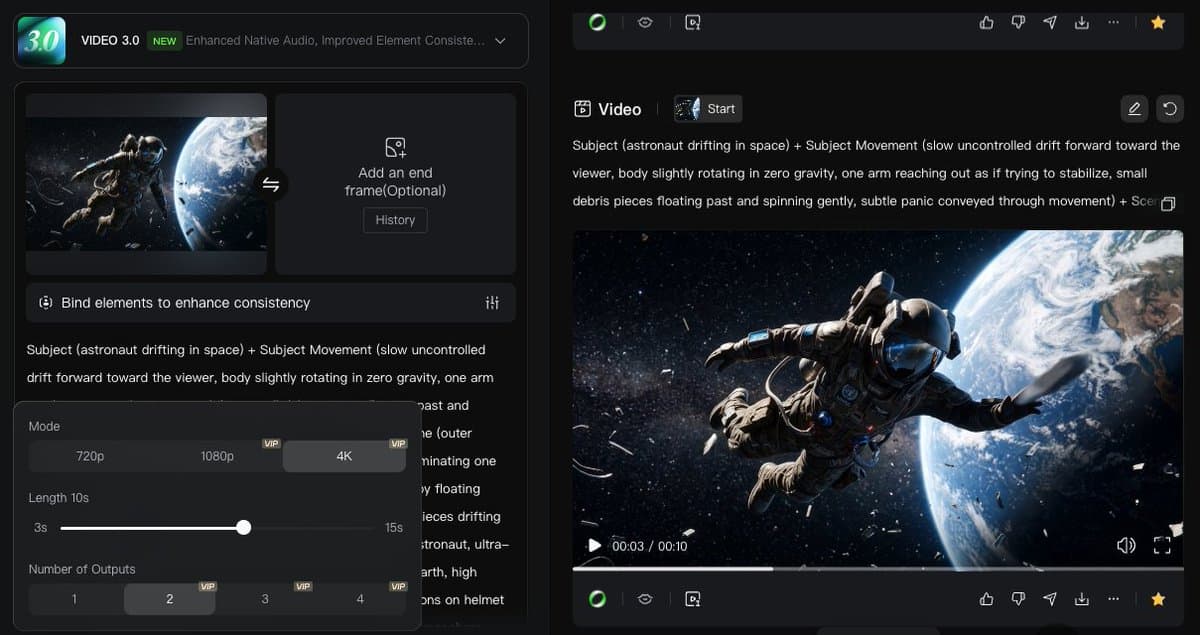
- Kling_ai's April 23 launch post said 4K mode is live in the Video 3.0 series, with one-click generation, stronger subject and text consistency, and a temporary discount of up to 20 percent for subscribers and team plans through May 7.
- Partner rollouts followed fast: freepik's launch post listed text-to-video, image-to-video, and reference editing at true 4K for 3 to 15 second clips, while AIwithSynthia's repost of OpenArt framed Kling 3.0 as the first AI video model with native 4K output.
- In hands-on tests, egeberkina's detail breakdown highlighted skin texture, hair, fabric, and logos as the first places the upgrade shows up, and egeberkina's color tests called out richer tones and steadier lighting transitions.
- Kling paired the rollout with collaboration updates: Kling_ai's Team Plan post added asset and credit transfers into managed workspaces, with team credits starting at $0.59 per 100 until May 7, while egeberkina's workflow post showed shared workspaces and reusable asset libraries.
- The creative hook is a global contest: Kling_ai's contest announcement put up a $25,000 cash pool plus 700,000 credits, and Kling_ai's contest link post points to the official submission page with entries open through May 24.
You can browse the contest page, jump straight into the Freepik 4K surface, and read Simon Meyer's longer LinkedIn write-up that Kling linked as creator context. The odd little constraint is that the headline feature is ultra-HD output, but CharaspowerAI's quick how-to says the in-product 4K flow still tops out at 15 seconds. Kling also turned the launch into distribution, with freepik's rollout post live on day one and a string of partner reposts across SeaArt, Glam, Fotor, Runware, Clipfly, and SocialSight.
Native 4K
Kling's main claim is simple: native 4K inside the model, not a post-pass upscale. Kling_ai's launch thread pitched it as part of Video 3.0, and Kling_ai's demo clip reduced the message to "Blurry in. 4K out."
The feature list that matters most came from freepik's rollout post:
- text-to-video
- image-to-video
- reference editing
- true 4K output
- 3 to 15 second clip length
- positioning for ads, film, TV, and livestreams
That 3 to 15 second range is the first real caveat. The model is clearly being pitched at production visuals, but the current shot length is still short-form.
Detail tests
The most useful practitioner notes came from egeberkina's thread, which broke the visual gains into failure points creators already know too well:
- skin texture holds up
- hair and fabric break less often
- logos and text stay cleaner
- close-ups preserve pores, facial hair, and small reflections
- colors look richer with less shot-to-shot shifting
- lighting transitions read as more natural
egeberkina's detail breakdown and egeberkina's close-up tests focused on macro detail, while egeberkina's color tests argued the bigger change is temporal consistency, not just sharper frames. Uncanny_Harry's realism clip pushed the same point from another angle, framing the new output as an "AI or real" threshold test.
Partner rollout
Kling did not keep 4K locked to its own app. The evidence pool shows the model landing across partner surfaces almost immediately.
A quick map from the rollout posts:
- Freepik: freepik's rollout post advertised Kling 3.0 at native 4K with text-to-video, image-to-video, and reference editing.
- OpenArt: AIwithSynthia's repost of OpenArt called it the first AI model with native 4K video and "production-ready visuals from a single model."
- Zopia: Kling_ai's Zopia repost announced Kling 4K mode live on Zopia.
- fal: Kling_ai's fal repost said native 4K is live for enterprise-grade video.
- SeaArt, Glam, Fotor, Runware, Clipfly, SocialSight: Kling_ai's SeaArt repost, Kling_ai's Glam repost, Kling_ai's Fotor repost, Kling_ai's Runware repost, Kling_ai's Clipfly repost, and Kling_ai's SocialSight repost extended the same message across creator platforms.
The partner pattern matters because it turns 4K into a distribution story, not just a feature drop. Kling is treating native 4K like infrastructure other tools can wrap immediately.
Team Plan 2.0
The collaboration update shipped in the same window, and it is more concrete than most "team" AI launches.
According to Kling_ai's Team Plan post, Team Plan now includes:
- transfer of personal assets into team workspaces you manage
- transfer of credits into those workspaces
- team credits starting at $0.59 per 100 until May 7
- asset management and privacy framing for commercial use
[egeberkina's workflow post](src:7|egeberkina's workflow post) added the practical layer:
- shared workspace
- no file sending
- handoff from one teammate to another
- shared asset library
- reuse of shots and styles across ongoing projects
That sits neatly with the 4K pitch. Higher-resolution output is one part of a production workflow, but reusable shots and shared style libraries are what make an agency or in-house content team move faster.
4K Short Film contest
Kling used the rollout to seed examples. Kling_ai's contest announcement opened a global 4K short film competition with a $25,000 prize pool, 700,000 Kling credits, and an in-person screening at Seoul Film Center for winners.
The contest details in Kling_ai's contest images and the official activity page fill in the actual rules:
- launch date: April 23, 2026
- submissions: April 23 to May 24
- judging: May 25 to June 16
- winner announcement: June 17
- duration: more than 45 seconds
- theme: open
- required usage: entries must be primarily created with Kling's native 4K feature
- required ending: submissions must include the official contest end screen
The prize structure is unusually specific for an AI video launch campaign:
- Gold, 1 winner: $10,000 plus 200,000 credits
- Silver, 3 winners: $5,000 each plus 100,000 credits each
- Bronze, 10 winners: 20,000 credits each
The judging rubric is also a tell.
gives 40 percent of the score to AI technology application, explicitly naming clarity, detail rendering, realism, light and shadow, texture quality, and visual stability. Kling is not just asking for pretty films. It is asking creators to prove the 4K claim on screen.