
Ozan Sihay releases 7-minute AI short film with Seedance 2.0 and Kling 3.0
Turkish creator Ozan Sihay released a seven-minute one-person AI short film built with Seedance 2.0, Kling 3.0, Nano Banana 2, Runway, HeyGen, Suno, and CapCut. The film matters because it turns Seedance’s weak face realism into a masked-character design rule and shows the planning graph behind the finished cut.
TL;DR
- Turkish creator Ozan Sihay released a seven-minute AI short film made as a one-person production, and his release thread framed it as a full project built from scratch with AI.
- The sharpest creative move came from a model limitation: Sihay's teaser and his launch post say Seedance 2.0 struggled with realistic human faces, so he redesigned the film around masked characters.
- Sihay's tool list spans Seedance 2.0, Kling 3.0, Nano Banana 2, Runway Workflows, Google AI Studio, HeyGen, Suno, Epidemic Sound, and CapCut, which turns the film into a compact map of the current solo-filmmaker stack.
- The official Seedance 2.0 launch post says the model supports text, image, audio, and video inputs, while Runway's Workflows page pitches node-based pipelines for chaining multi-step creative jobs.
You can watch the finished short via the YouTube release, skim Runway's intro to Workflows, and compare Sihay's comments about face realism with ByteDance's broader Seedance 2.0 product page. The funny part is that the production story is almost as useful as the film itself: a seven-minute comedy built from tool handoffs, regional Turkish voiceover, and a giant workflow canvas.
Masked characters
Sihay says the project started as testing, then turned into a short once two masked characters gave him a fight scene worth expanding. According to his release post, Seedance 2.0's weak face realism pushed him toward a knitted tiger mask and a rusty dog mask, and those props became the movie's visual identity instead of a workaround.
That is the real trick here. A model weakness usually leaks into the frame as an apology, but Sihay's description shows the limitation getting promoted into character design, plot logic, and tone.
One-person tool stack
Sihay's release thread breaks the film into a very specific pipeline:
- Seedance 2.0 for masked scenes
- Kling 3.0 for face-visible scenes
- Nano Banana 2 for character design
- Claude plus Nano Banana inside Runway Workflows for scene composition
- Google AI Studio for accented Turkish voiceover
- HeyGen for lip sync
- Suno plus Epidemic Sound for music
- CapCut for editing
The official Seedance 2.0 launch post says the model can mix text, image, audio, and video inputs in one generation flow. That makes Sihay's split especially telling: he still routed around faces with Kling, even while using Seedance for the masked action it could already handle.
The workflow graph
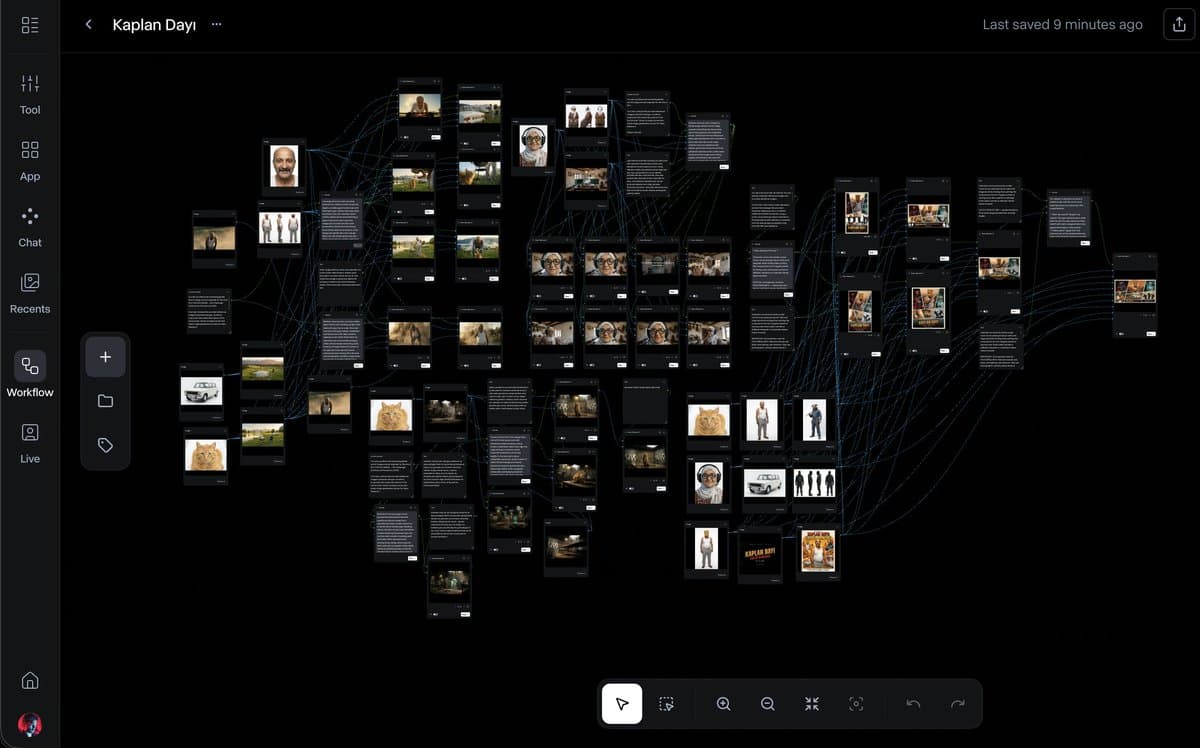
Sihay posted a screenshot of the Runway graph behind the film, and it is messy in the good way. The canvas shows a dense node network of images, prompts, and branches, which lines up with Runway's own description of Workflows as a node-based system for repeatable, multi-step media pipelines.
That screenshot adds one new fact the finished film cannot show: the solo workflow was not a single prompt plus cleanup. It was a large orchestration layer, with reusable nodes for characters, shots, and poster-style assets sitting behind a seven-minute cut.