
Edit Banana opens DrawIO exports from screenshots with SAM 3
Edit Banana can reconstruct screenshots into editable DrawIO files using SAM 3. Try it to save rebuild time on diagrams, flowcharts, and site comps pulled from references.
TL;DR
- Edit Banana turns screenshots of flowcharts, schematics, and similar diagrams into editable DrawIO XML, with creator-facing claims of SAM 3 shape segmentation, four-pass multimodal image parsing, and OCR that converts formulas to LaTeX, according to the launch thread.
- The project is pitched as a time-saver for anyone rebuilding reference material by hand; the same launch thread says exports are draggable and editable instead of flattened screenshots.
- A parallel “web to design” push is also surfacing: a reposted launch describes a tool that turns any website URL into an editable UI, suggesting a broader shift from static references to reusable design assets.
- That fits the wider agentic-design moment, where a linked walkthrough covers prompt-driven design tools that iterate layouts and export working web output, rather than stopping at mockups.
What shipped
Edit Banana’s core promise is simple: upload an image or PDF, get back an editable diagram file instead of redrawing it from scratch. In the announcement, Hasan Toor says the stack uses SAM 3 to segment shapes, arrows, and icons, then runs multimodal analysis in four passes so smaller elements are not missed.
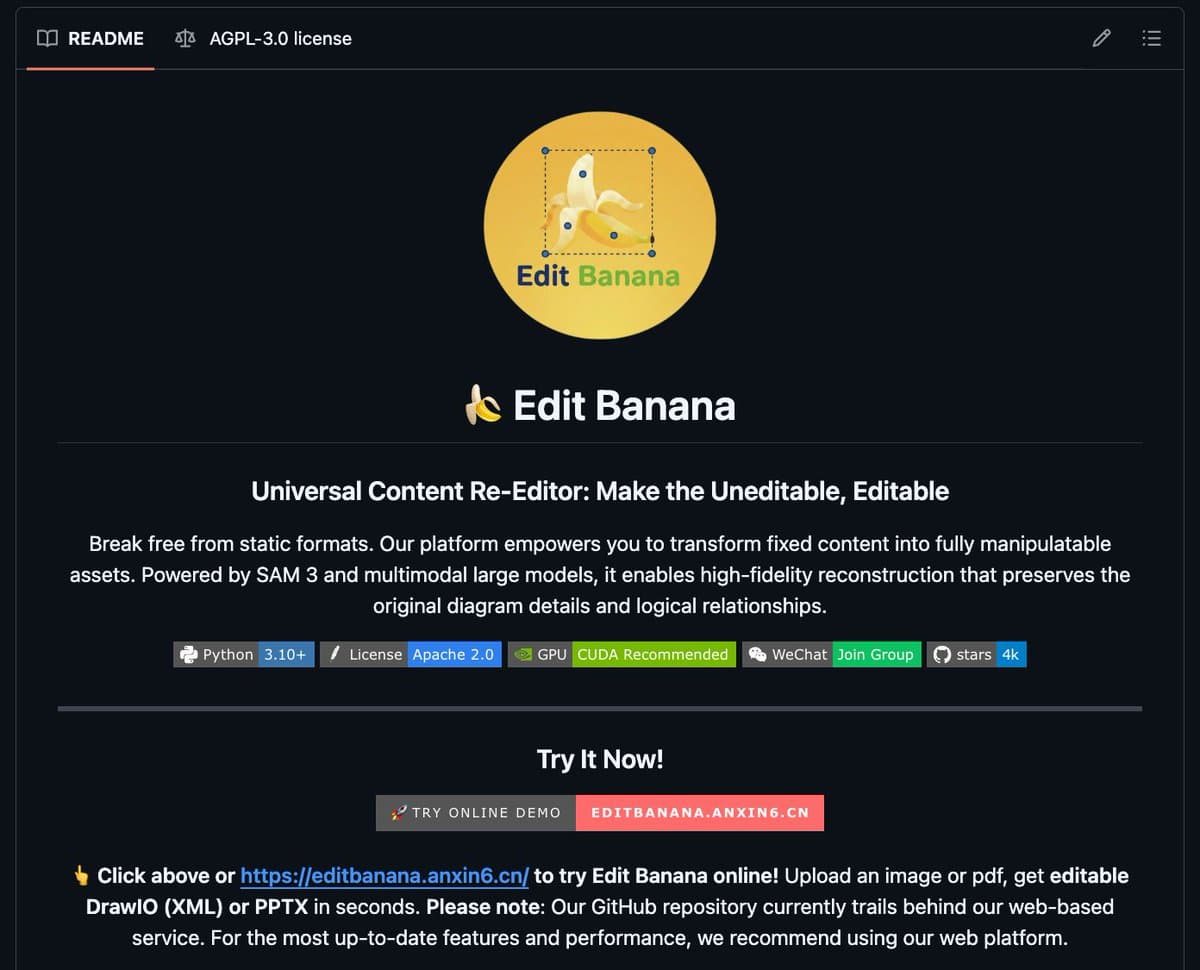
The output target matters for creative workflows. The same [img:0|README screenshot] shows a web demo positioned around DrawIO XML and PPTX export, with the repo published under Apache 2.0 and a live demo plus code repository linked from GitHub. That makes the tool more useful for moodboard pull-aparts, architecture diagrams, deck graphics, and UI references that need to become editable components again.
Where it fits in creative workflows
Edit Banana lands inside a bigger pattern: creators increasingly want source material they can manipulate, not screenshots they can only trace over. The reposted Web to Design post describes the same idea applied to websites — paste a URL, get an editable UI you can variant and extend.
That same “make static inputs reusable” logic shows up in adjacent production stacks. In this workflow thread, David Recap chains Firecrawl, Apify, Gemini 2.5 Pro, and Gamma to turn scraped brand sites and ad-library assets into a finished audit deck in about five minutes, while the design-tools video points to Paper and Pencil as prompt-based design environments that iterate layouts and export code. Edit Banana is narrower, but the creative value is similar: recover structure from references so the next step is editing, not rebuilding.