
Google releases Gemini 3.6 Flash, 3.5 Flash-Lite, and 3.5 Flash Cyber for cheaper agents
Google says Gemini 3.6 Flash, 3.5 Flash-Lite, and 3.5 Flash Cyber target faster, cheaper agent workloads. Early tests cite lower token use and stronger coding results.
TL;DR
- Google shipped three Flash-family models for agents, with Gemini 3.6 Flash and 3.5 Flash-Lite rolling into Gemini App and developer surfaces while Cyber stays tied to CodeMender, according to Google DeepMind's rollout note.
- 3.6 Flash is the efficiency play: OfficialLoganK's launch post described it as higher-intelligence, more token efficient, and lower priced, while Google DeepMind's quality note says it targets production-ready code, multimodal analysis, and report drafting.
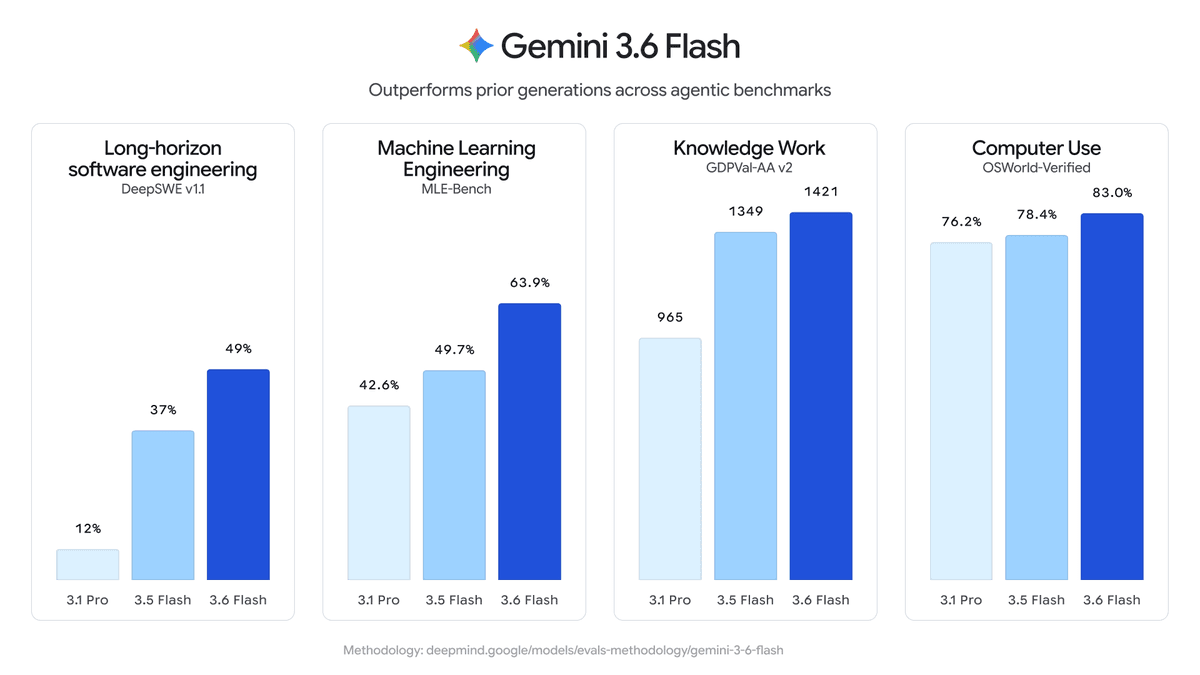
- Google's 3.6 Flash chart moves DeepSWE from 37% to 49%, MLE-Bench from 49.7% to 63.9%, GDPVal-AA v2 from 1349 to 1421, and OSWorld-Verified from 78.4% to 83.0%, as shown in OfficialLoganK's benchmark chart.
- Early creator tests centered on fast code loops and lower token use, from stevibe's Canvas comparison to LLMJunky's Rocket League test.
The official announcement buries two future-model notes: Gemini 3.5 Pro is still in testing with partners, and Gemini 4 pre-training has started. The developer guide gives the usable slugs, gemini-3.6-flash and gemini-3.5-flash-lite, plus default thinking levels. The Cyber post narrows the security model to governments and trusted partners first.
Three Flash models
Google framed the release as an agent scaling update, not a frontier-model replacement. The official announcement splits the lineup cleanly:
- Gemini 3.6 Flash: workhorse model for coding, knowledge work, and multimodal tasks, with 17% fewer output tokens than 3.5 Flash on the Artificial Analysis Index and API pricing at $1.50 per 1M input tokens and $7.50 per 1M output tokens.
- Gemini 3.5 Flash-Lite: fast, low-cost model for repetitive high-volume work like ticket sorting, data extraction, document processing, and agentic search, priced at $0.30 per 1M input tokens and $2.50 per 1M output tokens.
- Gemini 3.5 Flash Cyber: specialized cybersecurity model paired with CodeMender for finding, validating, and patching vulnerabilities.
Gemini 3.6 Flash and 3.5 Flash-Lite are rolling out in Gemini App, Google AI Studio, Android Studio, and developer workflows, while Google DeepMind's availability post says Flash Cyber will be available through CodeMender in a limited-access pilot.
3.6 Flash benchmarks
The 3.6 Flash chart is unusually agent-heavy. Google's evaluation methodology says Gemini scores are pass@1 unless noted, with single-attempt settings and no majority voting or parallel test-time compute.
Against 3.5 Flash, the chart shows:
- DeepSWE v1.1: 37% to 49%, +12 points.
- MLE-Bench: 49.7% to 63.9%, +14.2 points.
- GDPVal-AA v2: 1349 to 1421, +72 Elo.
- OSWorld-Verified: 78.4% to 83.0%, +4.6 points.
A broader table that OfficialLoganK shared in replies puts 3.6 Flash at 58.7% on SWE-Bench Pro, 78.0% on Terminal-bench 2.1, 89.4% on CharXiv with tools, and 54.0% on GDM-MRCR v2 at the 1M pointwise setting.
Artificial Analysis speed caveat
The independent read is flatter on raw intelligence and stronger on speed. The Artificial Analysis benchmark scored Gemini 3.6 Flash at 50 on its Intelligence Index, the same score as 3.5 Flash, while cutting time per task from 2.7 minutes to 1.3 minutes and measuring output speed around 304 tokens per second.
OfficialLoganK answered that framing directly: Google pushed 3.6 Flash toward agentic real-world tasks, while Artificial Analysis mostly covers reasoning benchmarks, according to his reply.
LLMJunky made the same price-performance point from the user side: his comparison reply says the larger models in the chart are 4 to 7 times more expensive, while 3.6 Flash is competitive for a Flash model.
3.5 Flash-Lite throughput
Flash-Lite is the latency model. OfficialLoganK's Flash-Lite note says it is Google's smallest and fastest Gemini model, and a follow-up put it at nearly 350 output tokens per second.
The Flash-Lite charts in Google DeepMind's post compare it against 3.1 Flash-Lite and 3 Flash:
- Terminal-bench 2.1: 31.0% to 54.0% versus 3.1 Flash-Lite, +23 points.
- GDPVal-AA v2: 642 to 1140 versus 3.1 Flash-Lite, +498 Elo.
- SWE-Bench Pro: 49.6% for 3 Flash to 54.2% for 3.5 Flash-Lite, +4.6 points.
- OSWorld-Verified: 65.1% for 3 Flash to 74.0% for 3.5 Flash-Lite, +8.9 points.
The fast-token pitch showed up in Google's own product framing: the rollout thread says Flash-Lite is moving into Gemini App, Google Search, Google AI Studio, and Android Studio.
Model IDs and tools
The developer guide lists both models as generally available and production-ready:
gemini-3.6-flash, default thinking levelmedium.gemini-3.5-flash-lite, default thinking levelminimal.- Both support a 1M-token context window and 64k max output tokens.
- Both support thinking and built-in tools, including Computer Use.
Google's 3.6 Flash API docs list text, image, video, audio, and PDF inputs with text output. The same page lists code execution, computer use in preview, file search, function calling, structured outputs, context caching, Batch API, flex inference, and priority inference.
The migration gotchas are practical: the developer guide says temperature, top_p, and top_k are deprecated sampling parameters, and prefilled model turns are no longer supported.
Creator tests
The most useful early creator signal was not a leaderboard. It was people throwing browser animation and game prompts at 3.6 Flash and getting fast, editable outputs.
stevibe's Canvas test compared 3.6 Flash with 3.5 Flash on four single-file HTML Canvas prompts, then posted the exact prompts:
- fireball falling into a glass water tank, with splash, steam, bubbles, and refraction.
- paper burning from one corner, with embers, ash, char, smoke, and disappearing consumed areas.
- cursive "hello" drawn as continuous strokes, with no fonts.
- first-person rainy windshield view, with wipers that clear drops inside the sweep arc.
LLMJunky's Rocket League test ranked 3.6 Flash third on his subjective leaderboard and finished in under two minutes. The workflow behind it was small: his follow-up says it took one big prompt, then two or three tweaks for boost animation, turning radius, ball mass, and car speed.
ozansihay's early-access demo used Gemini 3.6 Flash for a webcam-controlled browser game. The prompt asks for open-hand targeting, fist-to-catch interaction, fruit emojis as valid targets, non-fruit objects as failure states, retro-cyberpunk graphics, sound effects, and a small live camera view.
3.5 Flash Cyber
Flash Cyber is the controlled-access piece of the release. Google's Cyber announcement says the model is built on 3.5 Flash and fine-tuned to find, validate, and patch vulnerabilities more efficiently than mainline Flash models.
The access path is narrow at launch. The same Cyber announcement says 3.5 Flash Cyber is being deployed through a limited-access pilot for governments and trusted partners via CodeMender, with broader customer availability planned later through the Gemini Enterprise Agent Platform.
Batch API latency
Google also shipped agent-infra work right before the model rollout. OfficialLoganK said Gemini Batch API upgrades cut p95 latency by 80%, cut p99 latency by 68%, pushed batch success rate above 99.998%, reduced batch expirations by 98%, and added support for partial batches.
The thread links to the Batch API docs.