
Harbor releases v0.4.18 with Open Design and Voicebox
Harbor 0.4.18 added one-command access to Open Design and Voicebox, bundling a local-first design app and a voice cloning and TTS studio inside one homelab layer. The release cuts setup friction, so users can migrate both tools into a single local install path.
TL;DR
- Harbor v0.4.18 added one-command startup for Open Design and Voicebox, with
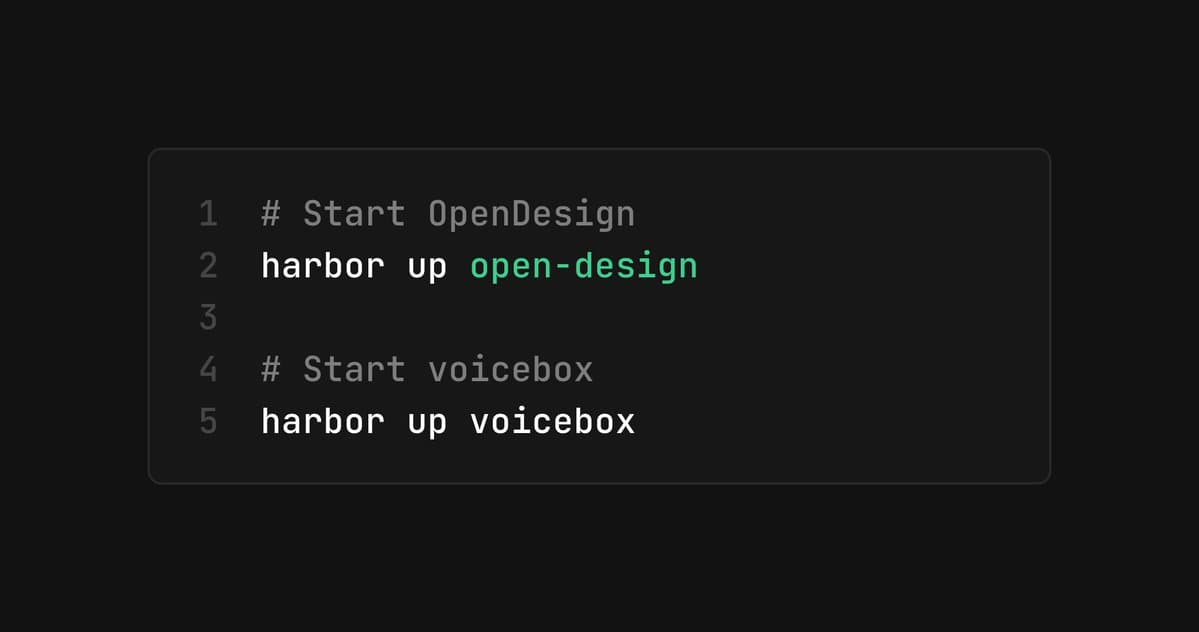
harbor up open-designandharbor up voiceboxshown directly in Everlier's release post. - According to Everlier's follow-up, Harbor is only the orchestration layer here, while the actual apps live in the separate OpenDesign repo, Voicebox repo, and Harbor's own services wiki.
- Everlier's Open Design screenshot pitches Open Design as a local-first Claude Design alternative with 71 design systems, 19 composable skills, and support for six coding agents.
- Everlier's Voicebox screenshot frames Voicebox as a GUI-heavy voice cloning and TTS studio, and the UI shown in the post already exposes model, language, import, and sample-generation controls.
You can jump from Harbor's announcement to the OpenDesign repo, the Voicebox repo, and Harbor's services catalog. The more interesting angle is that Harbor is bundling two very different creator workflows, UI generation and voice generation, behind the same local homelab entry point that Everlier's clarification says stays decoupled from the underlying OSS projects.
Harbor commands
The release's main convenience claim is setup compression. Everlier's command screenshot shows both services exposed as single Harbor commands, which turns two standalone installs into the same orchestration pattern.
That distinction matters because Harbor is not presenting these as native Harbor features. In Everlier's follow-up, the author explicitly says Open Design and Voicebox remain standalone OSS projects, with Harbor acting as the setup layer.
Open Design
Open Design is positioned as a local-first alternative to Claude Design. The screenshot inside Everlier's release post says it can use existing agents including Claude Code, Codex, Cursor, Gemini, OpenCode, and Qwen, and pairs them with 19 composable skills and 71 design systems.
That pitch lines up with the workflow people described around Claude Design in the main HN thread and the discussion summary: rapid layout exploration, comment-driven iteration, and handoff into coding tools. One HN commenter said a two-line prompt was enough to bolt on a backend, while another described exporting designs into Claude Code for implementation.
Voicebox
Voicebox looks like the more immediately polished half of the update. The UI shown in Everlier's release post includes voice import, voice creation, preset samples, language selection, model selection, and effects controls, all from one desktop-style interface.
Everlier described it in the launch post as a fully featured voice cloning and TTS studio, then compared the experience to "LM Studio of TTS." Harbor's addition gives that workflow the same one-command local install path as Open Design, but for audio instead of interface mockups.
Claude Design context
Discussion around Claude Design
Thread discussion highlights: - stopachka on backend integration: A 2-line prompt can give Claude Design a backend by fetching InstantDB credentials from an AGENTS.md URL; the commenter says they used it to build a multiplayer pelican game. - firasd on workflow friction: A commenter describes the tool as a bit fiddly but useful for exploring a UI in the sidebar, asking questions about existing HTML, and iterating on an interactive prototype. - florakel on spec-to-prototype: A PM says Claude Design was the missing piece for exploring layouts, adjusting details with comments, and exporting to Claude Code, reducing the need for a separate designer/dev for small projects.
The HN discussion adds one useful benchmark for what Open Design is trying to replace. According to the thread summary, users were already treating Claude Design as a fast mockup and prototype layer, but also called it fiddly, stronger for exploration than polished handoff, and most useful when paired with downstream coding tools.
That makes Harbor's v0.4.18 update feel less like a random services drop and more like a local creative stack: one path for interface generation, one path for synthetic voice, both exposed through the same homelab launcher.