
SenseNova U1 open-sources unified image-text generation with 2K images in ~15s
Posts report SenseTime open-sourced SenseNova U1, a unified text-image model with interleaved generation, 8-step distilled LoRA and ComfyUI workflows. They cite 2K image times around 15 seconds and H100 inference cuts to about 2 seconds, so compare it against your current image pipeline.
TL;DR
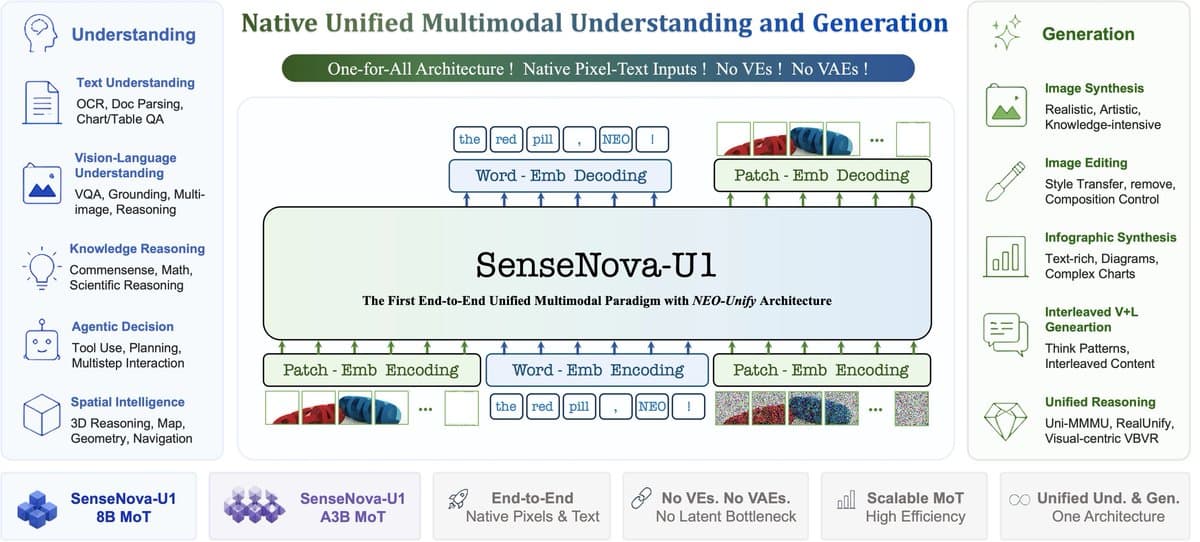
- SenseTime says hasantoxr's launch post open-sources SenseNova U1 as a unified image-text model, with hasantoxr's architecture summary describing a single representation space instead of a separate visual encoder plus language model stack.
- The clearest workflow shift in hasantoxr's interleaved demo is interleaved generation: the model can write a step, render the matching image, then continue the sequence in one run.
- Performance is the headline claim in hasantoxr's benchmark post, which says U1-8B-MoT makes a 2K image in about 15 seconds, while hasantoxr's deployment post adds an H100 inference cut from 23 seconds to 2 seconds after an 8-step distilled LoRA path.
- For tool builders, hasantoxr's deployment post says ComfyUI workflows ship on day one for text-to-image, editing, and interleaved generation, and hasantoxr's retweet shows the thread quickly escaping the original post.
You can open the technical report, browse the GitHub repo, and pull the models from the Hugging Face collection. The interesting part is not just that U1 is open, it is that the pitch centers on one stack for text and pixels, plus a ready-made ComfyUI path for people who actually want to poke at it today.
NEO-Unify
The core claim is architectural. SenseNova U1 is pitched as a multimodal model without the usual visual encoder, VAE, or adapter handoff, with hasantoxr's summary calling the design NEO-Unify and describing language and vision as fused at the foundation.
That matters mostly because it changes where image-text coherence is supposed to come from. Instead of translating between subsystems, U1 is presented as one model operating in one representation space.
Interleaved generation
The most concrete creator-facing example is a cooking tutorial in hasantoxr's interleaved demo, where the model alternates between written steps and matching images in a single flow.
The obvious use cases are already listed there:
- recipes
- tutorials
- comics
- storyboards
The interesting bit is consistency. hasantoxr's interleaved demo frames the output as one coherent visual style carried across the sequence, not a pile of disconnected generations.
Speed claims
The performance claims break into two layers:
- 2K image generation in about 15 seconds for SenseNova U1-8B-MoT, according to hasantoxr's benchmark post
- comparison figures above 70 seconds for GPT-Image-2.0, Seedream-5.0, and Qwen-Image-2512, also from hasantoxr's benchmark post
- a drop from 100 NFE to 8 NFE through an 8-step distilled LoRA path, according to hasantoxr's deployment post
- H100 inference cut from 23 seconds to 2 seconds, also in hasantoxr's deployment post
Those numbers are all sourced from the launch thread, so they read as launch claims rather than independent evals. Still, an 8B open model posting 2K image times in that range is the part image-tool people will keep.
ComfyUI workflows
The practical shipping list in hasantoxr's deployment post is short and useful:
- ComfyUI workflows for text-to-image
- ComfyUI workflows for image editing
- ComfyUI workflows for interleaved generation
- SenseNova U1-8B-MoT as the dense option
- SenseNova U1-A3B-MoT as a 38B-A3B MoE option
That last point is new relative to the headline. This is not one model drop, it is a small stack with two sizes, repo access, a report, and a ComfyUI on-ramp already attached.