
Seedance 2 supports CapCut 15s single-shot workflows in $4.50 tests
Creators shared CapCut access, time-travel and battle prompts, and agent-led 15-second tests built around Seedance 2. Several posts claimed usable concept runs at $4.50 to $4.60 before teams expand the ideas into longer series.
TL;DR
- CapCut's official rollout puts Seedance 2.0 inside an editing workflow, and creators immediately started treating it like a 15-second scene engine for battle shots, cartoon gags, and concept trailers ogre battle test cartoon bag gag.
- The strongest examples are not vague one-liners. They read like compressed shot lists, with lens choices, timing blocks, physics cues, and explicit bans on drift or costume changes time-travel prompt single-shot battle prompt.
- Several creators are also using Seedance 2 as a cheap idea filter, claiming usable tests at about $4.50 to $4.60 before expanding a concept into a longer piece or series history concept test future museum test.
- One emerging workflow is agent-led preproduction: a custom "pipeline agent" handles prompt structure, cinematography, storyboard logic, and scriptwriting, then hands Seedance 2 and companion tools the execution step pipeline agent format testing.
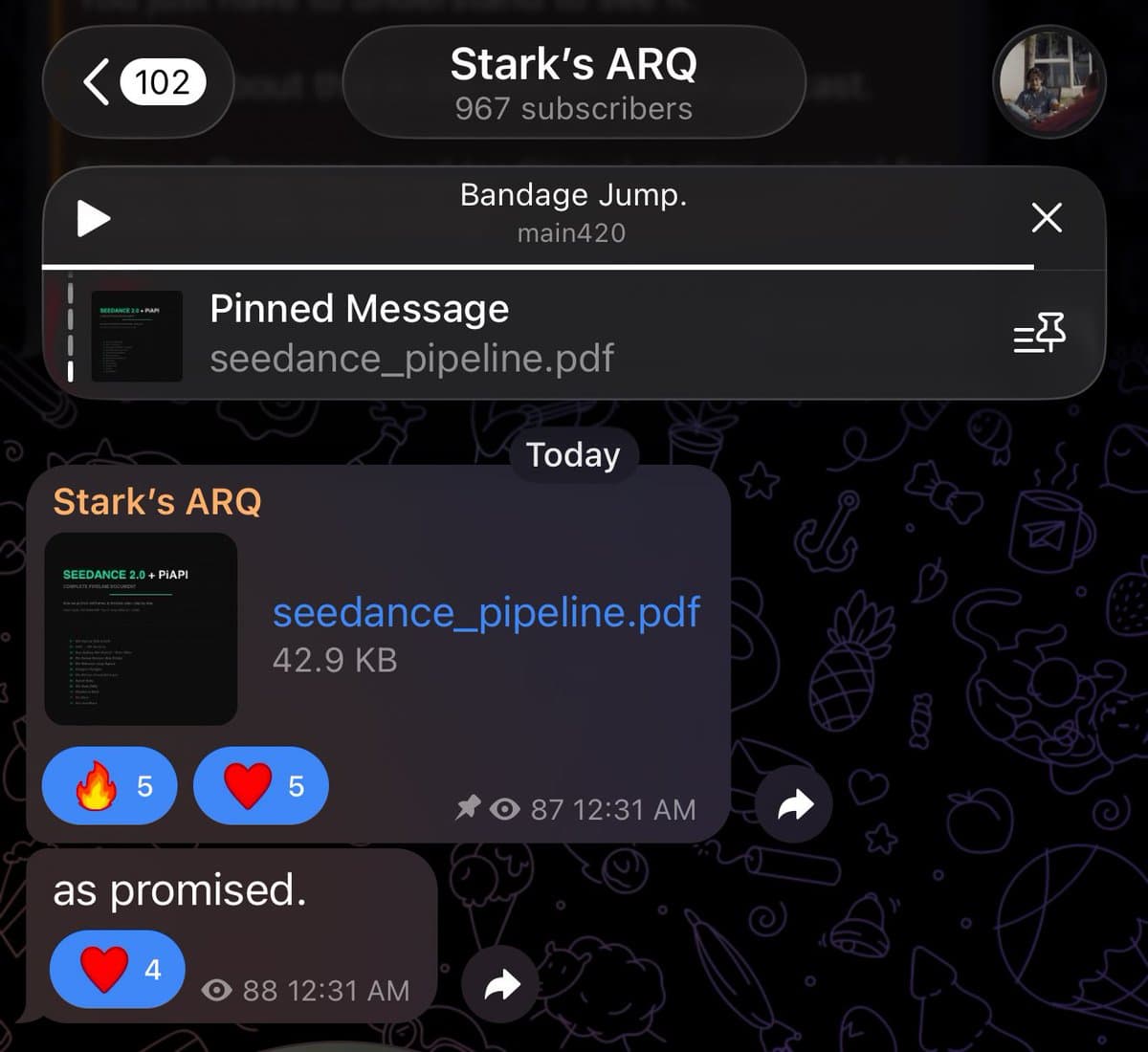
You can read CapCut's rollout post, skim Dreamina's official overview, and check CapCut's own settings guide. The weirdly useful bit in the tweet evidence is how often creators publish the full prompt block instead of the usual magician's flourish, including a Jurassic time-travel sequence with a frame-by-frame prompt dump time-travel prompt, a cartoon single shot built around escalating reveals cartoon bag gag, and a Telegram teaser for a full Seedance pipeline PDF pipeline PDF teaser.
15-Second Single Shots
The early CapCut examples all converge on the same format: one uninterrupted 15-second scene with a clean progression, then stop. Christmas came early for prompt maximalists.
The ogre clip is structured as four beats: tension line, emergence, impact break, aftermath pressure. The tweet thread turns that into a production brief:
- 0 to 3 seconds: lateral camera move along the shield wall
- 3 to 6 seconds: fog parts, silhouette forms, mass registers
- 6 to 10 seconds: the charge and shield break
- 10 to 15 seconds: slow-motion stomp, then recovery and looming freeze single-shot battle prompt
The cartoon version uses the same skeleton for comedy instead of action.
Its beats are setup, small reveal, absurd reveal, final reversal. The scene never cuts, the camera stays readable, and the escalation happens through object scale: ladder, elephant, UFO, then the bag swallowing the character cartoon bag gag.
Long Prompts as Shot Lists
Seedance 2 creators are writing prompts like mini shooting scripts, not adjective soup.
The Mach Zero prompt specifies camera package, grain, environment, timing, sound cues, negative constraints, and even micro-actions such as a visor closing or a heel lifting. The most revealing part is the inserted "part 0.5" time-travel bridge, where the creator adds a psychedelic transition with a year counter racing back to "-65,000,000 BCE" before the world reassembles as Jurassic jungle time-travel prompt.
That style lines up with Dreamina's own official guide, which frames Seedance 2.0 as a tool for controlling roles, style, motion, camera language, and rhythm. The creator examples are basically that product language pushed to its extreme.
Cheap Concept Tests
Several posts describe Seedance 2 less as a final renderer and more as a fast concept market.
One creator says a historical montage built with Seedance 2.0, Nano Banana Pro, and Midjourney v8 cost $4.50 and one prompt, then describes the setup as a way to test unlimited ideas before deciding whether an idea deserves a bigger universe or series history concept test. Another Meek Mill clip claims 60,000 plus views from a 20-minute run that cost $4.60, then funnels viewers toward a Telegram group and pipeline PDF Meek Mill clip teaser.
The future-museum test makes the same point more explicitly.
The thread describes a low-depth, high-volume process:
- feed an existing essay or idea into the pipeline seed idea
- let the agent propose a video concept seed idea
- generate multiple IDs in different moods and palettes format testing
- list concrete motifs such as violins, laughter, dreams, tears, love, crayons, and paintings format testing
- post the rough concept, measure response, then decide whether to build the full episode A/B test results
That is a very online way to do preproduction, but it is also a clear workflow.
Pipeline Agents
The most interesting creative claim in the thread is not the cost, it is the division of labor.
According to the creator, the custom agent was trained on four filmmaker tasks:
- prompt structure
- cinematography
- visual storyboard
- scriptwriting pipeline agent
The agent "doesn't generate," in the creator's words. It thinks through the film logic first, then Seedance 2 and Nano Banana Pro handle the making step pipeline agent. That mirrors a broader multi-tool workflow described in this MindStudio production guide, where concept development, scene visualization, image generation, and video generation are split across separate systems instead of forced into one box.
Rollout and Controls
CapCut's official newsroom post says the paid rollout started in Indonesia, the Philippines, Thailand, Vietnam, Malaysia, Brazil, and Mexico. Dreamina's tool page describes multimodal inputs across text, images, video, and audio, with up to 12 clips per project.
CapCut's own settings guide documents why these tweet experiments all look so similar. The exposed controls are duration, aspect ratio, and resolution, with short clip presets including 5, 10, and 12 seconds. The tweets are effectively showing what happens when creators use those short-form constraints to design self-contained scenes rather than chopped-up trailers.
The official pages also pitch smoother motion, stronger character control, and director-style control over camera language https://www.capcut.com/tools/seedance-2-0 https://dreamina.capcut.com/resource/what-is-seedance-2-0. The creator evidence fills in the missing part: people are using that control budget on very specific things, namely shot timing, physical weight, comedic escalation, and fast audience testing.