
ACE opens ace-platform for self-hosting with MCP-compatible playbooks
ACE open-sourced ace-platform so teams can self-host its playbook-based context engineering workflow instead of relying only on the hosted service. Use it if you want MCP-compatible prompting infrastructure with your own Postgres, Redis, and deployment controls.
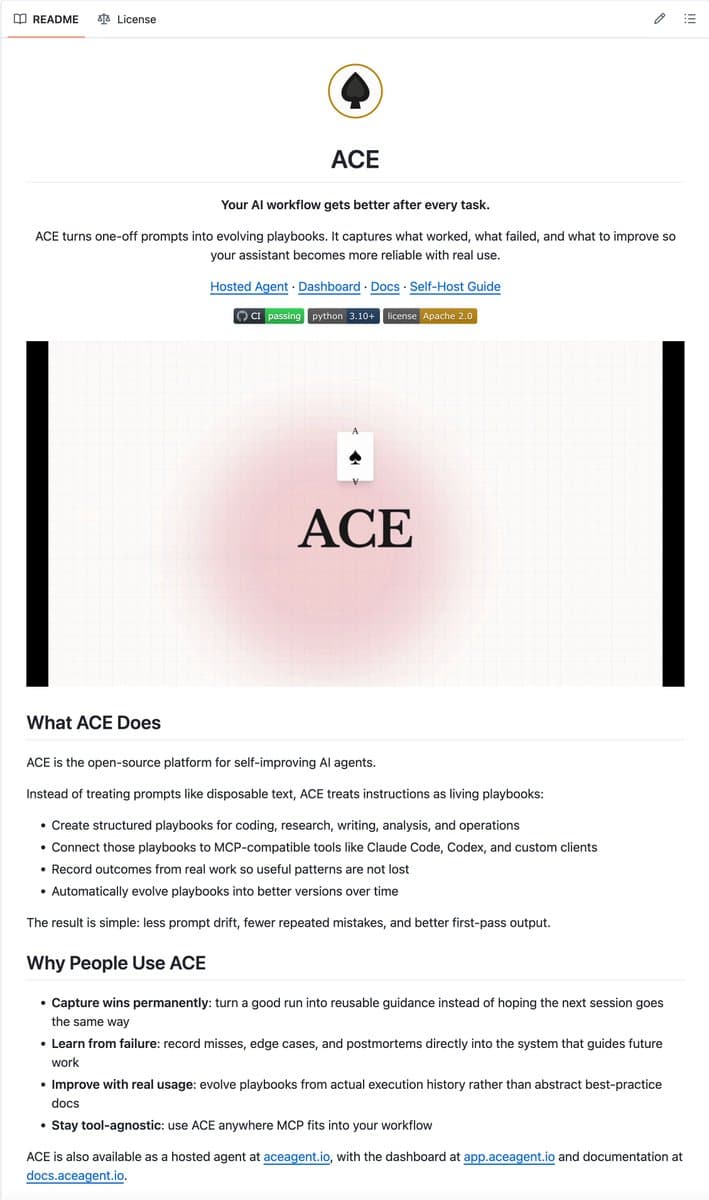
TL;DR
- ACE has open-sourced its platform, so the same workflow that powered its hosted service can now be self-hosted instead of staying SaaS-only, according to the launch post.
- The GitHub repo describes ACE as an "agentic context engineering" system built around evolving playbooks that capture wins, failures, and improvements over time the repo summary.
- ACE says those playbooks can connect to MCP-compatible tools including Claude Code and Codex, which makes this a piece of reusable prompting infrastructure rather than a single-agent app the repo summary.
- Self-hosting comes with real infra requirements: the repo summary points to Docker and local-dev setups with PostgreSQL, Redis, and a FastAPI-based stack the repo summary.
What actually shipped?
ACE's change is simple but useful for engineering teams: the platform behind its hosted product is now available as open source, and Daniel Mac says "you can now self-host" while the hosted service remains available the launch post. That turns ACE from a managed-only workflow into something teams can run inside their own environment.
The linked GitHub repo frames the project as a system for "agentic context engineering" rather than a generic chat wrapper. Its core unit is a playbook that "captures successful strategies, failures, and areas for improvement" so prompts evolve from real usage instead of staying static the repo summary.
How does it fit into coding-agent workflows?
The repo summary says ACE is designed to plug into MCP-supported workflows and specifically names Claude Code and Codex as compatible tools the repo summary. The practical angle is persistent context: teams can keep structured playbooks for coding, research, or analysis tasks, then reuse and refine them across runs instead of rebuilding prompt scaffolding each time.
For deployment, the same summary points to both Docker Compose and local development paths, with PostgreSQL, Redis, and FastAPI in the stack the repo summary. That gives teams an explicit self-hosting path, but it also means ACE lands closer to shared internal infrastructure than a lightweight local utility.