
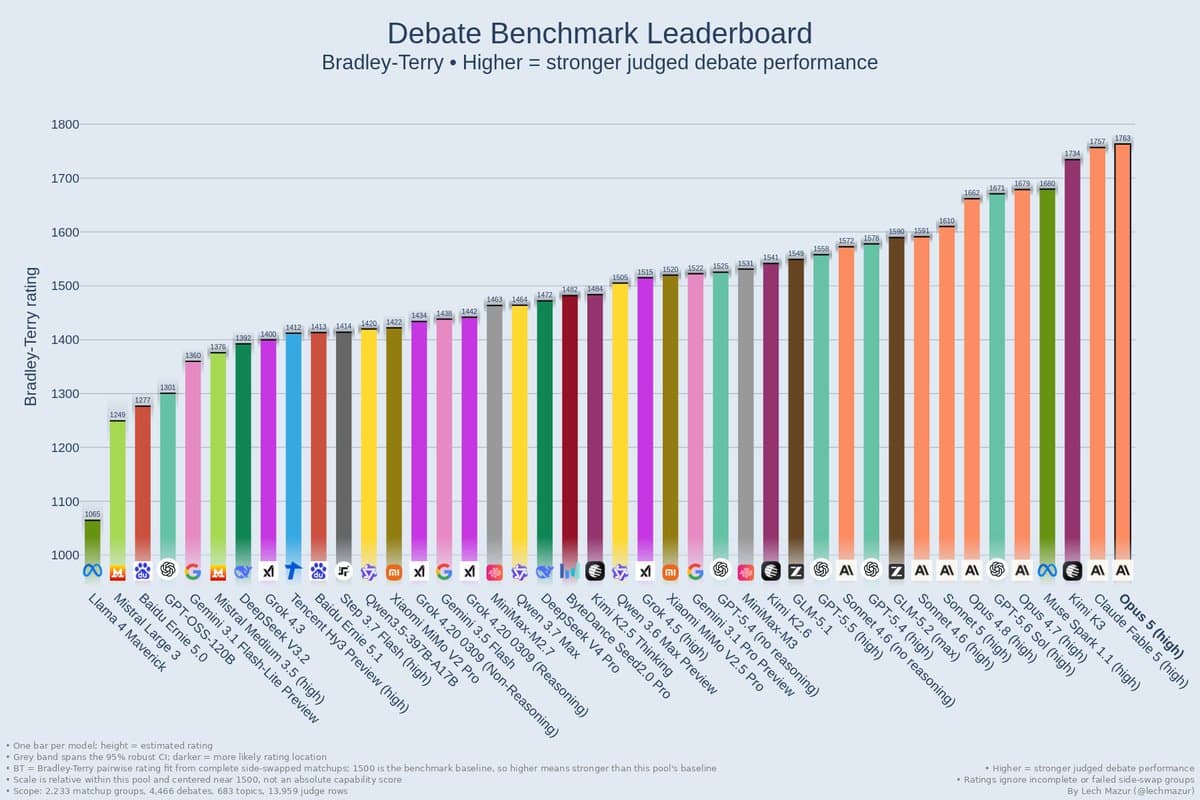
Claude Opus 5 ranks first on LLM Debate, DeepSWE, and other public benchmarks
New benchmark posts put Claude Opus 5 first on LLM Debate, a short-story test, Extended NYT Connections, and DeepSWE. Developers also reported over-editing and long-session failures, making private evals a recurring caveat.
TL;DR
- Claude Opus 5 shipped as the Opus-tier daily driver: all paid plans and API access, same price as Opus 4.8, default on Claude Max, Fast mode at about 2.5x default speed, according to Claude's availability note.
- The public benchmark headline is broad but uneven: Opus 5 leads ARC-AGI-3 at 30.2% in ARC Prize's result, tops the Artificial Analysis Intelligence Index at 61 in Artificial Analysis's report, and still trails GPT-5.6 Sol on DeepSWE in Rohan Paul's launch-table excerpt.
- More test-time compute is not reliably better for this model: Vals AI's Vibe Code Bench run found high effort beat xhigh and max, while Jerry Liu's chart skim saw the same pattern across roughly 20% to 30% of reported benchmarks.
- Hands-on reports split between daily-driver enthusiasm and reliability complaints: kunchenguid's first-day report called it fast and cheap but error-prone without enough context, while doodlestein's context-rot note claimed long sessions degrade sharply past roughly 500k tokens.
- The rollout landed everywhere at once: Cursor, Devin, OpenRouter, VS Code, Lovable, Vercel AI Gateway, Warp, Perplexity, Linear, Cline, Arena, and more all posted day-one or near-day-one support, including Cursor's availability post, Devin's FrontierCode post, and OpenRouter's provider post.
The odd details are more useful than the launch headline. ARC Prize's Opus 5 scorecard says the model beat five previously unbeaten ARC-AGI-3 public demo environments, while ARC Prize's thread highlighted a reflection equation the model wrote mid-run. Anthropic also published a context-engineering post saying it removed over 80% of Claude Code's system prompt for newer Claude 5 models. Simon Willison's quote post surfaced Boris Cherny's claim that Opus 5 is Anthropic's least prompt-injectable model so far, a detail buried in the 193-page system card.
What shipped
- Model: Claude Opus 5, positioned by Anthropic as close to Claude Fable 5 intelligence at half the price, according to Claude's launch post.
- Availability: all paid Claude plans and the Claude API on day one, default on Claude Max and strongest on Claude Pro, per Claude's availability note.
- Pricing: same list price as Opus 4.8, with Artificial Analysis listing $5 per million input tokens and $25 per million output tokens in its Opus 5 report.
- Fast mode: about 2.5x default speed, with Cedric Chee's launch-note excerpt describing it as twice the base price.
- Context and output: 1M context window, 128k max output, and five effort settings from low through max, per Artificial Analysis.
- API behavior: server-side fallback is supported, and Vals AI's refusal-rate note said it did not observe a significant fallback rate on Opus 5 outside cyber cases.
- Claude Code: version 2.1.219 switched the Opus default to Claude Opus 5, added a bash-output tool, and added an agent-launch tool, according to ClaudeCodeLog's release summary.
Benchmarks that moved
First-party
- Frontier-Bench v0.1: Opus 4.8 21.1% → Opus 5 43.3%, +22.2 points, per the launch-table screenshot.
- GDPval-AA v2: Opus 4.8 1593 Elo → Opus 5 1861 Elo, +268 Elo, per the launch-table screenshot.
- ARC-AGI-3: Opus 4.8 1.5% → Opus 5 30.2%, +28.7 points, per the launch-table screenshot.
- OSWorld 2.0: Opus 4.8 55.7% → Opus 5 70.6%, +14.9 points, per the launch-table screenshot.
- AutomationBench: Opus 4.8 17.0% → Opus 5 26.0%, +9.0 points, per the launch-table screenshot.
- Humanity's Last Exam with tools: Opus 4.8 57.9% → Opus 5 64.7%, +6.8 points, per the launch-table screenshot.
Third-party evaluators
- ARC-AGI-3: previous high GPT-5.6 Sol 7.8% → Opus 5 30.2%, +22.4 points, according to ARC Prize.
- Artificial Analysis Intelligence Index: Opus 4.8 max 56 → Opus 5 max 61, +5 points, per Artificial Analysis.
- GDPval-AA v2: Fable 5 1747 Elo → Opus 5 1861 Elo, +114 Elo, per Artificial Analysis's GDPval-AA note.
- AA-Briefcase: Fable 5 1574 Elo → Opus 5 max 1720 Elo, +146 Elo, per Artificial Analysis's AA-Briefcase report.
- AlmanBench: Opus 4.8 max 74.8% → Opus 5 max 94.5%, +19.7 points, per AlmanBench result.
- Short-story writing: Fable 5 high 3.23 → Opus 5 xhigh 4.28, +1.05 comparison-score points, with effort settings differing in Lech Mazur's writing benchmark.
- Extended NYT Connections, xhigh: Opus 4.8 91.1 → Opus 5 94.3, +3.2 points, per Lech Mazur's Connections result.
- Extended NYT Connections, high: Opus 4.8 88.3 → Opus 5 92.2, +3.9 points, per Lech Mazur's Connections result.
Customer-reported
- CursorBench default effort: Fable 5 66.5% → Opus 5 66.7%, +0.2 points, according to Cursor's launch post.
- CursorBench max effort cost: Fable 5 $17.32 per task → Opus 5 $8.23 per task, -$9.09 per task, while score moved 70.5% → 70.0%, -0.5 points, per BridgeMind's CursorBench table.
- Lovable demanding coding tasks: Opus 4.7 baseline → Opus 5, +22%, according to Lovable's launch post.
- Warp agent evals: Fable 5 baseline cost per task → Opus 5, -43% cost per task, with nearly the same quality in Warp's launch post.
Lech Mazur's LLM Debate test did not publish an Opus 4.8 delta in the evidence, but Mazur's debate post put Opus 5 at #1 in a statistical tie with Fable 5, and his follow-up said Fable won the head-to-head while Opus won by wider margins against the rest of the field.
Where it regressed
- DeepSWE v1.1: Fable 5 69.7% → Opus 5 68.8%, -0.9 points, and GPT-5.6 Sol 72.7% → Opus 5 68.8%, -3.9 points, per the launch-table excerpt.
- Legal Agent Benchmark held-out: Fable 5 13.3% → Opus 5 11.7%, -1.6 points, per the launch-table screenshot.
- HealthBench Professional: Mythos 5 66.0% → Opus 5 59.8%, -6.2 points, per the launch-table screenshot.
- AA-Omniscience: Opus 5 improved accuracy by +7 points over Opus 4.8, but its hallucination rate rose +14 points to 50%, according to Artificial Analysis.
- Vibe Code Bench: high effort beat xhigh and max, with Vals AI's follow-up attributing some higher-effort failures to more complex implementations and more mistakes.
- Terminal Bench: max reasoning cost more and underperformed high, with strict timeouts giving the agent fewer turns, according to Vals AI's Terminal Bench note.
- ParseBench dense tables: Opus 4.8 89.7 → Opus 5 86.7, -3.0 points, and semantic formatting 71.4 → 65.6, -5.8 points, per Jerry Liu's ParseBench table.
Under the hood
- Effort ladder: Opus 5 exposes low, medium, high, xhigh, and max, with reasoning on by default, according to Rohan Paul's effort-setting note.
- Migration trap: disabling thinking while selecting xhigh or max returns an API error, according to Rohan Paul's migration note.
- Prompting shift: Cedric Chee's excerpt says explicit verification instructions can cause over-verification, while Opus 5 already catches and fixes more of its own mistakes without being told.
- Delegation: the same prompting excerpt says Opus 5 delegates to subagents more readily than Opus 4.8 and can expand task scope beyond the request, according to Chee.
- Context engineering: Anthropic's context-engineering post says Claude Code removed over 80% of its system prompt for newer models such as Opus 5 and Fable 5.
- Claude Code plumbing: ClaudeCodeLog's diff summary reported added model aliases, a 337.1 KB bundle increase, 6,483 more prompt tokens, and nested subagents up to depth 3 by default.
- Prompt injection: Opus 5 reduced Gray Swan IPI success within 15 attempts from 5.5% to 2.0%, and one-attempt success from 0.5% to 0.2%, according to the system-card chart excerpt.
- Layered defenses: Boris Cherny's post said prompt-injection success dropped to about zero when Opus 5 alignment was combined with probes and Auto Mode in Claude Code.
- Cyber posture: the system-card cyber excerpt says Opus 5 was not deliberately trained on cybersecurity tasks, while Vals AI's CyberBench note found nearly 100% refusal on PoC crash-input tasks and near-zero refusal on patch tasks.
- Multi-agent testing: a system-card readthrough said a 10-agent Opus 5 team reached 93.6% on BrowseComp with a modeled 5.9x latency speedup over a 10M-token single-agent run.
Vibe Check
- Dan Shipper said the Every team saw Opus 5 argue with instructions and stop early under existing skills, then improve dramatically after deleting old workflows and starting fresh, in his day-zero report.
- Kunchenguid called it a cost-and-speed fix for Fable 5 and praised its judgment about when to stop for human input, but said the model made technical mistakes when it jumped to conclusions from partial context, in his first-day report.
- Jeremy Howard said Opus 5 was a step back from Fable for his work and that he switched back, according to his reply.
- Theo described Opus 5 as an in-between model with Fable-like taste and GPT-5.6 Sol-like thoroughness, writing less pretty code than Fable but catching things Fable missed, in his hands-on note.
- Doodlestein said Opus 5 worked across roughly 15 projects as a faster, more dogged implementation model, while Fable still fit planning and long-tail factual knowledge, in his workflow breakdown.
- The same user later reported sharper context rot than Fable past about 500k tokens, with the model suddenly making many mistakes, according to his long-session update.
- Matt Shumer published a one-shot Three.js shooter with no external assets, then posted the public repo and prompt in his repo post and his prompt post.
- Shumer later said the run used Claude Code, Opus 5, ultracode, and zero skills or MCPs, and one reply said skills hurt Opus 5's creativity.
- Dex Horthy's SlopCodeBench run ended with Opus 5 winning, but he said none of the models did a very good job and shared an example where the model overwrote an edited draft, in his final update.
- Outside X, the Hacker News thread focused more on settings, memory, safety policy, and fallback snippets than on reproducible workload reports.
Where it shows up
- Cursor added Opus 5 and said it matched Fable 5 on CursorBench at default effort, 66.7 vs 66.5, at half the price and with Zero Data Retention compatibility, per Cursor.
- Devin added Opus 5 and reported 63.6% with a 69.6% pass rate on FrontierCode 1.1 Extended, according to Cognition's benchmark detail.
- OpenRouter added Opus 5 and Opus 5 Fast, with OpenRouter's follow-up pointing to a migration guide.
- VS Code and GitHub Copilot began rolling it out, according to the VS Code post.
- Vercel AI Gateway added the model slug
anthropic/claude-opus-5with Fast mode support, per Vercel's post. - Lovable said Opus 5 was up 22% over Claude Opus 4.7 on its most demanding coding tasks, according to Lovable.
- Letta said Opus 5 matched Fable in memory generation and improved over Opus 4.8 in memory adherence and memory or skill usage, per Letta's post.
- Warp reported a 43% reduction in cost per task at nearly the same quality as Fable 5 in its agent evals, according to Warp.
- Perplexity added Opus 5 to Perplexity and Perplexity Computer, where WANDR put it below Fable 5 but 57% cheaper, per Perplexity's chart.
- Linear added Opus 5 to Coding Sessions for drafting PRs from Linear, according to Linear's post.
- Cline listed the model ID
anthropic/claude-opus-5, while Cline's announcement claimed a 97% SWE-Bench result. - Arena added Opus 5 to Agent Arena, Frontend Code Arena, Text, Vision, and Document Arena, with scores pending in Arena's post.
- Factory, Hyperbrowser, Genspark, Hermes Agent, Nous Portal, and Julius also posted support, including Factory's connector notes, Hyperbrowser's browser-agent post, Genspark's rollout, Teknium's Hermes Agent note, and Julius's availability post.
What the release signals
- Epoch AI scored Opus 5 at 159 on overall ECI versus Fable 5 at 161, while its SWE-ECI matched Fable 5 at 161, according to Epoch AI's ECI post.
- Artificial Analysis said Opus 5 sits on the intelligence-versus-cost frontier only at high intelligence levels, while lower effort levels sit just behind the GPT-5.6 family, in its Opus 5 report.
- Nat Lambert attributed the jump to faster iteration speed and scaled RL, and noted Anthropic expected classifiers to intervene around 85% less often than for Fable 5, in his launch read.
- Kunchenguid argued public benchmarks are becoming less predictive of practical use and said he trusts private, domain-specific evals more after using Opus 5, in his longer critique.
- Zeeg pushed back on relative cost claims by saying his team had engineers, including himself, spending $5k+ in a week on model usage and was still hard-pressed to show ROI, according to his cost thread.