
Coding Agent Index ranks cheaper configs near the top
Fresh runs and charts put GPT-5.6 Sol high on SWE-Bench Pro and Design Arena, while Coding Agent Index and Amp reports emphasized cheaper strong configs. Results vary by harness, effort tier, and agent setup.
TL;DR
- GPT-5.6 Sol put real pressure on the coding-agent leaderboard: Margin Lab's daily SWE-Bench Pro run jumped to about 82% for Sol xhigh in Codex, from about 54% for 5.5 xhigh, according to danielhanchen's post.
- The cost curve became the story: skirano's explorer put Terra Max slightly ahead of Fable 5 Max, 77.4 vs 77.2, at roughly 76% lower cost per task.
- DeepSWE favored Sol on cost and steps: koltregaskes's table showed Sol max at 73% for $8.39, while Fable 5 max showed 70% for $21.63.
- The launch also exposed Codex plumbing problems: thsottiaux's update cited unintended usage from the 372k context limit, juice-value experiments, and too much multi-agent usage at high and xhigh.
- Product teams moved fast: Amp became about 50% cheaper on average after mostly replacing Opus with GPT-5.6, according to sqs's Amp post.
OpenAI's launch post frames GPT-5.6 as a three-model family: Sol, Terra, and Luna. The pricing page lists standard API pricing at $5/$30 per million input/output tokens for Sol, $2.50/$15 for Terra, and $1/$6 for Luna. The weird launch detail was not the top score, it was the amount of benchmark movement caused by effort tier, harness, subagent policy, and context accounting.
Coding Agent Index
OpenAI's launch post says GPT-5.6 Sol max scored 80 on the Artificial Analysis Coding Agent Index, 2.8 points above Fable 5, while using less than half the output tokens and taking less than half the time.
The index combines average pass@1 across DeepSWE, Terminal-Bench v2, and SWE-Atlas-QnA, according to rasbt's benchmark note. That makes it a harnessed agent score, not a pure model IQ score.
rasbt's corrected routing takeaways were blunt:
- Luna with higher effort often beats cheaper Sol settings.
- Terra only made sense at the top end of its curve.
- Sol xhigh sat near Sol max, but with a lower bill.
- Sol Ultra looked hard to justify over Max after the label correction.
Cheap configurations
The linked Coding Agent Index Explorer turned the scatterplot into something engineers could actually inspect.
skirano pulled out three value picks:
- Terra Max edged Fable 5 Max, 77.4 vs 77.2, for about 76% less per task.
- Sol XHigh landed 1 point behind Max at about 26% lower API cost.
- Luna Max beat Opus 4.8 Max for about 80% less per task.
Artificial Analysis later made the same cost-shape point for the broader Intelligence Index: ArtificialAnlys's chart put Luna and Sol ahead of Terra at every comparable point on the intelligence-vs-cost curve.
DeepSWE
DeepSWE was the cleanest table for the cost story because it listed pass rate, average cost, output tokens, and steps in one place.
Key rows from koltregaskes's DeepSWE screenshot:
- GPT-5.6 Sol max: 73% ±3%, $8.39, 60k output tokens, 61 steps.
- GPT-5.6 Sol xhigh: 71% ±1%, $4.70, 41k output tokens, 44 steps.
- Claude Fable 5 xhigh: 70% ±3%, $13.41, 80k output tokens, 68 steps.
- Claude Fable 5 max: 70% ±4%, $21.63, 119k output tokens, 88 steps.
- GPT-5.6 Terra max: 70% ±3%, $4.95, 72k output tokens, 76 steps.
The number that will get screenshotted is Sol max at the top. The number that will change routing decisions is Sol xhigh nearly matching it with fewer tokens and fewer steps.
SWE-Bench Pro caveat
Margin Lab's daily SWE-Bench Pro trace showed the most dramatic visual move: a late spike to roughly 80% after months of 5.5 runs clustering closer to the mid-50s.
OpenAI's SWE-Bench Pro audit complicates every clean reading of that chart. The company found 27.4% of tasks broken by automated analysis and 34.1% broken by human review, then retracted its earlier recommendation to adopt SWE-Bench Pro as the replacement for SWE-bench Verified.
Capital & Compute's breakdown put the split plainly: Sol leads on the Coding Agent Index, DeepSWE, and Terminal-Bench, while Fable still leads SWE-Bench Pro by a large margin in published model-level numbers.
Frontend leaderboards
Code Arena: Frontend gave OpenAI a cleaner win narrative. arena's post said GPT-5.6 Sol xHigh reached joint #1 with Claude Fable 5, moving from GPT-5.5 xHigh at #18 to Sol at #1, while priced at $5/$30 per million input/output tokens.
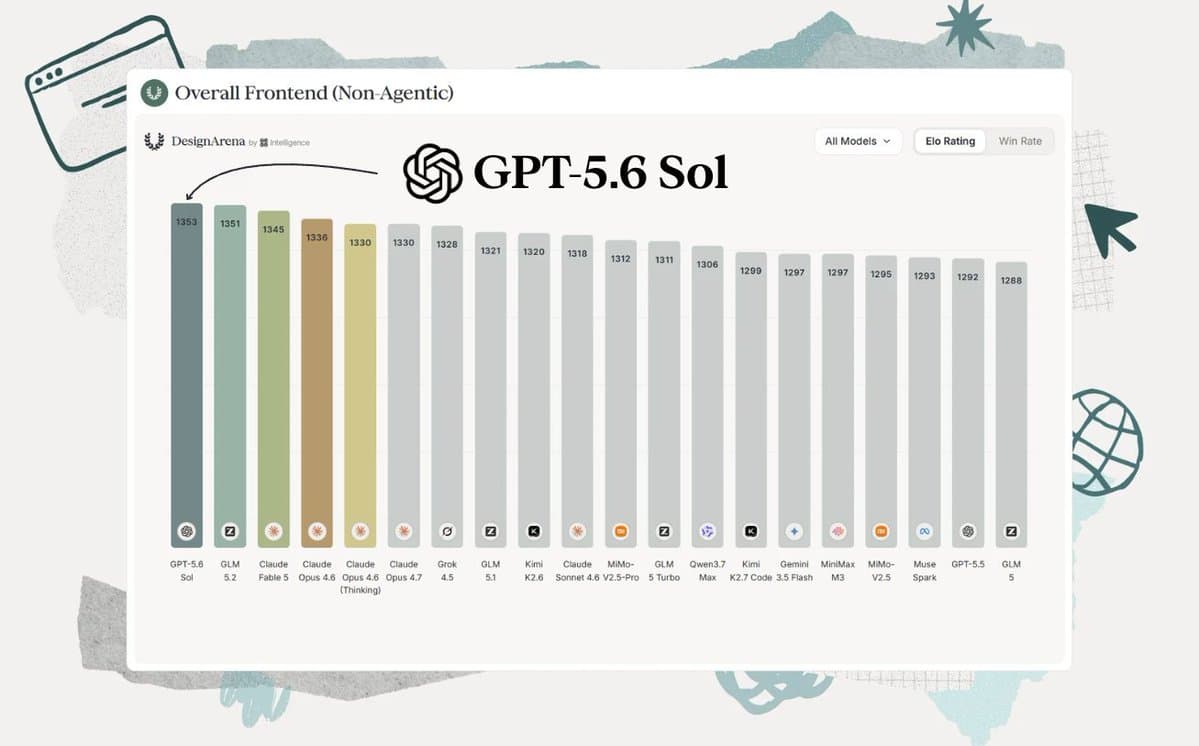
Design Arena was narrower and easier to misread. rohanpaul_ai said Sol reached 1353 Elo, 60 points above GPT-5.5, and moved OpenAI up 18 leaderboard positions, but the arena measures human preference over webpages produced from prompts, not software correctness or reliability.
Harness effects
Composio ran 47 real agentic SaaS tasks and found a behavioral split: Claude Fable 5 finished 47/47, while GPT-5.6 Sol finished 45/47 and used fewer tool calls when a short path was obvious.
Same model, different harness became its own mini-story. theo's Claude Code complaint said GPT-5.6 Sol was meaningfully better inside Claude Code than Codex, and thsottiaux's claudex recipe posted a proxy-based alias for running Sol through Claude Code.
The harness axis also explains the smart-router obsession. Yuchenj_UW counted the new routing surface as five recent model launches plus three GPT-5.6 models and five effort levels inside one family.
Usage burn
The launch's roughest operational bug was usage drain. thsottiaux listed four changes after the rollout:
- Inference optimizations passed through to subscriptions, worth about 10% more usage.
- Codex's GPT-5.6 Sol context limit reverted from 372k to 272k after higher-than-intended usage charging.
- Reasoning-effort experiments, called juice values under the hood, were reverted.
- Multi-agent usage in high and xhigh was higher than intended, with fixes planned alongside an auto-review efficiency fix.
theo connected those pieces into one failure mode: long threads filled context windows, subagents inherited that context, Ultra spawned expensive nested subagents, and fast mode could add another multiplier.
The pattern matched community reports. A Reddit user said one Extra High Codex task consumed more than 70% of a five-hour limit in roughly 20 minutes the Reddit usage report.
Integrations and routers
Amp was the cleanest product-side signal: sqs said Amp became about 50% cheaper on average after mostly replacing Opus with GPT-5.6.
Amp's differentiators were model routing and agent infrastructure, not just raw model access: agent modes could tap Fable and other models, Orbs ran agents remotely, and the plugin API exposed deeper customization than Codex.
Capy also added GPT-5.6 Sol, Terra, and Luna with Codex subscription support, with Capy's launch post saying Sol nearly matched Fable 5 in its internal evaluations at a fraction of the cost.