
OpenCode users reportedly average $1.14/day on DeepSeek V4 Flash
OpenCode’s thdxr said Go users spent $1.14 per day on DeepSeek V4 Flash last week. Wafer added a fast OpenRouter route, while Nous extended a 90% discount for the 0731 model.
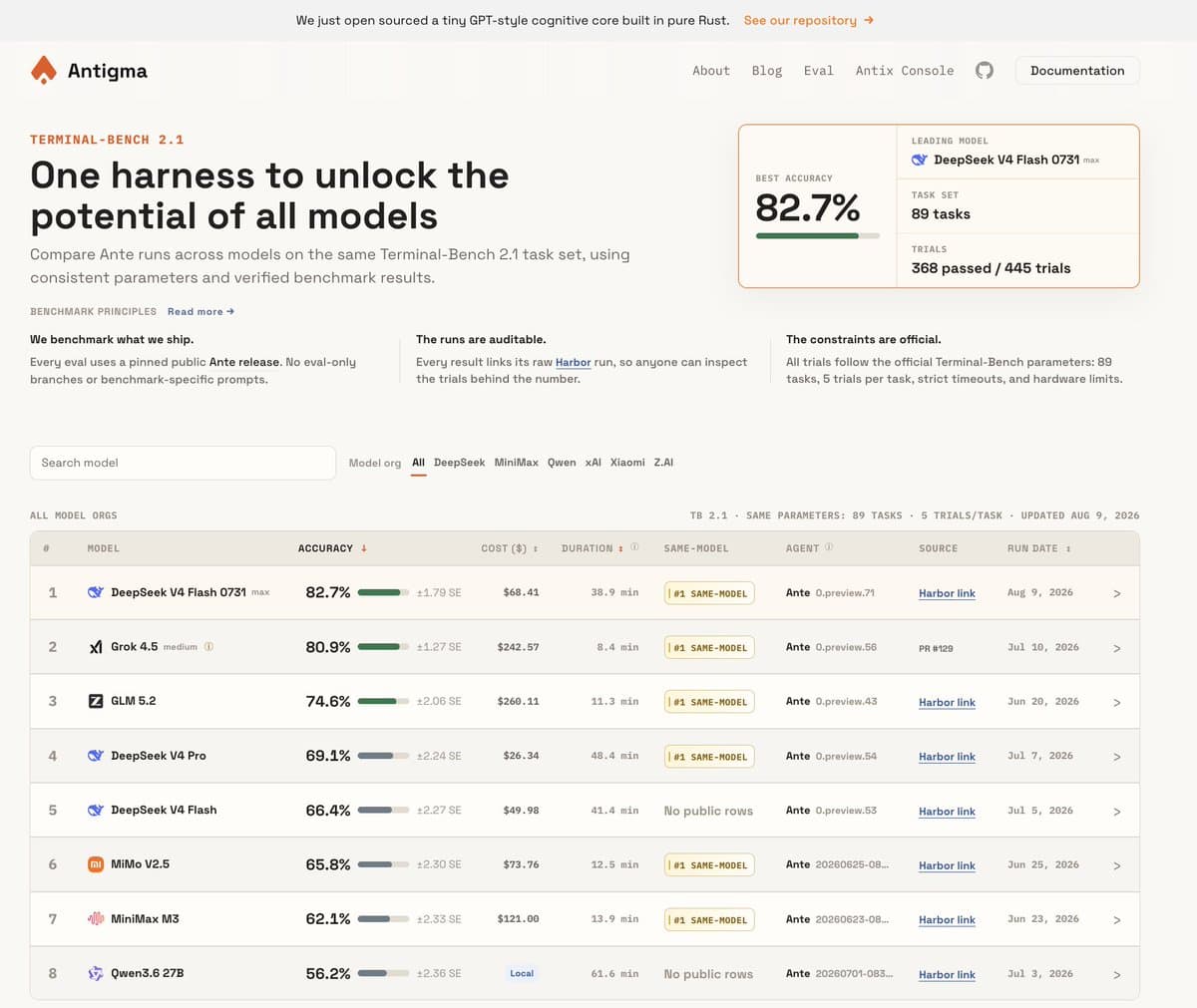
TL;DR
- OpenCode spend crossed from benchmark chat into product telemetry: thdxr's estimate put the average OpenCode Go user at $1.14 per day on DeepSeek V4 Flash last week.
- Serving competition moved to the provider layer: wafer_ai's OpenRouter post put a 225 tps route on OpenRouter, while NousResearch's discount post extended a 90% off V4 Flash 0731 deal for three more days.
- Official pricing is cheap but unstable: DeepSeek's pricing docs list V4 Flash at $0.0028/M cached input tokens, $0.14/M uncached input tokens, and $0.28/M output tokens, and Teknium's neocloud reply says Nous is not using the official endpoint.
- The cost story has eval support: the ARC result post reported 61.4% on ARC-AGI-2 at $0.04 per task, and Together's cascade post said a DeepSeek-first DeepSWE cascade beat Luna alone at 37% lower cost per task.
- Harness details are doing real work: aibuilderclub_'s Claude Code config set
CLAUDE_CODE_AUTO_COMPACT_WINDOW=786432, and Cline's usage post said V4 Flash became its most-used model after the 0731 update.
DeepSeek's own docs now carry the weird caveat, the current API price table includes a planned "significant increase" notice in Models & Pricing. OpenCode's public model data page adds the telemetry version: rank #1, 126T recent tokens, 96% cached input, and $0.10 average session cost. OpenRouter's model page turns the same model into a host-selection problem, while Together's DeepSWE writeup turns cheap rollouts into a retry-and-verify strategy.
The $1.14 day
According to thdxr, the average OpenCode Go user spent $1.14 per day on DeepSeek V4 Flash last week. The same post compared that with a $10,000 dual-DGX setup, yielding a 24-year break-even period at current usage and 2.4 years at 10x usage.
On OpenCode's model data page, DeepSeek V4 Flash is ranked #1 across last week's OpenCode Go usage, with 64% token share, 126T tokens, 11,987,562 completed sessions, $1.2M total spend, and $0.10 average session cost.
The cache number is the most important line: OpenCode lists a 96% input-token cache ratio. That is how a 10M-token average session lands at dime-scale pricing.
OpenRouter provider math
OpenRouter describes V4 Flash 0731 as a sparse MoE with 13B active parameters out of 284B total, and says requests can route by Balanced, Nitro, or Exacto modes on the model page. The provider table in wafer_ai's post made the speed-price tradeoff explicit:
- Wafer: $0.28/M input, $0.56/M output, $0.07/M cache read, 1.86s latency, 225 tps, 100% uptime.
- Baidu Qianfan: $0.0882/M input, $0.1764/M output, $0.01764/M cache read, 0.63s latency, 78 tps, 99.88% uptime.
- CoreWeave: $0.14/M input, $0.28/M output, $0.07/M cache read, 0.48s latency, 50 tps, 99.08% uptime.
Wafer is pricing for throughput, not cheapest tokens. Christmas came early for people who benchmark providers instead of model names.
90% discounts
DeepSeek's official docs list V4 Flash 0731 with 1M context, 384K max output, tool calls, Anthropic API support, Responses API support, and a 2,500 concurrency limit in Models & Pricing. The same page says DeepSeek plans to raise overall API pricing "in the near future," with a "significant increase expected."
Nous is trying to route around that official price surface. NousResearch extended its 90% discount for three more days, while Teknium's pricing reply said Nous Portal had DeepSeek Flash at 90% off DeepSeek's prices.
The endpoint detail matters. Teknium said Nous made a deal with a neocloud, not a self-hosted endpoint or DeepSeek's official endpoint, and added that DeepSeek does not control anyone else's prices.
1M context compaction
DeepSeek's Claude Code docs point Anthropic-compatible clients at https://api.deepseek.com/anthropic and keep the deepseek-v4-flash model name for the latest 0731 build in the integration guide.
The operational trick in aibuilderclub_'s post is the compaction window:
That sets Claude Code's auto-compact threshold to 786,432 tokens, leaving more of DeepSeek's 1M context available before session summarization. aibuilderclub_'s reply said this was the officially recommended optimal setting.
Task-level cost
ARC Prize reported DeepSeek V4 Flash at 89.0% on ARC-AGI-1 for $0.02 per task and 61.4% on ARC-AGI-2 for $0.04 per task in its verified result post. ARC's testing policy matters here because it publishes costs, durations, model outputs, and scoring rules rather than only leaderboard ranks.
The reasoning-effort curve was not monotonic in cost. ARC's follow-up said max reasoning got better results than high reasoning while using fewer reasoning tokens overall; on task 28a6681f, low used 26K tokens and failed, high used 98K tokens and failed, and max used 76K tokens and solved it.
Together's DeepSWE comparison put the fan-out economics in coding terms:
- Luna pass@1: 67.2%.
- DeepSeek V4 Flash pass@1: 53.3%.
- DeepSeek rollout cost: $0.10.
- Luna rollout cost: $0.61.
- DeepSeek-first cascade: 78.9% solved at $0.385 per task, 37% cheaper than Luna alone, according to Together's DeepSWE post and Together's cascade tweet.
Hands-on coding runs
The most shareable demo was yacineMTB's Melee.c post: roughly 5,000 lines of C for a Super Smash Bros. Melee reverse-engineering project, done with DeepSeek Flash 0731 from a phone. yacineMTB's follow-up clarified that it was a reimplementation using decompilation and reverse engineering, plus custom agent tooling, Dolphin, public Slippi replays, and a side-by-side test harness.
The caveat came from the same run. yacineMTB said the model still needed roughly daily intervention to stop it from producing bad code.
Other hands-on reports converged on persistence. teortaxesTex called Flash-0731 harness-sensitive, fast, and capable of overnight progress after a /goal, while yacineMTB said he missed DeepSeek after spending $20 in a week because it "actually listens" and "doesn't give up."
Cline saw the usage version of that behavior: Cline said DeepSeek V4-Flash became its #1 model, usage rose 40% after the 0731 update, tokens tripled, and it had more users than the next two models combined.
Local custody
Local Flash is slower than the cheapest hosted path, but it changes the custody story. Teknium said two DGX Sparks connected with one cable got around 40 tok/s on DeepSeek V4 Flash 0731 without DSpark, with private inference.
That setup was for inference, not training. Teknium's training reply said even two Sparks were not good enough for training, and Teknium's vLLM reply attributed a user's poor results to the inference engine and said he was using vLLM.
Cline separately reported local-model usage had more than doubled since December, from 5.4% to 11.2% of users on Ollama or LM Studio, with some users running DeepSeek V4-Flash locally in Cline's local-model chart.