
DeepSeek V4 Flash adds Baseten and Together AI serving with 1M-token context
Baseten and Together AI added DeepSeek V4 Flash with a 1M-token context window, reasoning-effort controls, and DSpark decoding. ValsAI ranked it the cheapest model above 60 on its index, and Nous promoted a short 90% discount.
TL;DR
- DeepSeek V4 Flash 0731 landed on production APIs, with Baseten's launch post citing a 1M-token context window and Together's launch thread framing the model around coding, tool use, and long-running agents.
- The official release kept the small active footprint, with the release summary listing 284B total parameters, 13B active parameters per token, tool calling, built-in web search, and Responses API support.
- The headline number is cost per task: ValsAI's chart called it the cheapest model above 60 on the Vals Index, and Cline's cost chart cited Artificial Analysis at $0.03 per task, 105x cheaper than Fable 5.
- The caveat is harness behavior: RampLabs' SWE-Bench comparison found V4 Flash taking more turns, nearly 3x longer, and 3x the cost per task versus GPT-5.6 Luna in its harness.
The Hugging Face model card says 0731 supersedes the preview while keeping the DSpark speculative decoding module attached. DeepSeek's API docs keep the model call unchanged as deepseek-v4-flash; Together's model page exposes low, high, and max reasoning effort; Baseten's library page lists MIT licensing and provider prices of $0.13 input, $0.028 cached input, and $0.26 output per 1M tokens. Artificial Analysis measured a 10-point jump over the April Flash release.
What shipped
The public shape is boring in the best way: same API slug, same small active parameter count, bigger agent numbers.
The official and provider docs converge on this inventory:
- Model:
deepseek-v4-flash, updated to DeepSeek-V4-Flash-0731 in DeepSeek's API docs. - Architecture: 284B MoE, 13B active per token, per Together's model page and Baseten's model library.
- Context: 1M tokens, with ValsAI running high-effort evals at a 384K max output limit in its setup note.
- Decoding: DSpark speculative decoding, cited by Together's feature list.
- Effort controls: low, high, and max reasoning effort, also in Together's feature list.
- API surface: OpenAI-compatible agent workflows, with the release summary also calling out OpenAI Responses API support.
DeepSeek's Hugging Face model card says the 0731 checkpoint outperforms V4-Pro Preview on its listed agent benchmarks despite the smaller activated parameter count.
Provider paths
Baseten and Together were the clean production paths in the evidence pool.
Baseten positioned the model as 80 to 98% cheaper than other frontier models with comparable intelligence and 1M context in its launch post. Together framed the same release as a high-throughput path for coding, tool use, and agentic workloads in its follow-up.
Cline made the updated model free inside its provider menu, then later said it had tripled the free quota because the economics were sustainable in its setup post in its quota update. OpenHands also exposed it for free to cloud users under the openhands/deepseek-v4-flash profile in its launch post.
Nous turned the pricing story into a timed promo: DeepSeek V4 Flash 0731 was 90% off on Nous Portal for seven days through Novita Labs, and the promo claim said the discounted model was over 1000x cheaper than Fable 5 on comparable tasks while beating it on Terminal-Bench 2.1 in the Nous announcement.
Ollama's cloud path moved during the same window, with Ollama saying DeepSeek-V4-Flash-0731 was more than 2x faster than the previous day.
Cost per task
ValsAI's chart is the shareable version of the release: DeepSeek V4 Flash cleared 60 on the Vals Index at $0.06 per test.
The same thread breaks the result into coding-heavy components:
- Vals Index: 63.95% to 64.0% at $0.06 per test, behind Kimi K3 at $2.34 and GLM 5.2 at $2.08, according to ValsAI's earlier leaderboard and ValsAI's chart.
- Vibe Code Bench: 74.7 at $0.20 per task, ahead of GLM 5.2 at 72.9; Kimi K3 led at 84.9 but cost $17.56, per ValsAI's Vibe Code Bench note.
- LiveCodeBench: 87.3, effectively tied with Kimi K3 at 87.2 and Opus 4.8 at 87.8, with token pricing at $0.14 input and $0.28 output per 1M, per ValsAI's LiveCodeBench note.
- Terminal-Bench 2.1: 67.0, one point behind GLM 5.2, at 20x less cost and 683 seconds average runtime versus 821 and 891 seconds, per ValsAI's terminal benchmark note.
Artificial Analysis reached the same broad cost story with a different harness. Its model page lists DeepSeek V4 Flash 0731 at 50 on the Intelligence Index, 122.7 output tokens per second, $0.14 input per 1M, $0.28 output per 1M, and 1M context.
Agent benchmarks
DeepSeek's own benchmark table is the optimistic read: post-training, not a larger active model, drove the jump.
The table in the release summary reports these vendor-side moves from Flash Preview to Flash 0731:
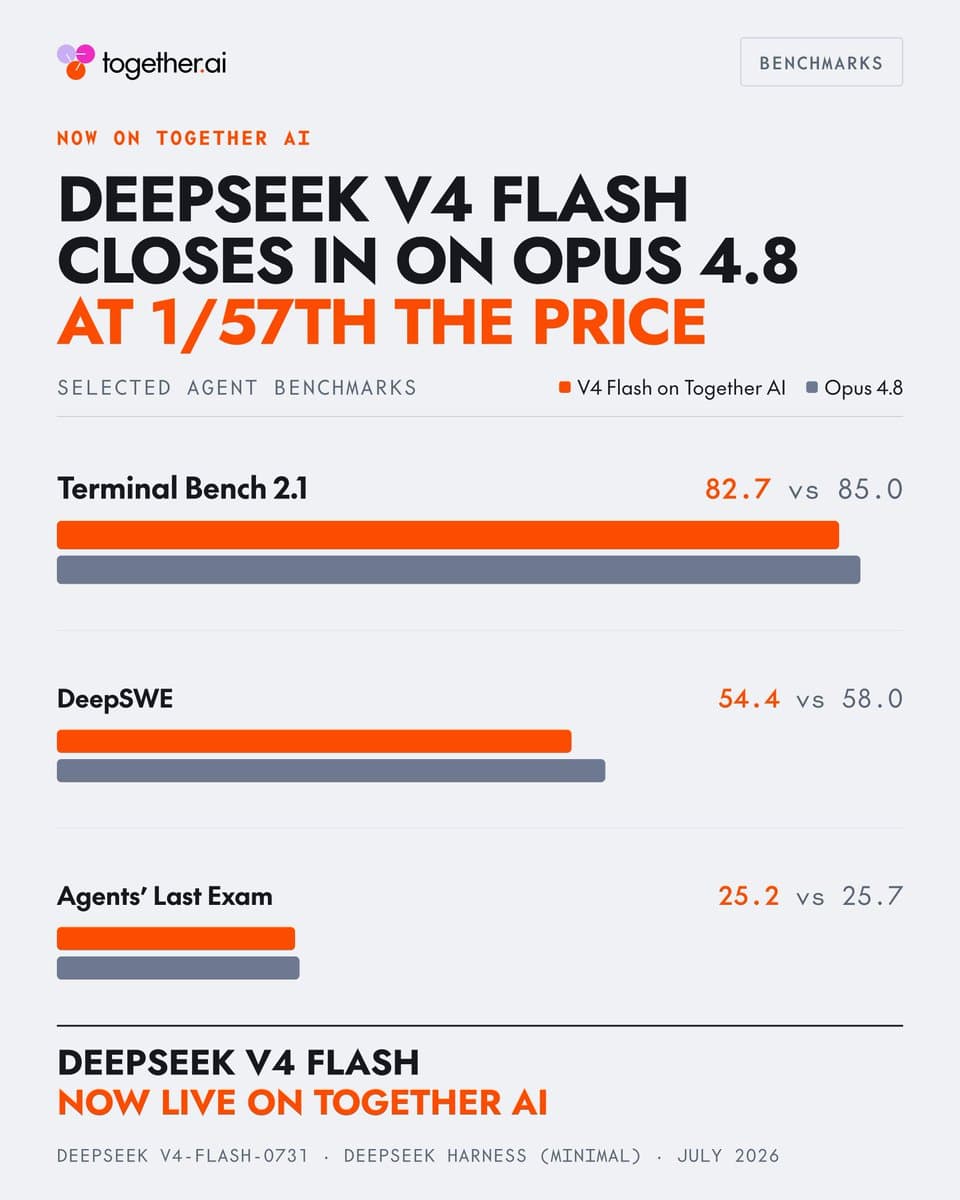
- Terminal Bench 2.1: 61.8 to 82.7.
- NL2Repo: 39.4 to 54.2.
- Cybergym: 38.7 to 76.7.
- DeepSWE: 7.3 to 54.4.
- Toolathlon-Verified: 49.7 to 70.3.
- Agents' Last Exam: 15.8 to 25.2.
- AutomationBench Public: 10.8 to 25.1.
- DSBench-FullStack: 37.0 to 68.7.
- DSBench-Hard: 25.8 to 59.6.
The Community Note captured in the DeepSWE screenshot says the 0731 release kept the exact same model architecture and size as the preview version.
Harness sensitivity
The strongest dissent came from Ramp: cheap tokens did not automatically mean cheap completed tasks in its private SWE-Bench harness.
Ramp said V4 Flash ran at 3x the cost per task versus GPT-5.6 Luna, spent nearly 3x longer in the harness, and took more turns on every task in its comparison. The trace pattern was specific: DeepSeek churned through many turns before the first code change, then persisted through repeated tests and revisions once it started editing in RampLabs' follow-up.
The benchmark context matters. Ramp SWE-Bench describes an 80-task benchmark derived from merged Ramp PRs, using a shared mini-swe-agent harness with bash access in a sandboxed local environment.
Community testing split along harness lines. One user found the model strong at long-horizon tasks and said it usually did not lose the plot in gneubig's hands-on note, while one Pi/OpenCode comparison said the same model looked weak in Pi and Claude Code but produced a much stronger result in OpenCode.
Hermes reacted by tightening the harness itself. Teknium's Hermes Agent post listed 16 merged toolset improvements, including a 40% schema diet, 21% fewer LLM turns for weak models, 29% fewer tool calls, tool errors falling to zero, and 23% lower wall clock.
Reasoning effort
DeepSeek exposes effort controls, but early sweeps did not produce a clean more-tokens-more-accuracy curve.
The mapping screenshot in the effort-mode post shows Flash accepting low, high, xhigh, and max requests, with xhigh mapped back to high. It also says thinking is enabled by default and the default effort is high.
One VulcanBench chart attached to a reasoning-effort critique put DeepSeek V4 Flash at 87% pass@1 on low, 91% on medium, and 87% on high. The same chart showed GPT-5.6 Sol rising from 78% to 83% to 87% across the same effort sweep.
Together's launch materials still expose low, high, and max as request-level controls in its feature list. TeortaxesTex asked Artificial Analysis to benchmark low and high separately after observing that V4 Flash low and high did not form a Pareto frontier in one effort curve in the follow-up.
Local footprint
The model's serving story is partly a memory story: the sparse attention design keeps the KV cache unusually small at long context.
The calculator screenshot in the KV-cache comparison puts DeepSeek V4 Flash at 2.89 GiB total cache for one 1M-token sequence with FP8 or INT8 KV and FP4 or INT4 indexer precision. The paired Gemma 4 31B screenshot shows 38.54 GiB for the same 1M-token sequence.
That difference shaped local claims. Cline said r/LocalLLaMA users were already running V4 Flash on a Mac M2 Ultra in its local-model convergence post, and Teknium said the model was running on two NVIDIA DGX Sparks in a reply.
The same local theme showed up in throughput anecdotes: Teknium reported 70 tokens per second for DSV4 Flash, then clarified it was on two devices in the speed reply in the correction.