
Factory launches Analytics to tie tokens, tool calls, commits, and PRs to software output
Factory released an analytics layer for teams deploying coding agents, surfacing usage, tool calls, activity, and productivity from tokens through pull requests. Use it if you need ROI, readiness, and cost visibility as agent adoption scales.
TL;DR
- Factory's launch thread introduces an analytics layer for coding-agent deployments that maps "tokens → usage → commits → pull requests → shipped software," aiming to give engineering leaders a direct ROI view.
- The accompanying product post says the system tracks six buckets: token consumption, tool usage, activity and adoption, productivity output, per-user activity, and "agent readiness," with OpenTelemetry as the data backbone product post.
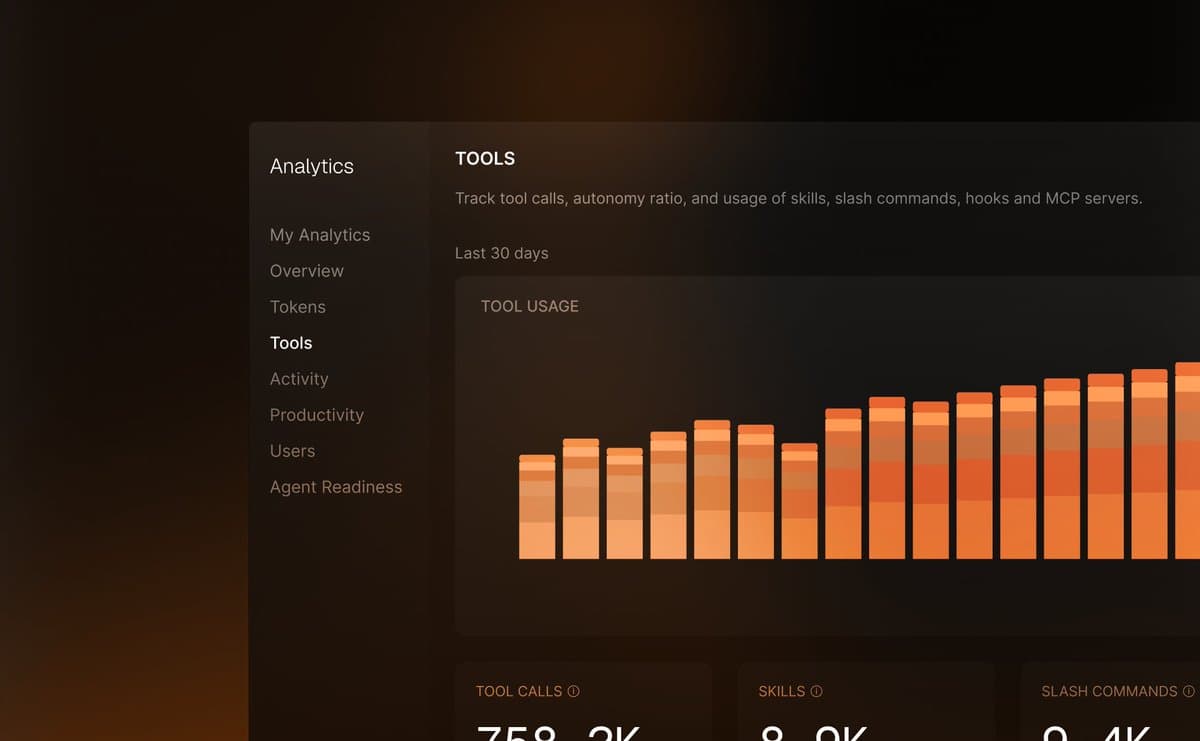
- Factory's interface preview shows the product going beyond token counts into operational signals like tool calls, skills, slash commands, hooks, and MCP server usage, plus an "autonomy ratio" that measures delegated agent work.
- The launch lands as teams report much higher agent output: a widely shared Uber repost cites "1,800 code changes per week" at Uber, while one engineer's post argues the bottleneck has already shifted from generation to review.
What shipped in Factory Analytics
Factory is packaging agent telemetry into an engineering analytics product, not just a dashboard for model spend. In Factory's launch thread, the company frames the core problem as proving how agent activity turns into software outcomes, and the product post expands that into a pipeline spanning tokens, tool calls, sessions, files, commits, and pull requests.
The technical payload is in the dimensions it exposes. According to the product post, teams can break down token use by model, user, date, billable versus cached tokens, and input versus output volume; inspect tool usage across skills, slash commands, hooks, and MCP servers; and track adoption through active users, session counts, client breakdowns, and a "stickiness ratio." Factory also surfaces per-user metrics and an "agent readiness" layer meant to show where environments, repos, and workflows are prepared for more autonomous use.
The screenshot in Factory's launch materials suggests the product is built for organizations already operating agents at scale: the Tools view highlights "tool calls," skills, slash commands, and a 30-day usage trend rather than a single prompt log.
Why this matters for teams running coding agents
The timing makes sense because the measurement problem has changed. As one engineer's post puts it, "the bottleneck has so quickly moved from code generation to code review," which means raw acceptance rates or anecdotal demos no longer capture the real operational constraint.
Factory is effectively pitching a control plane for that next phase. Its launch thread says leadership needs visibility into "adoption, cost, and output" when thousands of engineers start using agents, and the product post adds metrics like autonomy ratio, session behavior, and PR output that can show whether usage is concentrated in experimentation or translating into shipped changes. That matters more when adoption numbers start to look like the Uber repost, which claims "1,800 code changes per week" are now written entirely by agents.
The broader caveat is that instrumentation does not solve organizational redesign by itself. In a related reaction, Ethan Mollick's thread argues AI application rollouts are "far less of a technical issue" than a question of structure and decision-making, a useful reminder that analytics can quantify agent-native development without answering how teams should govern it.