
FastVideo claims FastH3 Omni cuts video generation latency 12×
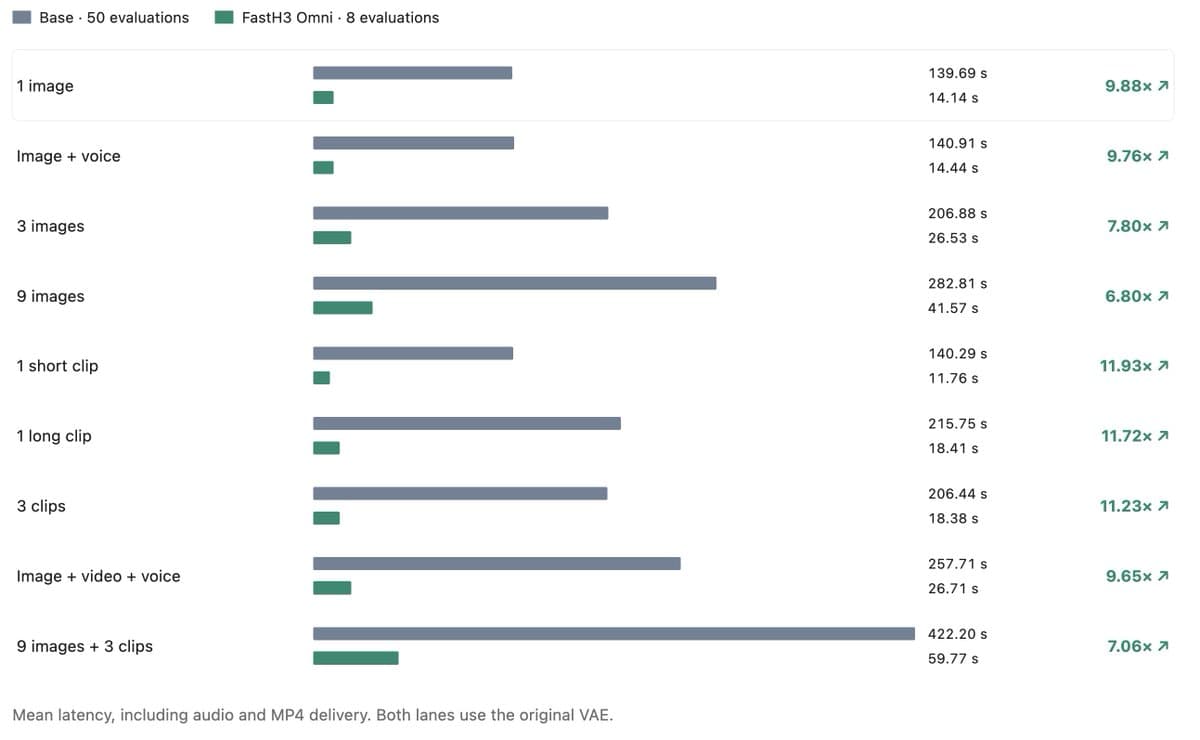
FastVideo releases FastH3 Omni weights and training code, claiming 12× lower latency than base MiniMax-H3. The comparison covers 27 matched workloads on eight GB200 GPUs, and ComfyUI support is available.
TL;DR
- FastVideo shipped FastH3 Omni weights and training code for reference-guided video with synchronized audio, according to the launch announcement.
- The headline 12× latency reduction comes from 27 matched workloads on eight GB200 GPUs, as the team's benchmark announcement specifies.
- ComfyUI support is available for local workflows, per ComfyUI's announcement.
The release gallery exposes the original reference media and lets readers switch which model's soundtrack plays. The ComfyUI package bundles a Qwen3-VL 32B text encoder with the vision tower needed to read reference inputs.
27-workload benchmark
FastVideo reports 5.6–11.9× lower end-to-end latency in its October 20 release post. Its matched setup covers:
- Hardware: Eight NVIDIA GB200 GPUs across two four-GPU trays.
- Workloads: Nine reference compositions at three requested lengths: 5, 10 and 15 seconds.
- Output: 1344×768 video at 24 FPS, with synchronized audio.
- Runs: Measured seeds 0, 1 and 2, after a warmup using seed 42.
- Timer: Client-side time until the complete MP4 is available, excluding model loading and server startup.
Base MiniMax-H3 Ref2VA uses 50 denoising evaluations under SGLang's quality="lossless" policy, with unquantized weights and dense attention. Omni uses eight evaluations and Video Sparse Attention (VSA), so the comparison includes changes to model weights, attention and serving runtime.
FastVideo publishes these three-seed mean latencies in the matched gallery:
| References | Requested clip | Base | FastH3 Omni |
| --- | --- | --- | --- |
| One image | 5 s | 35.44 s | 5.67 s |
| One image | 10 s | 78.53 s | 9.37 s |
| One image | 15 s | 139.69 s | 14.14 s |
| Three images | 10 s | 131.25 s | 19.15 s |
Mixed reference prompts
A request can combine up to nine images with video clips and voice references. Prompts assign appearance, motion and voice through the ordered reference tags:
<Picture 1>identifies an image reference.<Video 1>identifies a video reference.<Audio 1>identifies an audio reference.
PDD and DMD
FastVideo released both distillation code and reference-aware preprocessing, the most reusable part of the package. The recipe combines:
- PDD: Teaches the model to cover several denoising steps in one forward pass.
- DMD: Pulls the resulting output toward the base model's quality.
Three-way VAE comparisons
Every gallery example uses matched inputs and seed 0 across three configurations:
- Base MiniMax-H3 Ref2VA.
- FastH3 OmniRef.
- OmniRef with FastVideo's trained 36-layer NVFP4, 4-bit video VAE decoder.
FastVideo explicitly describes the gallery as qualitative comparisons that do not establish output parity.
GB200 and local serving
FastVideo's server recipe uses four GB200 GPUs for one image plus one voice, scaling to eight GPUs across two hosts for larger reference mixes. The UniServe repository provides the serving implementation and deployment guide.
Separate NVFP4 QAD checkpoints and device recipes target DGX Spark and RTX 5090, according to the BF16 release's runtime table. A browser demo on Hugging Face Spaces was also shared in multimodalart's announcement.
ComfyUI setup
Native ComfyUI support includes BF16 and INT8 ConvRot diffusion weights. The documented configuration specifies:
- The MiniMax H3 Reference to Video conditioning node.
- Eight sampling steps and guidance 1.0.
- Video shift 12.0 and audio shift 3.0.
- A matching text encoder, video VAE and audio VAE; the audio VAE is required for synchronized sound.
ComfyUI uses its own model layout, sampler and runtime kernels, so outputs can differ from FastVideo and UniServe.
ComfyUI said its cloud offering was still “coming soon”. The weights are governed by the MiniMax-H3 Community License Agreement, according to the model card.