
Firecrawl releases /search endpoint with agent-ready excerpts
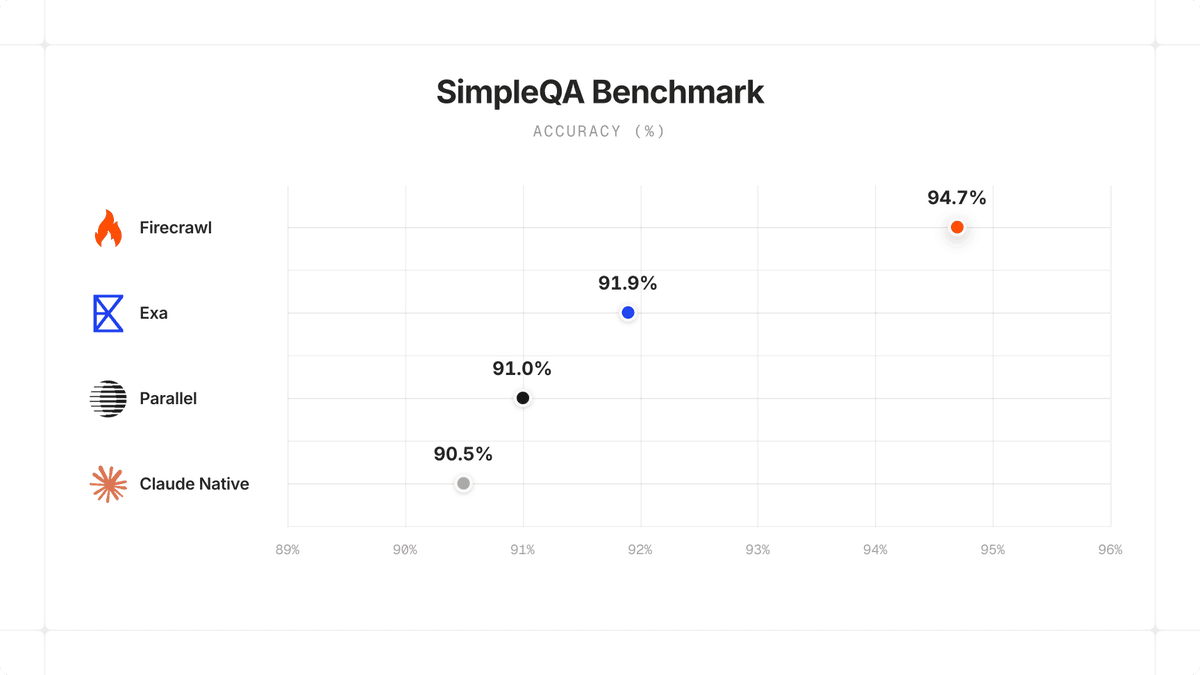
Firecrawl introduced a new /search system that returns relevant excerpts instead of full pages for agent workflows. The launch claims 94.7% on SimpleQA and roughly 10x fewer tokens than full-page processing.
TL;DR
- Firecrawl upgraded
/searchto return query-relevant excerpts from each result, and Firecrawl's launch tweet says the new behavior is now on by default at no extra cost. - The benchmark claim is 94.7% on SimpleQA, where Firecrawl's SimpleQA note says agents using
/searchbeat every other provider in its test. - The new relevance layer works below the page level: Firecrawl's model note says it scores paragraphs, lists, and tables against the query before returning context.
- Existing integrations keep the same API shape, while Firecrawl's blog pointer leads to the launch post saying the upgrade is live across the API, SDKs, CLI, and MCP.
Eric Ciarla, Firecrawl cofounder, put the full eval setup in the official launch post: GPT-5.4 as the agent, up to 20 tool calls, GPT-5.4 as the judge, and the full 4,326-question SimpleQA set. The search docs add a practical wrinkle: highlights are default, but full-page Markdown still requires scrapeOptions. The API reference exposes a highlights toggle, plus source and geo controls that did not fit in the launch tweet.
Agent-ready excerpts
Firecrawl's new /search layer ranks page components against the user's query, not just whole documents. The model scores:
- paragraphs
- list items
- tables
The output is meant to hand an agent the answer-bearing fragments without stuffing full pages into context. For agent search nerds, the useful part is the retrieval granularity: tables and lists get treated as first-class candidate evidence, not leftover Markdown noise.
SimpleQA score
Firecrawl reported 94.7% on SimpleQA for agents using /search. OpenAI describes SimpleQA as a factuality benchmark for short, fact-seeking questions with single, verifiable answers.
The launch post's methodology has six details worth separating:
- Agent: GPT-5.4 with high reasoning effort.
- Tool budget: up to 20 calls.
- Tools:
search_web, backed by the provider under test, plusweb_fetchthrough that provider's extraction API. - Claude comparison: Claude Sonnet 4.6 with Anthropic server-side web search, evaluated as a complete system.
- Judge: GPT-5.4 using the official SimpleQA grader prompt.
- Dataset run: all 4,326 questions, across two sessions per provider, with the best observed score selected.
The same setup put GPT-5.4 with no search tools at 43.8, according to Firecrawl's launch post.
API shape
The migration story is deliberately boring. Firecrawl says existing /search calls now return more relevant context automatically, with the same result shape: title, URL, description, and query-relevant excerpts.
The feature docs describe those excerpts as query-relevant Highlights by default. The API reference exposes highlights: false for callers that want plain snippets instead.
Full-page Markdown
Excerpt mode does not remove full-page retrieval. Firecrawl's launch post shows full Markdown still available in the same search call through scrape_options:
The search docs list additional scrape formats for search results, including HTML, links, and screenshots. They also document the two-step pattern: search first, then scrape selected URLs when the caller wants to filter or rank results before paying for full content.
Search surfaces and billing
Firecrawl says the upgraded /search is live across the API, SDKs, CLI, and MCP. The docs also expose three result sources:
web, the defaultnewsimages
The same docs list category filters for github, research, and pdf, plus includeDomains and excludeDomains filters that Firecrawl converts into search operators internally.
Billing stays credit-based. The search docs price search at 2 credits per 10 results, rounded up, with standard scrape costs added when scrapeOptions fetches page content.