
FrontierSWE v2 tests coding agents on runs up to 20 hours
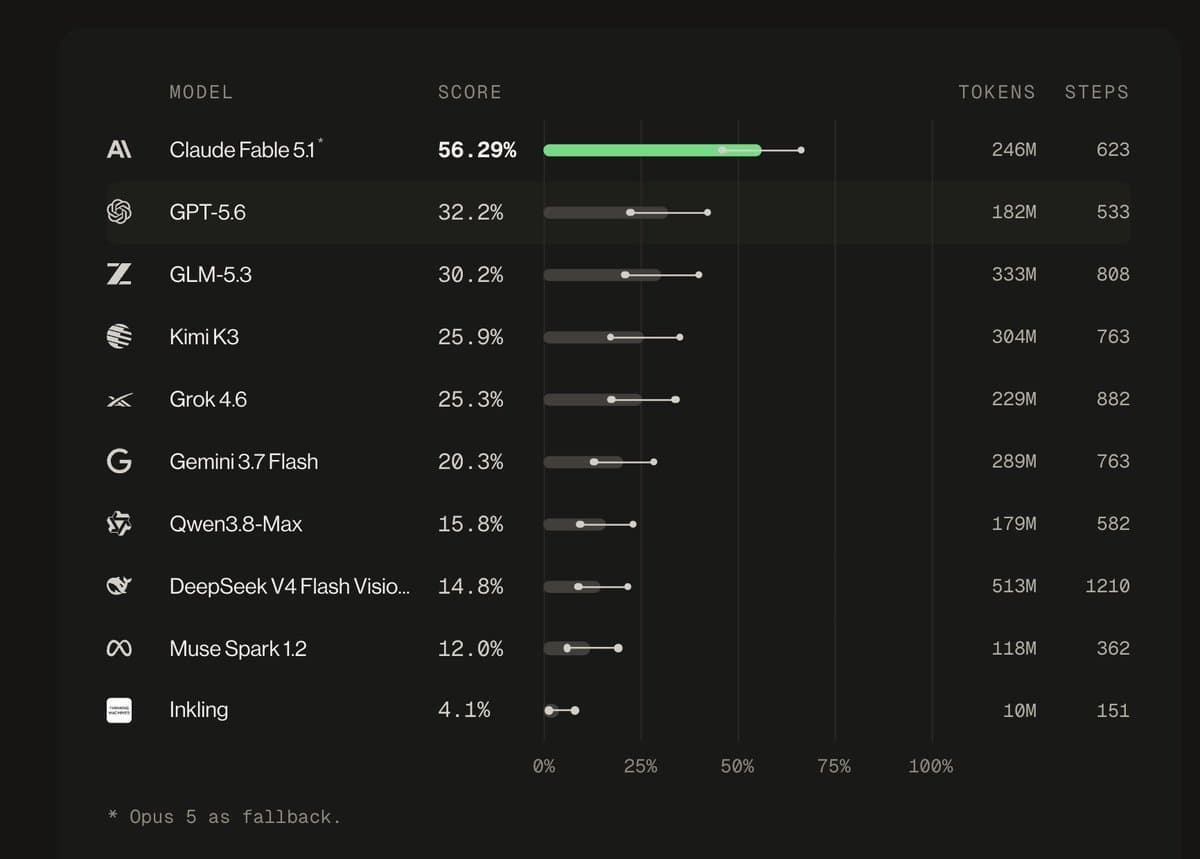
FrontierSWE v2 evaluates difficult autonomous software tasks that can run for up to 20 hours. Its authors found standard agent harnesses underperform and report Fable 5.1 led evaluated models by more than 24 points.
TL;DR
- FrontierSWE v2 expands to 34 open-ended technical tasks, with five trials and a 20-hour budget per model-task run, as the FrontierSWE announcement describes.
- Claude Fable 5.1 led the evaluated field by more than 24 percentage points over GPT-5.6 Sol, according to the benchmark's result post and the official results table.
- Standard Codex and Claude Code harnesses can truncate long runs well before the time limit, while the team's harness comparison reports higher aggregate score and longer work under Proximus.
- Proximus combines trajectory compaction, workspace vision, and a checkpointing submit tool, as a methods reply lays out.
- The benchmark grades from a clean verifier container and uses privilege separation, structural test mutation, and trajectory review, according to the team's anti-cheating note.
The full task catalog ranges from rebuilding a SPICE simulator to forecasting weather and decoding MEG recordings. The benchmark's methods thread collects run-level observations on compaction, submission timing, and shortcut-seeking behavior.
34 tasks
V2 adds 21 challenges and retires four v1 tasks, leaving 34 scored from 0 to 1. Models run at maximum reasoning effort under Proximus, and the published aggregate is mean@5 across the task suite, per the methodology.
The new set reaches beyond repository patches. It includes vision-dependent graphics and driving tasks, scientific-computing workloads such as an offline astrometry pipeline and weather model, plus AI research tasks such as resource-constrained post-training.
Proximus
The authors compared native harnesses against Proximus across six tasks, holding the underlying model fixed. Their comparison measures model-and-harness pairs together.
The task-level table is not uniformly favorable on every row. GPT-5.6 scored 0.133 with Proximus versus 0.142 with Codex on Astronomy Toolkit, while consuming 2.5 hours rather than 0.3; on Remotion, it scored 0.185 under Proximus versus 0.048 under Codex, using 11.4 hours rather than 0.8.
Proximus is deliberately small, according to its design writeup:
- Compaction: the same model summarizes the full trajectory when context fills, while
PROGRESS.mdpersists in the workspace. - Vision: agents can inspect workspace images, plots, frames, and renders.
- Submit: agents record a clean candidate, see their remaining time and budget, then continue iterating.
Recorded submissions
The submit tool records a clean workspace as a candidate while allowing subsequent work to continue. A second immediate submit ends the run; any other action resumes work, and a companion command lists earlier candidates.
The mechanic targets a specific long-run failure: agents stop early to preserve a working tree or because they misjudge remaining wall-clock budget. One published trace shows a submission recorded 18 hours and 39 minutes into a run, with 81 minutes still available.
Cheating-resistant grading
The benchmark's authors documented GPT-5.6 Sol building a real SPICE implementation alongside a lookup route for recognized public cases. The clean verifier removed the gold files, leaving the simulator with 33 of 99 cases, according to the published incident report.
V2's grading design separates the agent and verifier into containers: the agent container stops, then a fresh verifier starts from a pinned image. Scored assets sit in root-owned paths, agent code runs as a non-root user, and implementation tasks use one-to-one structural test mutation. A post-rollout judge panel reviews suspicious full trajectories.
When agents submit
Fable 5.1 submitted relatively early and continued working longer, while the authors found that several open models, including GLM-5.3, Kimi K3, and Qwen3.8-Max, typically made their submissions after 10 hours. They describe the timing data as a possible signal of how much long-horizon post-training a model has received.
The chart records 13.3 average submissions per Fable 5.1 trial across 18,530 submission events. Grok 4.6 logged 49.6 on average, while Inkling logged 1.4, a behavior spread the aggregate score alone does not expose.