
Google ships Gemini 3.6 Flash and 3.5 Flash-Lite to serving platforms
Gemini 3.6 Flash and 3.5 Flash-Lite went live on OpenRouter, Venice, Hyperbrowser, and Google surfaces. Early benchmarks show lower token use and cost, but mixed document and coding results.
TL;DR
- Google shipped three Flash models: GoogleDeepMind's launch post framed 3.6 Flash as the workhorse, 3.5 Flash-Lite as the fast low-cost model, and 3.5 Flash Cyber as a CodeMender security model.
- Gemini 3.6 Flash's cleanest win is efficiency: WesRoth's Artificial Analysis screenshot shows the same Intelligence Index score as 3.5 Flash, 50, while time per task fell from 2.7 minutes to 1.3 minutes.
- The agentic benchmark chart moved: DeepSWE rose from 37% to 49%, MLE-Bench from 49.7% to 63.9%, and OSWorld-Verified from 78.4% to 83.0%, according to rohanpaul_ai's benchmark chart.
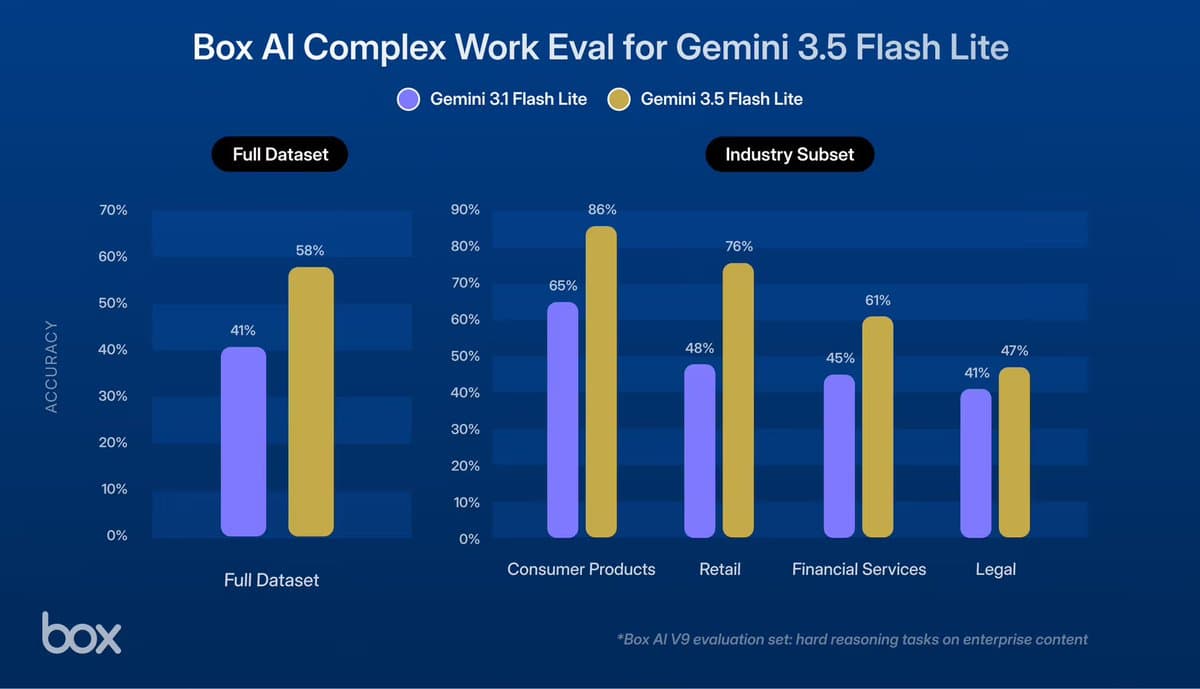
- 3.5 Flash-Lite is the cheap subagent SKU: _philschmid's post put it at 350 output tokens per second, $0.30 per 1M input tokens, $2.50 per 1M output tokens, and a Box document-reasoning jump from 41% to 58%.
- The caveats arrived quickly: jerryjliu0's ParseBench table measured document-understanding regressions, while ValsAI's result put 3.6 Flash nearly identical to 3.5 Flash on the Vals Index.
Google's developer guide says gemini-3.6-flash and gemini-3.5-flash-lite are GA, with 1M-token context, 64K max outputs, thinking, and built-in tools including Computer Use. The Gemini 3.6 Flash Enterprise page lists migration gotchas: custom temperature, topP, topK, frequency penalty, and presence penalty are unsupported, either ignored or future errors. The DeepSWE leaderboard puts 3.6 Flash high at 49% ±5%, $3.53 per task, 97K output tokens, and 108 steps.
What shipped
Google's official announcement split the release into three Flash-family models:
- Gemini 3.6 Flash: workhorse model for coding, knowledge work, multimodal tasks, and agentic workflows.
- Gemini 3.5 Flash-Lite: fastest and lowest-cost 3.5-class model, aimed at high-volume execution.
- Gemini 3.5 Flash Cyber: a cybersecurity model used inside CodeMender to find, validate, and patch vulnerabilities.
The Google AI developer guide lists model IDs and defaults:
gemini-3.6-flash, medium thinking by default, $1.50 per 1M input tokens, $7.50 per 1M output tokens.gemini-3.5-flash-lite, minimal thinking by default, $0.30 per 1M input tokens, $2.50 per 1M output tokens.
Google's Gemini Enterprise docs for 3.5 Flash-Lite describe it as a replacement target for Gemini 2.5 Flash and less complex Gemini 3 Flash workloads.
Where it shows up
The release landed across first-party and inference-router surfaces on day one:
- Google Search, Gemini app, Google AI Studio, and Android Studio, according to GoogleDeepMind's availability note.
- OpenRouter, where OpenRouter's launch thread put Gemini 3.6 Flash and 3.5 Flash-Lite at 150+ tok/s for agents.
- Venice, where AskVenice's rollout post said both models were live, and AskVenice's follow-up linked anonymous 3.6 Flash chat.
- Hyperbrowser, where hyperbrowser's launch note paired 3.5 Flash-Lite with stealth browsing, proxies, captcha solving, and live browser view.
- Antigravity, where Lentils80's prelaunch screenshot showed
gemini-3.6-flash-tieredbefore the broader announcement.
One early user moved a Hermes agent to Gemini 3.6 Flash and said the first 45 minutes were going well, according to ai_for_success's setup screenshot.
Agent benchmarks
Google's evaluation methodology page says Gemini scores were pass@1 unless noted, used gemini-3.6-flash through the Gemini API, and used single-attempt settings without majority voting or parallel test-time compute.
The headline deltas versus 3.5 Flash:
- DeepSWE v1.1: 37% to 49%, +12.0 points, per rohanpaul_ai's chart.
- MLE-Bench: 49.7% to 63.9%, +14.2 points, per rohanpaul_ai's chart.
- GDPval-AA v2: 1349 to 1421, +72 Elo, per rohanpaul_ai's chart.
- OSWorld-Verified: 78.4% to 83.0%, +4.6 points, per rohanpaul_ai's chart.
The independent DeepSWE page also lists Gemini 3.6 Flash high at 49% ±5%, and datacurve's DeepSWE post compared that result to Opus 4.8 at medium reasoning.
Speed and token economics
Artificial Analysis is the source of the simplest read on the release: same intelligence score, much shorter task time. WesRoth's screenshot put Gemini 3.6 Flash and 3.5 Flash both at 50 on the Intelligence Index, while average decode time per task fell from 2.7 minutes to 1.3 minutes.
DeepSWE's cost curve moved more sharply. datacurve's efficiency note said Gemini 3.6 Flash used 65% fewer output tokens per task and cost 52% less per task than its predecessor while scoring higher.
OpenRouter's pages add the deployment angle: its Gemini 3.6 Flash page emphasizes lower token usage and fewer calls, while its 3.5 Flash-Lite page frames the smaller model around document processing, agentic search, and subagents.
ValsAI got a flatter result. ValsAI's note measured $1.40 per test for 3.5 Flash versus $1.45 for 3.6 Flash, with higher 3.6 latency that it said was likely a release-day inference-load artifact.
3.5 Flash-Lite
Cheap perception is the fun SKU here. _philschmid's post listed 350 output tokens per second, $0.09 per task on Artificial Analysis, and a Box complex document-reasoning jump from 41% to 58%.
The model also went straight into web-agent infrastructure. hyperbrowser's first run said one Flash-Lite browser task used 21,173 input tokens and 863 output tokens, finished in 5 steps, and streamed every click and scroll live.
A second Hyperbrowser run used Gemini 3.5 Flash-Lite for a multi-hop research task across GitHub docs. hyperbrowser's thread said the model found REST API rate limits, checked GraphQL differences, and summarized both after 24 browser steps.
Flat spots and regressions
Document understanding did not follow the agentic benchmark chart. jerryjliu0's ParseBench post said later Flash models looked post-trained toward coding and reasoning, with visual-recognition capabilities plateauing.
ParseBench's table showed the split:
- Gemini 3.6 Flash average score: 69.9 to 66.8, -3.1 points versus 3.5 Flash.
- Gemini 3.6 Flash chart rule pass rate: 45.0 to 31.0, -14.0 points.
- Gemini 3.6 Flash layout score: 65.1 to 67.3, +2.2 points.
- Gemini 3.5 Flash-Lite layout score: 55.3 to 66.0, +10.7 points versus 3.1 Flash-Lite.
- Gemini 3.5 Flash-Lite table score: 85.5 to 73.5, -12.0 points.
ValsAI found another flat spot. ValsAI's Index result put Gemini 3.6 Flash at No. 14, nearly identical to Gemini 3.5 Flash within error margins, and ValsAI's qualitative note said final responses were more concise on its Finance Agent Benchmark without reducing total trajectory tokens.
OfficialLoganK gave the clearest explanation for the mismatch: OfficialLoganK's reply said 3.6 Flash was pushed on real-world agentic tasks, while Artificial Analysis mostly covers reasoning benchmarks and “we weren’t focused on those.”
Early hands-on reports were noisy. Lentils80's first outputs called two frontend and spatial-reasoning prompts the worst results they had seen, while ai_for_success's Hermes setup was positive after a short run.
3.5 Flash Cyber
Google's Flash Cyber announcement says the model is built on 3.5 Flash and fine-tuned to find, validate, and patch vulnerabilities. Access starts as a limited CodeMender pilot for governments and trusted partners.
The CodeMender setup is multi-agent. testingcatalog's CodeMender excerpt says multiple 3.5 Flash Cyber agents work together to produce one combined report.
The CyberGym chart in testingcatalog's post put the field this way:
- Mythos Preview in Anthropic agent: 83.1%.
- Gemini 3.5 Flash Cyber in CodeMender, max 5 model calls: 83.2%.
- GPT-5.6 Sol in OpenAI agent: 83.6%.
- Mythos 5 in Anthropic agent: 83.8%.
- GPT-5.5-Cyber in OpenAI agent: 85.6%.
3.5 Pro and Gemini 4
The release also contained the roadmap note people were hunting for. haider1's screenshot quoted Google saying Gemini 3.5 Pro is already testing with partners and will be made broadly available “as soon as it’s ready.”
Google also said its team has started its most ambitious pre-training run yet for Gemini 4, according to haider1's roadmap screenshot. haider1's follow-up framed the timing bluntly: 3.6 Flash is a good release, but attention is already shifting to 3.5 Pro and 4.0.