
Google AI Studio updates Build with Antigravity and one-click Firebase
Google rebuilt AI Studio Build around the Antigravity coding agent, one-click Firebase auth and databases, multiplayer backends, and persistent sessions. It pushes AI Studio closer to production app scaffolding and gives Firebase Studio users a clear migration path.
TL;DR
- Google AI Studio's new Build experience now bundles one-click database setup, Sign in with Google, multiplayer and backend app support, and a coding agent powered by Antigravity into the same workflow, according to Logan's launch thread.
- Google's own AI Studio post adds concrete implementation details that matter for engineers: persistent builds that keep running after you close the tab, live service connections, and UI/package support including shadcn, Framer Motion, and npm.
- Additional launch details from Phil Schmid's summary point to Firebase-backed auth and Cloud Firestore, built-in support for Next.js, React, and Angular, plus a new Secrets Manager for API keys.
- The rollout also doubles as a product consolidation move: the Firebase Studio shutdown notice says Firebase Studio's core capabilities are already in Google AI Studio and Antigravity, with shutdown running through March 2027.
What shipped in Build
The new Build release pushes AI Studio from prompt-to-prototype toward prompt-to-scaffolded app. In the launch thread, Google lists "one click database support," "Sign in with Google support," multiplayer, backend app support, and a new agent layer powered by Antigravity. Google's product post fills in the operational details: builders can connect "real services," use persistent builds so work continues even after a tab closes, and pull in shadcn, Framer Motion, and npm packages.
A separate launch summary from Phil Schmid's breakdown adds the framework and security specifics missing from the teaser posts. He says the stack now integrates Firebase for auth and Cloud Firestore, supports Next.js, React, and Angular out of the box, and stores API keys in a new Secrets Manager. That makes this less of a toy "vibe coding" surface and more of a managed full-stack bootstrap path, especially for teams already using Google's frontend and backend stack.
How Antigravity changes the workflow
The most interesting new capability is not the UI refresh but the agent behavior around real app state. In Paige's debugging report, a permissions issue on a live site was fixed after a plain-language prompt; Antigravity reportedly inspected logs, opened the Firebase console, found the right project, changed the database configuration through the UI when "there wasn't an SDK," and then verified the fix. The claim is anecdotal, but it sketches the intended workflow: the agent is not limited to code generation and can traverse consoles, logs, and deployment state.
That fits the launch framing from the main announcement, which positions Antigravity as the engine behind the new coding experience rather than an optional assistant bolted onto an editor. Supporting posts also suggest Google is trying to remove cross-product friction: another builder says database and Google auth can now be added in "a couple of clicks or prompts," without bouncing between Google Cloud and Firebase consoles.
Why this also looks like a Firebase Studio migration
The product story is also a platform story. The Firebase Studio shutdown notice says Firebase Studio will enter shutdown on March 19, 2026 and become inaccessible on March 22, 2027, while explicitly telling users that its core capabilities are already built into Google AI Studio and Google Antigravity. That makes this Build update the clearest migration target Google has shown so far.
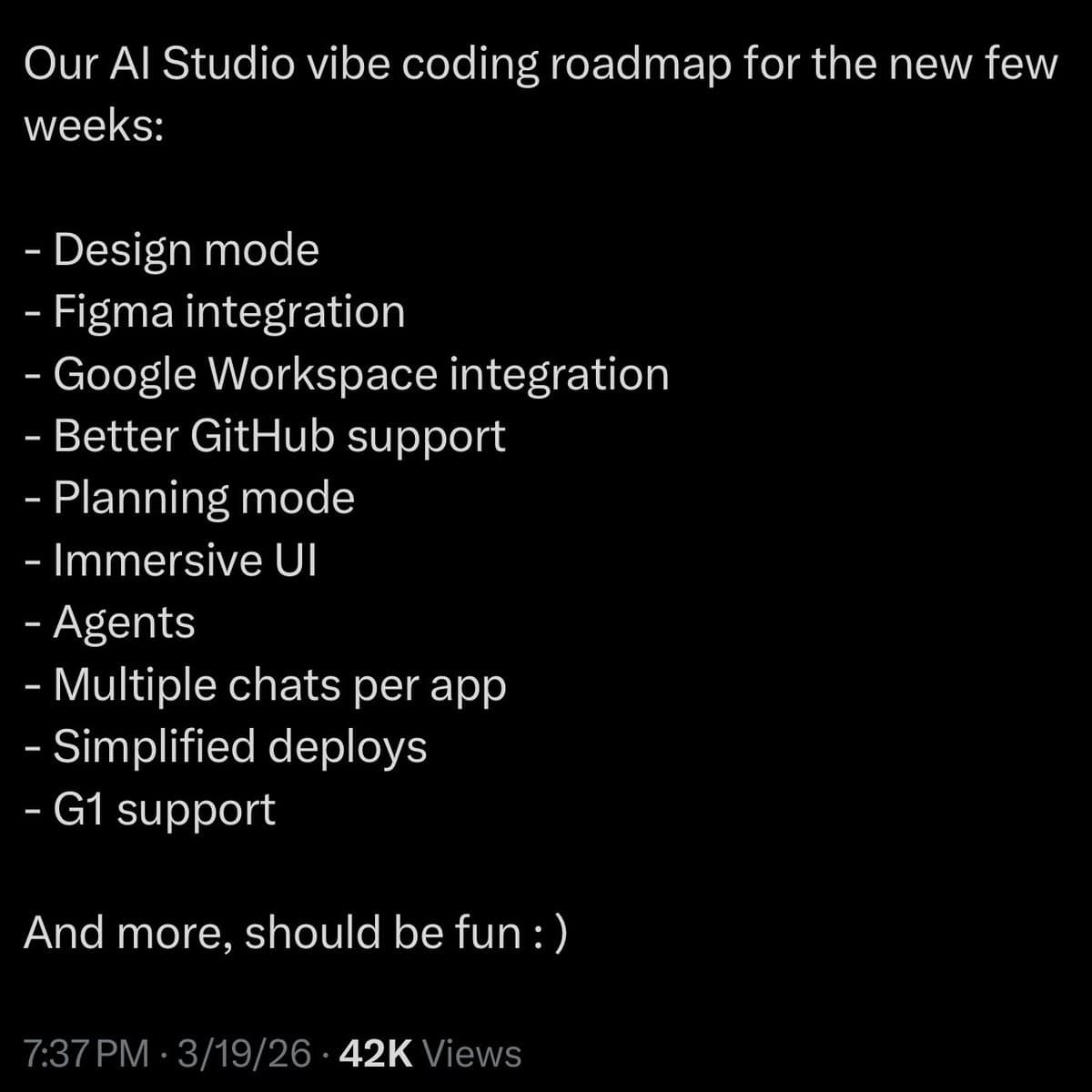
Google is also signaling that the rollout is unfinished. In the roadmap thread, the team lists Design mode, Figma integration, Google Workspace integration, better GitHub support, planning mode, simplified deploys, agents, multiple chats per app, and G1 support as near-term work. Taken together, the launch and roadmap show AI Studio Build moving past isolated prompt demos toward a more opinionated app-building environment that spans design import, agentic coding, backend wiring, and deployment.