
Hermes Agent integrates MCP Catalog, Qwen3.7 Max, Venice, and Krea 2 in one window
Hermes Agent added a built-in MCP Catalog while separate builders shipped Qwen3.7 Max support, Venice private-model workflows, and Krea 2 image generation. The cluster shows Hermes moving beyond a single-model assistant toward a broader agent shell with tool, model, and media providers.
TL;DR
- NousResearch's MCP Catalog post and the linked MCP docs show Hermes Agent adding a built-in catalog of preconfigured MCP servers, with one-click install for Nous-approved entries.
- Model support widened fast: NousResearch's Qwen 3.7 Max announcement added Alibaba's latest agent-focused model to Hermes, while AskVenice's walkthrough pitched the same computer-use flow on Venice-hosted Kimi K2.6 and Qwen 3.6 for a cheaper private setup.
- Hermes also grew sideways into orchestration and media: Teknium's OpenHands skill post added OpenHands as an optional skill, and NousResearch's Krea integration post plugged Krea 2 in as an image-generation provider.
- The rollout was not perfectly clean. bradmillscan's complaint captured gateway and provider failures, while Teknium's follow-up said an OpenAI Codex OAuth breakage was fixed after OpenAI changed its spec and Hermes shipped an update.
You can open the MCP Catalog docs, watch AskVenice's full computer-use walkthrough, and check the Atomic Bot iOS control app that showed up around the same window. The weird part is how many different surfaces moved at once: tools, model backends, agent-to-agent delegation, image generation, and even a mobile control layer.
MCP Catalog
Hermes' clearest product change this week was the built-in MCP Catalog. According to NousResearch's launch post, the catalog exposes preconfigured servers inside the agent, and Teknium's follow-up described them as trusted, already-available MCPs rather than raw endpoint plumbing.
The linked MCP Catalog docs, which NousResearch's docs link surfaced directly, frame it as "Catalog: one-click install for Nous-approved MCPs." That shifts Hermes a bit closer to an app shell for tools, not just a chat wrapper with model selection.
Model backends
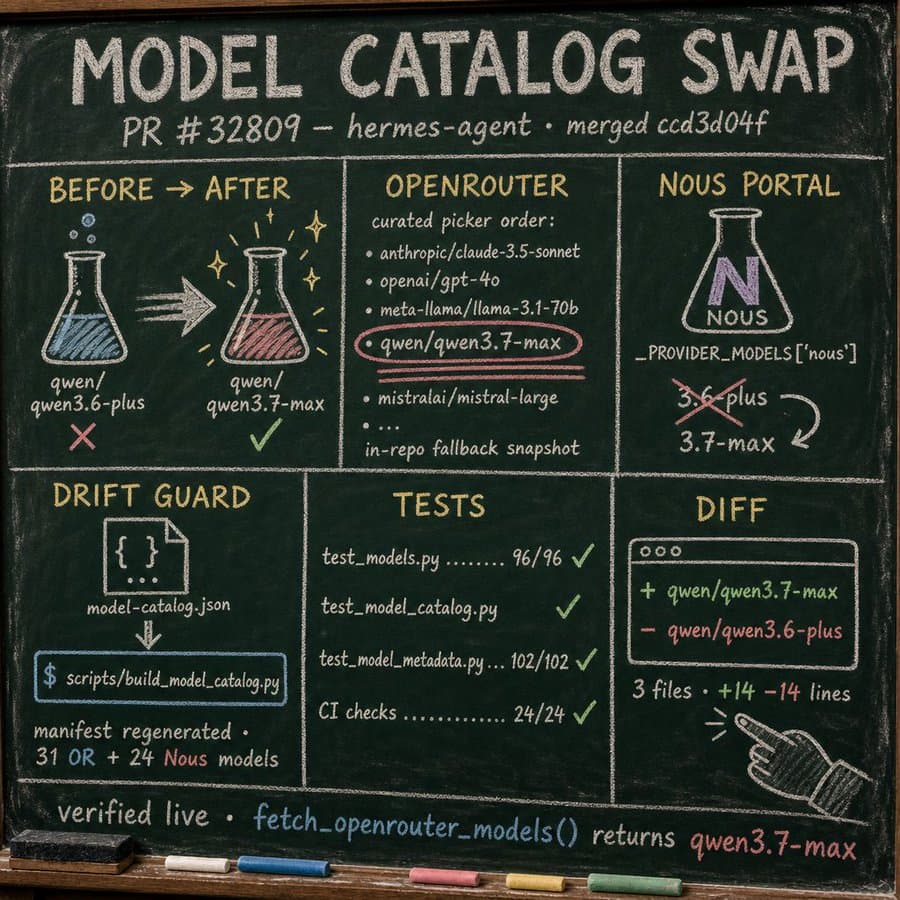
Hermes also widened the set of models it can sit on top of. NousResearch's Qwen 3.7 Max announcement said Qwen 3.7 Max was now supported, and WesRoth's post described it as access to Alibaba's latest agent-focused model inside the Hermes workflow.
AskVenice pushed a separate angle: AskVenice's thread opener argued that Hermes computer use does not need a frontier model, then used Venice-hosted Kimi K2.6 and Qwen 3.6 as the example stack. The company tied that claim to a private deployment pitch in AskVenice's follow-up, which pointed users to a Venice API key flow.
The result is a broader pattern than any single model add. Hermes is increasingly acting like a front end for interchangeable agent backends, with official support for one model family and community builders wiring in others through provider APIs.
OpenHands skill
The other notable expansion was agent orchestration. In Teknium's OpenHands skill post, Teknium said Hermes can now orchestrate OpenHands agents through an optional skill installed with hermes skills install official/autonomous-ai-agents/openhands.
That same post says Hermes already had built-in skills for Claude Code, Codex, OpenCode, and Hermes itself, with slash commands such as /<agent-name> <prompt> to force delegation. rbren_dev's repost echoed the OpenHands addition a day later, which makes the release look less like a one-off plugin and more like a growing skill-based router for other agent systems.
Krea 2
Hermes also added an image model provider. NousResearch's Krea integration post said Krea is built in as an image-generation API provider, exposing Krea 2 features including style transfer, moodboard input, and adjustable creativity settings.
Teknium's update note said users could access Krea support immediately with hermes update, ahead of the next major release. That is a small but useful tell about Hermes' release style right now: capabilities are landing continuously through updates and skills, not only through big tagged versions.
OpenAI OAuth turbulence
The messiest part of the week was provider reliability around OpenAI. bradmillscan's complaint described gateway errors and a rough first-run experience after adding ChatGPT OAuth, and Teknium's reliability check-in later asked users on the latest update whether OpenAI OAuth was working reliably yet.
The most concrete failure analysis came from altryne's patch writeup, which traced a NoneType object is not iterable crash to streamed Codex responses where the final response.completed frame omitted response.output. Teknium's response in the fix post blamed OpenAI's side, saying OpenAI changed the spec in the background and that users needed hermes update to pick up the fix. altryne's repost of Teknium's reply made the same point more bluntly.
Remote control
A separate builder shipped a mobile surface for Hermes. testingcatalog's Atomic Bot post highlighted an iOS app called Atomic Bot that controls a self-hosted Hermes agent running 24/7 on a VPS, with remote access over Tailscale, Cloudflare, or ngrok.
According to testingcatalog's follow-up, the agent stays on the user's own server and the iOS app acts as the control surface. That is a different kind of integration than MCP servers or model providers, but it fits the same story: Hermes is turning into an operating layer that other tools can plug into from above and below.