
Hermes Agent releases v0.2.0 with MCP client, editor links, and 70+ skills
Nous Research shipped Hermes Agent v0.2.0 after 216 merged PRs, adding native MCP support, editor integrations, worktree isolation, rollback, and a larger skills ecosystem. Try it in real repos if you want broader tool support, official Claude support, and lighter installs.
TL;DR
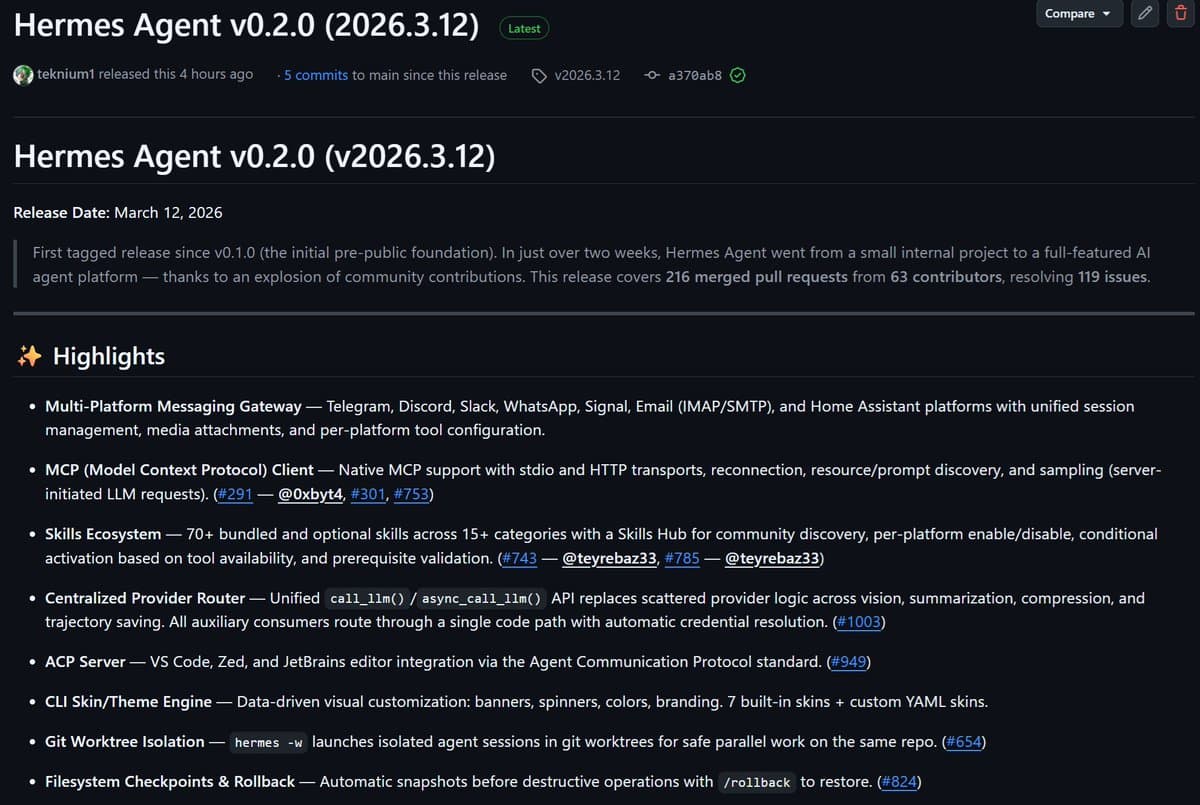
- Nous Research shipped Hermes Agent v0.2.0 after “216 merged pull requests from 63 contributors” in a little over two weeks, with native MCP support, editor connectivity, and a much larger tool surface according to the release post and Nous' announcement.
- The biggest implementation changes in the changelog are a native MCP client, an ACP server for VS Code, Zed, and JetBrains, and a centralized
call_llm()routing layer that replaces scattered provider-specific paths. - Hermes is also pushing harder on safe repo automation: the release notes add git worktree isolation for parallel sessions and filesystem checkpoints with
/rollbackbefore destructive operations. - A follow-up update from Teknium's thread adds official Claude provider support, lighter installs by making RL components optional, and a lower default context compression ratio that “might save some money.”
What actually shipped in v0.2.0
Hermes Agent's first tagged release since its pre-public foundation is less a point feature drop than a platform expansion. The release notes say v0.2.0 bundles a multi-platform messaging gateway across Telegram, Discord, Slack, WhatsApp, Signal, email, and Home Assistant, alongside “70+ bundled and optional skills” across more than 15 categories. The same release links to the full notes at the GitHub release.
The most relevant developer-facing additions are protocol and editor hooks. According to Nous' summary, Hermes now includes a native MCP client with stdio and HTTP transports, reconnection, prompt and resource discovery, and sampling for server-initiated model requests. It also ships an ACP server so the agent can plug into VS Code, Zed, and JetBrains over the Agent Communication Protocol instead of living only in its own CLI.
Under the hood, the release post says Hermes consolidated model access behind unified call_llm() and async_call_llm() APIs. That matters because vision, summarization, compression, and trajectory saving now share one routing path with automatic credential resolution rather than separate provider logic.
What changed for real-world repo use
The repo workflow changes are unusually concrete for an early agent release. In the release image, Nous says hermes -w launches isolated sessions in git worktrees, which lets multiple agent runs operate on the same codebase without stomping on each other. The same notes add automatic filesystem snapshots before destructive operations plus a /rollback command to restore prior state.
Reliability also appears to be a priority in this cycle. Teknium said a “huge foundational refactor” removed many issues caused by “model/provider switching/routing/handling” in an engineering update, and the release notes say test coverage grew to 3,289 tests across agent, gateway, tools, cron, and CLI components.
What landed immediately after the release
The first post-v0.2.0 update already changes the deployment picture. In Teknium's update, Hermes added official Claude provider support, made installs “much lighter” by moving RL-related pieces behind optional dependencies, and improved Slack integrations. Teknium also said the default context compression ratio was cut to 50%, which “might save some money.”
That follow-up also mentions an adapter PR to PaperClip, a multi-agent orchestrator, which points to a broader interoperability push beyond MCP and ACP. Taken together with the v0.2.0 release, Hermes is moving quickly from a standalone open-source agent into a protocol-aware, editor-connected platform aimed at day-to-day engineering workflows.