
Hermes Agent releases v0.9.0 with a local dashboard and monitoring APIs
Nous Research shipped Hermes Agent v0.9.0 with a local web dashboard, new monitoring APIs, and broader platform updates. Teams using multi-agent workflows should test the new controls for profile cloning and long-running dashboard-managed sessions.
TL;DR
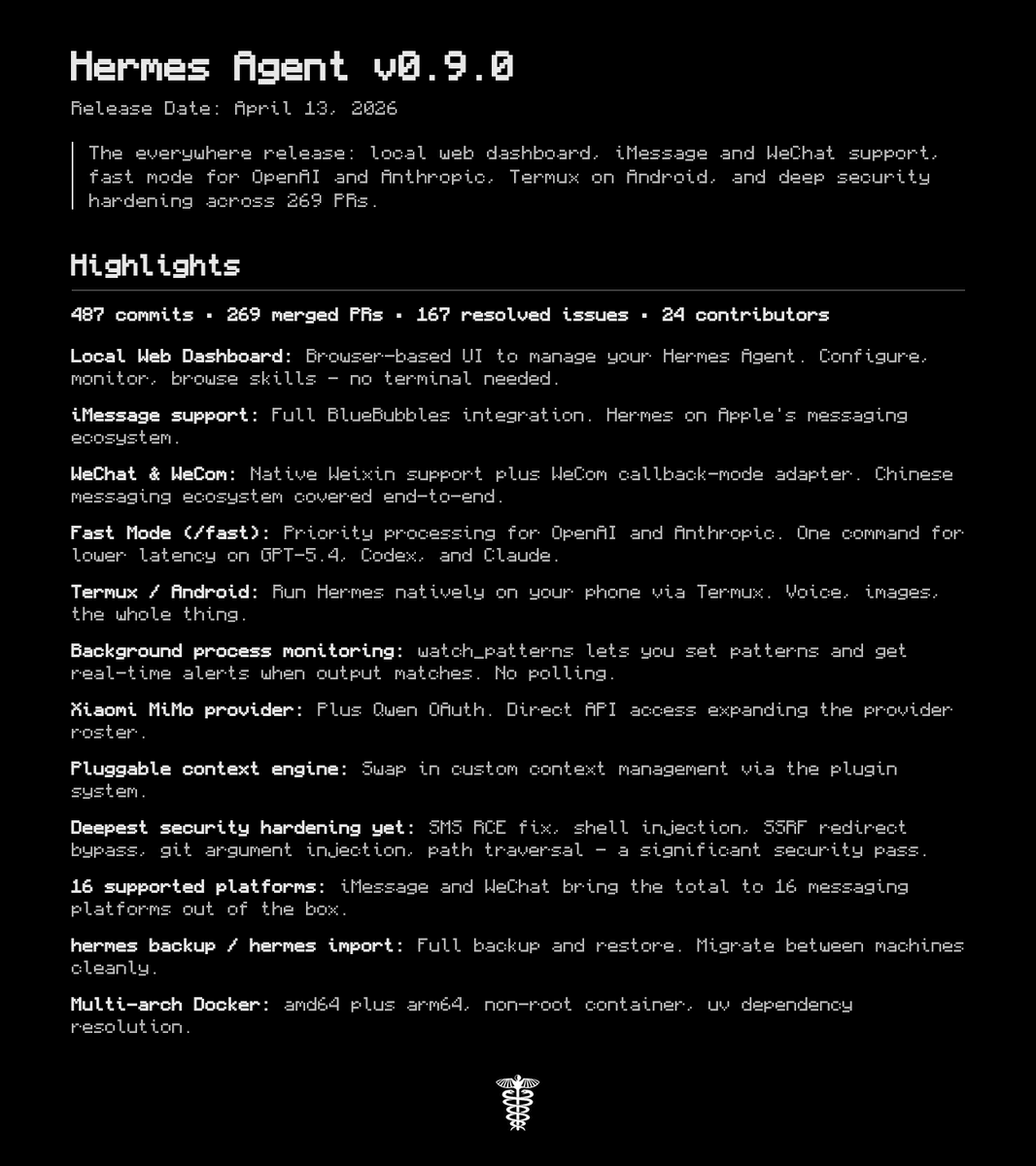
- Nous Research's launch post and the full release notes frame v0.9.0 as an "everywhere release," adding a local web dashboard, background process monitoring, Fast Mode routing, new messaging adapters, Android support, and a long list of security fixes.
- The headline feature is the local dashboard: Teknium called it the update many users had been waiting for, while Nous Research's screenshot shows a browser UI for status, sessions, and analytics that also appears in the CLI docs.
- The release adds two operator-facing controls that matter more than the marketing video: the
watch_patternsmonitor in the release file can alert on background process output in real time, and/fastroutes supported OpenAI and Anthropic models through priority queues. - Hermes also widened its deployment surface. According to the release notes, v0.9.0 adds iMessage via BlueBubbles, WeChat and WeCom support, Android via Termux, xAI and Xiaomi MiMo providers, and unified proxy handling across gateway platforms.
- The team also kept leaning into profile-based multi-agent work: coreyganim's workflow sketch describes cloning role-specific profiles with separate memory, while the official release adds backup, import, debug-share, and context-engine plugin hooks around that workflow.
You can browse the release notes, launch the new UI with hermes dashboard, and skim the homepage pitch that positions Hermes as a long-running server agent instead of an IDE copilot. The release file is also unusually dense: it claims 487 commits, 269 merged PRs, 167 resolved issues, 63,281 insertions, and 16 supported messaging platforms since v0.8.0. One of the more interesting low-level additions is watch_patterns, which lets Hermes wait for log text like "listening on port" without polling.
Local Web Dashboard
The dashboard is the cleanest signal that Hermes is trying to get less terminal-native without dropping its CLI roots. The release notes say the browser UI can configure settings, monitor sessions, browse skills, and manage the gateway locally, and the CLI reference lists hermes dashboard as a first-class command for config, API keys, and sessions.
That matters because most open agent tooling still treats observability as a pile of logs. The screenshot shows Hermes starting with explicit status, sessions, and analytics tabs, which is a more ops-shaped surface than the usual chat window plus YAML.
Monitoring and Fast Mode
The most practical addition in the changelog is watch_patterns. In the release file, Nous describes it as real-time matching on background process output, useful for error detection, build logs, and waiting for events like a service announcing that it is listening on a port.
The same release adds /fast, a routing toggle for OpenAI Priority Processing and Anthropic fast-tier models including GPT-5.4, Codex, and Claude. That gives Hermes a built-in latency knob instead of forcing users to swap providers or profiles just to change turnaround time.
Teknium also said Hermes had self-improved its GPT-5.4 prompting and steering, which makes the latency feature more interesting than a bare transport upgrade.
Messaging, Android, and Provider Sprawl
Hermes widened its surface area in several directions at once. The release notes list:
- iMessage support through BlueBubbles, with auto-webhook registration and setup-wizard integration.
- Native WeChat support through the iLink Bot API, plus a WeCom callback adapter for self-built enterprise apps.
- Android support through Termux, including mobile TUI adjustments, voice backend support, and on-device
/image. - First-class xAI and Xiaomi MiMo providers, plus Qwen OAuth portal support.
- Unified SOCKS and system proxy handling across gateway platforms.
The homepage already pitched Hermes as a cross-platform agent living across Telegram, Discord, Slack, WhatsApp, Signal, email, and CLI, and v0.9.0 pushes that story further into Chinese messaging, mobile, and firewall-heavy corporate environments.
Profiles, Skills, and the OpenClaw Comparison
The clearest community use case around this release is profile specialization. coreyganim describes a four-agent setup with cloned profiles for orchestration, research, writing, and building, each separated by its own SOUL.md and memory. That lines up with the official framing on the homepage, which sells Hermes as an agent that accumulates skills and memory over time rather than a disposable session runner.
Early user reaction also centered on speed and UX. After comparing Hermes with OpenClaw, dabit3 said Hermes felt about twice as fast and posted a terminal view showing 28 tools and 75 skills. The screenshot does not prove a benchmark, but it does show what Nous is shipping into the terminal: a large built-in tool and skill surface, plus delegate_task sitting next to browser, file, code-execution, and image tools.
Backup, import, and debugging
A quieter but durable part of v0.9.0 is the operational plumbing around long-lived agents. The release file adds hermes backup and hermes import for full snapshots of configuration, sessions, skills, and memory, while the CLI docs expose hermes debug and dashboard commands in the main shell interface.
That sits next to a broad security hardening pass in the release notes, including fixes for path traversal, shell injection in sandbox writes, SSRF redirects in Slack image uploads, Twilio webhook signature validation, API server auth enforcement, git argument injection, and approval-button authorization. For a product trying to live on servers, phones, and chat gateways at the same time, that list is Christmas come early for anyone who reads changelogs before marketing pages.