
Jev cuts Stagehand's median Act latency from 1.97s to 0.46s, Stagehand says
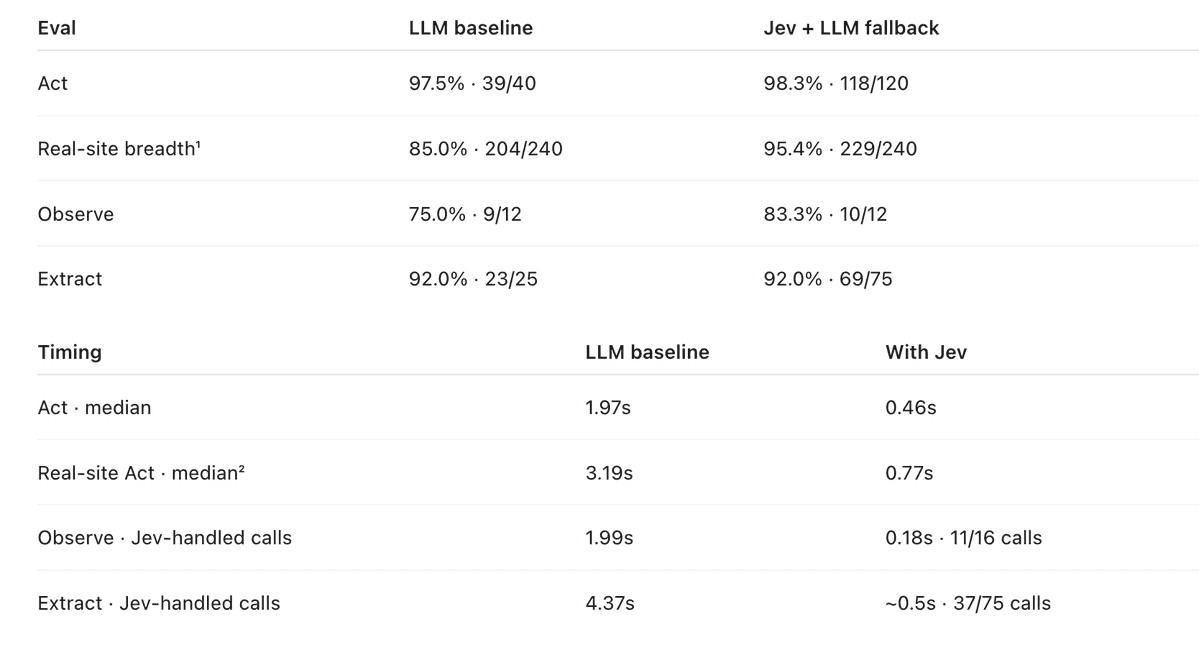
Stagehand says adding Jev to its browser primitives cut median Act latency from 1.97 seconds to 0.46 seconds. Jev handles page-level choices and falls back to an LLM when uncertain.
TL;DR
- Stagehand says its Jev-backed
Actpath cut median latency from 1.97 seconds to 0.46 seconds, while task success rose from 85% to 95.4% across 240 real-site runs, per kylejeong's early evaluation. - The browser loop sends an accessibility-tree view of the page plus proposed actions to Jev, then lets Stagehand execute the selected action, according to kylejeong's browser-loop post.
- A fill instruction becomes three bounded decisions, action type, text, and destination field, in kylejeong's Act breakdown.
- The Stagehand integration is an experimental branch, as kylejeong's branch announcement makes clear.
The Stagehand repository guide lists act, extract, observe, and agent as its core browser-agent methods. The Jev path makes the model a selector over page-derived candidates, while Stagehand executes the browser operation and falls back to an LLM when the choice is uncertain, as kylejeong's selection-loop explanation describes.
Candidate actions
Stagehand turns the page into candidates with context such as labels, headings, and table rows. Jev picks an action from that set, and uncertain selections route to an LLM in kylejeong's explanation.
The request shape separates shared browser state from decisions:
state: task, page, browser, and recent actions.questions: operation, click target, input target, input value, and whether the goal is complete.
That schema appears in kylejeong's request example. It gives deterministic browser code a selected operation and target instead of requiring it to interpret prose returned by the model.
Act, Observe, Extract
Stagehand applies Jev to its three browser primitives as a decision layer, covering the element to click, field to fill, and text to extract kylejeong's primitives post.
- Act: kylejeong's Act breakdown splits “type San Francisco into the destination field” into identifying
fill, identifying the text, and choosing the destination input. Stagehand then fills the field and checks its value. - Observe: kylejeong's Observe explanation uses one candidate selection for a single result, or batches match questions when several page elements may qualify.
- Extract: kylejeong's Extract explanation has Jev select the source elements; Stagehand copies their text, parses numbers, resolves URLs, and identifies repeated-card fields.
Act latency
Stagehand's reported median drop is 1.51 seconds, or about 76.6%, and its 85% to 95.4% success change is a 10.4-point increase. The team labeled the figures early evaluations, rather than a general browser-agent benchmark.
A separate Android experiment from kevinkern's Wikipedia test reported Jev running a 15-step Wikipedia task about 14.8 times faster than DeepSeek plus vision. That is a one-task comparison, but it points at the same bottleneck: repeated UI decisions inside a run.
Confidence gate
TypeSafe's primitives documentation defines three answer shapes: Choice returns an option, probabilities, and confidence; Score returns a rubric position with probabilities and confidence; Noul returns a 0-to-1 boolean probability. The system can ask several questions over the same state in one call.
Stagehand maps those forms onto browser control: Choice selects an action, Noul judges completion or action readiness, and Score measures action progress. It executes actions through a confidence-gated route, according to kylejeong's confidence-gating post.
TypeSafe describes the underlying model as a System One model built around structured decisions, a parallel sampler, and its RLCD training method in its Jev launch post.
Experimental branch
Stagehand asked for feedback on the experimental branch rather than presenting the Jev path as a default production mode in kylejeong's branch announcement. The public Stagehand API still exposes the broader browser-agent surface, including agent, alongside the three primitives.
Cline's browser plug-in
The pattern has already reached another coding-agent surface. cline's plug-in announcement says its Desktop beta ships a jev-browser marketplace plug-in that takes an AI Gateway key and launches Chrome in the background for a requested browser task.