
Martian launches Ship beta with 50% lower-cost inference target
Martian launched Ship, a beta endpoint that sits between an app and its reference model and routes each request through cheaper paths while aiming to preserve behavior. Martian says the beta targets 50% lower cost.
TL;DR
- Martian launched Ship as a beta inference endpoint that sits between an app and its reference model, with testingcatalog's launch post saying the public endpoint runs against a quality SLO and enterprise customers can contract the same measurements as an SLA.
- The integration path is a model-prefix swap: _avichawla's terminal test changed
claude-opus-4-8toship-like/claude-opus-4-8and got a standard Anthropic-style response back at half the cost. - Ship's core move is runtime execution search, with rohanpaul_ai's thread framing it as a JIT-like layer that can blend models, tools, harnesses, cascades, and ensembles.
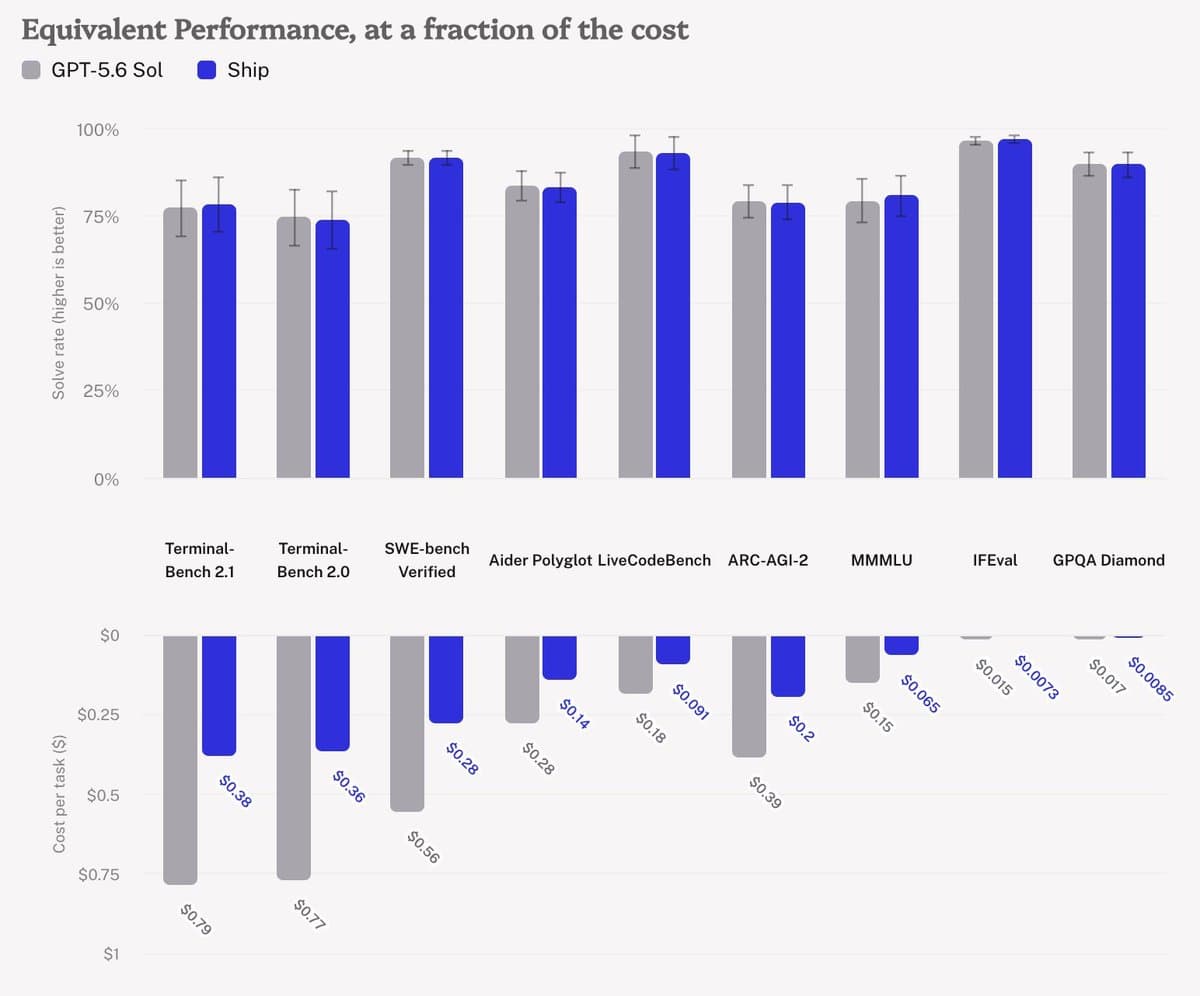
- The benchmark evidence is still provider-side, but karinanguyen's screenshots show near-matched solve rates, lower cost per task, and a claimed 91% distributional overlap with Claude Opus 4.8 behavior.
Martian's public Gateway docs already describe the substrate: one API for 200+ models, compatible with OpenAI and Anthropic formats. The quickstart shows the same base URL pattern, while the launch posts add the weirder bit: a ship-like/ prefix that asks the endpoint to imitate the model named after it. karinanguyen's post includes the spicy chart: Ship reportedly behaves more like Claude Opus 4.8 than same-family models do.
Model-prefix swap
The beta pitch is one line of application code:
_avichawla said the response came back as a standard Anthropic message with similar output, usage fields, and stop reasons, which means existing parsing code stayed unchanged in that test.
That matches Martian's public API shape. The API reference documents /v1/chat/completions for OpenAI-style calls and /v1/messages for Anthropic-style calls, and the quickstart says the Gateway uses https://api.withmartian.com/v1 as the base URL.
Execution search
Ship is closer to runtime specialization than a static routing table. _avichawla's writeup says Ship searches possible executions after seeing a request, including:
- single models
- cascades
- ensembles
- harnesses with tools
- interventions on model activations
rohanpaul_ai compared the design to a just-in-time compiler, because the system chooses a cheaper execution path at inference time while targeting the named model's capability and behavior.
Martian has been building toward this framing for a while. Its original model-router post claimed routing could deliver higher performance and lower cost than a single provider, and its later Pareto-frontier post described model selection as a cost-quality frontier problem.
Quality SLO
The important contract is behavioral equivalence, not token identity. rohanpaul_ai's reply called the target “statistical non-inferiority,” and kimmonismus's summary said the public SLO measures retained capability and output drift from the reference model.
testingcatalog said the public endpoint runs against a quality SLO, while enterprise teams can contract the same measurements as an SLA.
That distinction matters because model calls are already nondeterministic. _avichawla wrote that Ship outputs are not token-identical, because two calls to the same model can differ, but are measured to stay statistically indistinguishable in capability and behavior.
Benchmarks and overlap
karinanguyen's screenshots put two claims next to each other: a radar chart saying Ship has 91% distributional overlap with Claude Opus 4.8, and a benchmark table comparing ship-like GPT-5.6 Sol against GPT-5.6 Sol.
The table's cost-per-task pairs for GPT-5.6 Sol versus ship-like GPT-5.6 Sol are the clearest numbers:
- Terminal-Bench 2.1: $0.787 → $0.382
- Terminal-Bench 2.0: $0.769 → $0.364
- SWE-bench Verified: $0.556 → $0.279
- Aider Polyglot: $0.276 → $0.141
- LiveCodeBench: $0.184 → $0.091
- ARC-AGI-2: $0.387 → $0.195
- MMMLU: $0.150 → $0.065
- IFEval: $0.015 → $0.007
- GPQA Diamond: $0.017 → $0.009
The solve-rate rows in the same screenshots mostly sit within small margins of the reference model: SWE-bench Verified is 91.8% for GPT-5.6 Sol versus 91.7% for Ship, while LiveCodeBench is 93.3% versus 93.9%.
Fixed 50% price
The commercial claim is a fixed 50% discount on every request using the ship-like/ prefix. omarsar0 said Thesean covers the difference if a request costs more to execute than the customer paid.
omarsar0's follow-up framed inference cost as a ceiling on how many agent runs, retries, and verification passes a team can afford. The punchline for coding-agent shops is obvious enough: a verified half-price run changes the budget math for loops, not just one-off chat calls.
Gateway substrate
Martian's model catalog docs say Gateway prices are shown per 1M input and output tokens, with cache read and write prices where providers support prompt caching, and that model prices are fetched from the Gateway API every five minutes.
rohanpaul_ai's prefix example shows Ship using the same model field abstraction: change model="<original>" to model="ship-like/<original>".
The public docs still describe the broader Gateway surface, not the Ship measurement machinery. testingcatalog supplies the launch-specific SLO/SLA claim, while karinanguyen's screenshots supply the distributional-overlap and benchmark evidence.
Provider-reported caveat
The caution is simple: the equivalence and benchmark claims are launch-side claims so far. WesRoth called them provider-reported and unverified, then pointed at the new negotiation surface: whether “the intelligence itself arrived intact.”
That is the right skepticism to attach to Ship. The public artifact is not only uptime, latency, or token price; it is a measured claim that an optimized execution preserves the model contract an app was built around.
Kilo Code stealth usage
Kilo Code said it had already been running Ship as a stealth model and called it “one of the most used of all time” on its platform. Kilo Code said the launch starts bringing those models out of stealth.
That is the first ecosystem breadcrumb in the evidence pool: Ship was not only announced as a fresh beta endpoint, it had already been tested behind another product surface before the public launch.