
Meta releases Muse Spark 1.3 with 20% fewer tool calls
Meta is rolling out Muse Spark 1.3 in Muse Code and the Meta Model API for coding and agentic work. Meta says it uses about 20% fewer tool calls and 25% fewer tokens than version 1.2.
TL;DR
- Muse Spark 1.3 is rolling out in Muse Code and the Meta Model API, which alexandr_wang's announcement calls Meta's most capable Spark model so far.
- Meta reports roughly 20% fewer tool calls and 25% fewer tokens than Spark 1.2 in its internal comparisons, according to alexandr_wang's follow-up.
- The model is trained to ask clarifying questions, report when it is stuck, and seek confirmation before consequential actions, as AIatMeta's capability list describes.
- Meta's first-party table puts DeepSWE v1.1 at 75.4%, up from 55.0% for Spark 1.2, in finkd's launch post.
- Artificial Analysis puts the publicly available xhigh variant at 61 on its Intelligence Index, up from 57 for 1.2, while its limited-preview max variant reaches 62 in ArtificialAnlys' analysis.
Meta's release note says the model was shaped by production use of Muse Code and its API. The Artificial Analysis breakdown finds the improved index score is concentrated in agentic tasks, while LiteLLM's day-zero integration lists a Contributor SKU with a radically cheaper, rate-limited price schedule.
Muse Spark 1.3
Spark 1.3 is available in Muse Code and the Meta Model API now. In AIatMeta's rollout update, Meta said its existing reasoning modes ship immediately, while maximum reasoning will follow additional safety testing.
Meta also flagged larger Muse models, Spark open weights, and new products as upcoming work in AIatMeta's roadmap post. The model line has moved quickly: ren_hongyu described versions 1.1 through 1.3 arriving within two months.
Agent behavior
Meta frames the release around longer-running, user-in-the-loop work:
- Sustain several workflows in one thread.
- Ask clarifying questions for ambiguous prompts.
- Flag that it is stuck and seek help.
- Confirm before consequential actions.
- Calibrate its limits rather than claim an outcome it cannot deliver.
The behavioral work was explicit. shuchaobi said Meta spent more grading compute on laziness, instruction following, hedging, reward seeking, and reward hacking.
Long context and coding
Meta's chart compares Spark 1.3 max with Spark 1.2 xhigh, so these are mode-to-mode results rather than a like-for-like xhigh comparison.
- MRCR at 256K to 512K: 66.3% to 98.5%, a 32.2-point gain; at 512K to 1M: 55.5% to 98.1%, a 42.6-point gain.
- DeepSWE v1.1: 55.0% to 75.4%, a 20.4-point gain; SWEAtlas CodeBase QnA: 46.2% to 59.4%, a 13.2-point gain.
- OSWorld 2.0: 47.6% to 66.9%, a 19.3-point gain; Terminal-Bench 2.1: 82.9% to 88.8%, a 5.9-point gain.
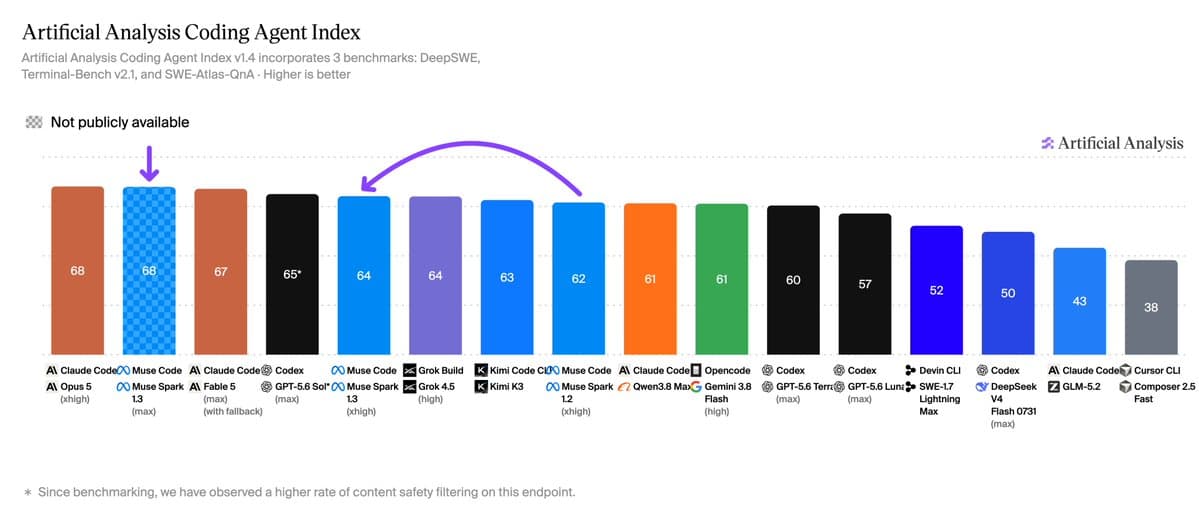
On Artificial Analysis' coding-agent harness, the public xhigh configuration rose from 62 to 64, while the limited-preview max configuration scored 68. ArtificialAnlys' Coding Agent Index post places that max result level with Claude Opus 5 xhigh, but excludes it from cost comparisons because Meta has not published its price.
Token accounting
The headline efficiency figures come from Meta's internal comparisons. The company's release note reports 20% fewer tool calls and 25% fewer tokens than 1.2, alongside fewer unnecessary turns and a less verbose coding style.
Artificial Analysis measured a different workload and saw the opposite direction in total task input: xhigh cost $0.55 per Intelligence Index task versus $0.40 for Spark 1.2, with about 57% more input tokens and only 8% more output tokens in its agentic evaluations, according to ArtificialAnlys' analysis. The internal and external figures therefore do not provide a direct before-and-after token measurement.
Pricing and access
The xhigh model retains Spark 1.2's $1.25 per million input tokens, $4.25 per million output tokens, and $0.15 cached-input rate. ArtificialAnlys' cost analysis calculates $0.55 per Intelligence Index task, below the $0.94 to $0.95 it reports for Grok 4.6 high and GPT-5.6 Sol max at the same 61 index score.
OpenRouter's provider listing publishes the same standard token rates. LiteLLM lists muse-spark-1.3-contributor at $0.10 input, $0.20 output, and $0.002 cached input per million tokens, with 100 requests per minute per team versus 3,000 RPM for the standard tier in its integration post. Pricing for the preview-only max variant remains unpublished.
Integration surfaces
The first-party entry points are Muse Code and Meta Model API. It can also be tried in opencode, per alexandr_wang's opencode reply.
Arena added Spark 1.3 to its Agent Arena, where models receive web-search, filesystem, and terminal tools, and to Code Arena's WebDev, Text, Vision, and Document categories.
Muse Code
Muse Code has separately moved out of beta with a developer-preview SDK for embedding agents, connecting custom tools, streaming progress, and resuming sessions.
Its workflow layer adds two concrete coordination primitives:
- Inter-session messaging lets sessions share state directly when work overlaps.
- Workflows split a task across focused agents, pass intermediate work between stages, and return one result.
alexandr_wang's Muse Code thread describes the latter as multiple teams of subagents handling complex work. Meta also published a one-command installer in alexandr_wang's install post and is rolling out monthly subscription plans.