
Xiaomi releases open-weight MiMo-V2.6 models with 1M-token context
Xiaomi released Pro and Flash MiMo-V2.6 mixture-of-experts models with open weights and a 1M-token context window. The release includes an RL dashboard and day-one vLLM support, while training artifacts are planned.
TL;DR
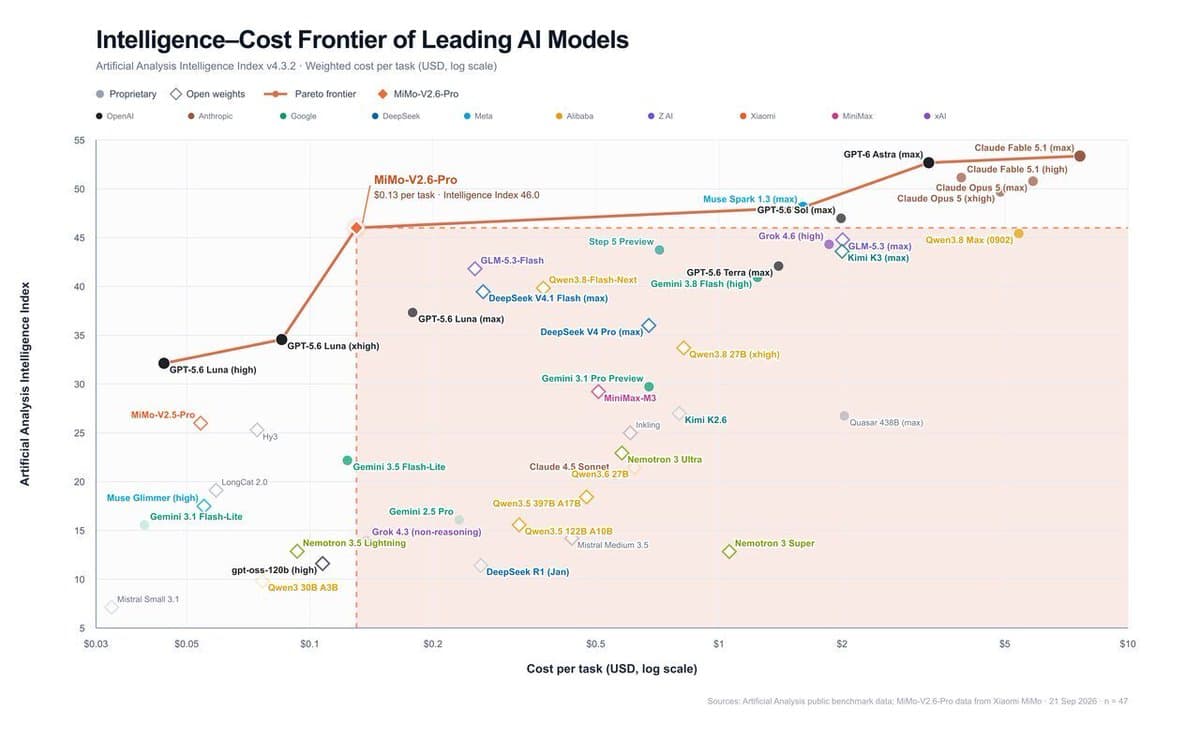
- Pro now leads the open-weights slice of Artificial Analysis’ Intelligence Index at 46, up 20 points from MiMo-V2.5-Pro’s 26, according to the benchmark announcement.
- Both released checkpoints take text, image, video, and audio across a 1M-token context window, while OpenRouter's launch thread identifies Pro as the 1T-plus flagship and Flash as the smaller MoE.
- Xiaomi coupled the weights with an unusually broad RL package: Vtrivedy10's release excerpt quotes the release as including 7K-plus task environments, an end-to-end framework, and composable mini-harnesses.
- Open serving arrived immediately: vllm_project's day-zero post lists native FP8 weights, MiMo reasoning and tool-call parsers, and DFlash speculative decoding support.
Xiaomi’s Pro model card puts a five-layer speculative decoder behind its trillion-parameter MoE and says it can draft seven future tokens per forward pass. The official release post also gives the public RL run a price tag: roughly $850,000 for Flash and $2.62 million for Pro.
Pro, Flash, and UltraSpeed
Xiaomi released two native fully multimodal checkpoints, Pro and Flash, with the same 1M-token limit and four input modalities.
- Pro: 1.02T total parameters, 42B activated, 70 transformer layers, 384 routed experts with eight activated per token.
- Flash: 309B total parameters, 15B activated, 48 layers, 256 routed experts with eight activated per token.
- Shared multimodal stack: a 681M-parameter vision encoder, a 308M audio tokenizer, a 127M audio patch encoder, and a five-layer MTP decoder.
UltraSpeed is a hosted Pro variant rather than a third open checkpoint. OpenRouter's model listing called it the same Pro checkpoint at roughly 10 times output speed, while Xiaomi’s release page now advertises up to 20 times inference speed through its desktop client and API.
Scores that moved
Artificial Analysis put Pro at 46 on its Intelligence Index and $0.13 per index task, while retaining Xiaomi’s stated $0.435 per million input tokens and $0.87 per million output tokens. Its prior MiMo-V2.5-Pro comparison was 26, putting the reported gain at 20 points.
Xiaomi’s Pro card reports sizable gains against its V2.5-Pro row: DeepSWE v1.1 rose 19.0 to 71.9, AutomationBench 16.0 to 53.1, and Terminal Bench 4.0 1.5 to 34.9. Those are vendor-reported table results, not a common third-party harness.
Code Arena offers a separate early signal. Its AutoEval estimate put Pro at 1,628, up 153 points from V2.5-Pro’s 1,475, but the score uses a reward model trained on Arena preference data while live human votes accumulate.
The six-day RL run
The public run is the release’s more unusual artifact. Xiaomi says each model completed 30 RL steps in under six days, producing about 750,000 trajectories in aggregate; Flash cost about $850,000 and Pro about $2.62 million.
The official account exposed the process live. Each fully asynchronous GRPO update used 1,568 prompts times 16 rollouts, while Xiaomi says the update payload reached 3.5 to 3.7 billion tokens and trained at 1M context.
The disclosed run answers how much work sat behind the short step count, but it leaves a specific scaling question open. stochasticchasm asked for batch-size, FLOPs-relative, or wall-clock-relative ablations, arguing that the report’s Figure 3 did not establish the contribution of batch size itself.
Groupwise rewards
Xiaomi used one mixed RL run spanning code, general agents, visual tasks, and cybersecurity. The technical report describes reward shaping around three pieces:
- Groupwise Reward Synthesis: offline, an agent creates task-specific rubrics from contrasting rollouts and combines them with test outcomes.
- Groupwise Advantage Redistribution: online, a grader ranks passing trajectories within a group and shifts advantage toward the better solution.
- Aligned RL: a self-correction cold start, plus environment hardening, adversarial screening, and verifier cross-checks.
Xiaomi says it also froze the MoE router to suppress expert-load drift and added reward-design, anomaly-detection, adversarial-evaluation, and validator cross-checks to its reward-hacking defenses. The mini-harness setup then separates system prompts, tools, and context management, so the same task mix can run through varied agent scaffolds.
Serving footprint
The released cards expose a real serving footprint rather than a toy local recipe. Xiaomi’s SGLang example for Pro uses tensor parallelism 16, data parallelism 2, expert parallelism 16, and two nodes; its Flash example uses TP 8 and DP 2. The vLLM examples use TP 8 for Pro and TP 4 for Flash, with --trust-remote-code, MiMo reasoning and tool-call parsers, and automatic tool choice.
Both cards describe hybrid sliding-window and global attention. Their DFlash-style multi-token predictor drafts seven later tokens per forward pass for parallel verification, which is the mechanism behind the release’s speculative-decoding claim.
Day-zero routes
Hosted access appeared across several engineering surfaces at launch. vercel_dev's API Gateway announcement listed all three slugs, xiaomi/mimo-v2.6-pro, xiaomi/mimo-v2.6-flash, and xiaomi/mimo-v2.6-pro-ultraspeed, while Xiaomi’s own release page lists its Open Platform API and desktop client.
OpenCode said Flash would be free for its first week and that both Pro and Flash were available in Go. Cline separately said the flagship was available in ClinePass on day zero in cline's launch post.
The 9B RL starter
Alongside the giant checkpoints, Xiaomi released MiMo-V2.6-Distill-Qwen-9B, a 9B agentic model created by supervised fine-tuning Qwen3.5-9B on MiMo-generated data. Its model card describes 77.4B tokens in the weighted SFT mixture and positions the checkpoint as a starting point for open agentic-RL work.
Xiaomi says RL begun from that SFT baseline improved all 11 of its reported benchmarks: SWE-bench Verified rose 61.1 to 66.2, MiMo Cyber Bench 31.3 to 47.0, Terminal Bench 2.1 37.1 to 52.8, and MiMo Visual Coding 64.0 to 72.4. The release pairs that starter model with the 7K-plus environments and a framework built on verl, uni-agent, and mini-swe-agent.